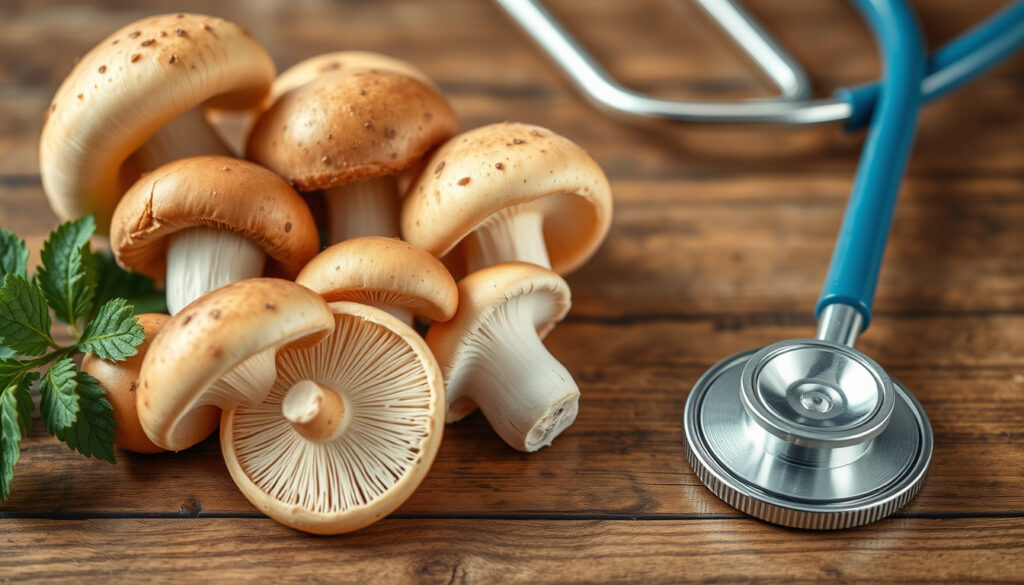
Are Mushrooms Good for You? Health Benefits & Risks
Mushrooms have a way of showing up on everyone’s plate, from omelets to stir-fries. But behind their earthy flavor lies a surprisingly dense nutritional profile.
Calories per 100 grams: 22 ·
Protein per 100 grams: 3.1 g ·
Fiber per 100 grams: 1.0 g ·
Selenium per 100 grams: 9.3 mcg ·
Copper per 100 grams: 0.3 mg
Quick snapshot
- Low calorie, about 22 kcal per 100 g (Harvard T.H. Chan School of Public Health)
- Good source of B vitamins, including riboflavin, niacin, and folate (Harvard T.H. Chan School of Public Health)
- Contains selenium (9.3 mcg per 100 g) and copper (0.3 mg) (WebMD)
- Provides vitamin D when exposed to UV light (UCLA Health)
- Supports heart health through beta-glucans (WebMD)
- May protect brain function (preliminary evidence) (2025 PMC review)
- Fiber content helps manage blood sugar (Harvard T.H. Chan School of Public Health)
- Contains antioxidants like ergothioneine and glutathione (UCLA Health)
- Wild mushrooms can be toxic – only eat from trusted sources (Medical News Today)
- Possible allergens for some individuals (WebMD)
- Pesticide residues possible on conventionally grown varieties (Cedars-Sinai)
- Raw mushrooms may be hard to digest for some people (Harvard T.H. Chan School of Public Health)
- Cook to break down cell walls and improve nutrient absorption (Cedars-Sinai)
- Sauté with minimal oil for best nutrient retention (UCLA Health)
- Avoid boiling, which can leach water-soluble vitamins (Harvard T.H. Chan School of Public Health)
- Store in a paper bag to maintain freshness (WebMD)
| Attribute | Value | Source |
|---|---|---|
| Calories (1 cup) | 22 kcal | Harvard T.H. Chan School of Public Health |
| Protein | 3.1 g | WebMD |
| Fiber | 1.0 g | Harvard T.H. Chan School of Public Health |
| Vitamin D (UV-exposed) | 7 IU | UCLA Health |
| Selenium | 9.3 mcg | WebMD |
Are mushrooms good to eat every day?
Daily consumption of common edible mushrooms is safe for most people. Harvard’s Nutrition Source notes that mushrooms are low in calories and contain no cholesterol or sodium, making them a reasonable everyday choice. The recommended serving size is about one cup of chopped mushrooms — roughly 100 grams.
For most adults, eating mushrooms daily poses no risk. The real concern is not the quantity but the source — store-bought mushrooms from reputable growers are tested and safe, while foraged ones can be lethal.
How many times a week should you eat mushrooms?
Several nutrition authorities suggest 1 to 2 cups per week as a reasonable target. A Cedars-Sinai article points to studies linking that range with a potential reduction in cancer risk. However, the exact frequency for optimal health outcomes remains an open question. What is clearer: most people can safely include mushrooms in their diet several times a week without negative effects.
The pattern: moderation is wise for any single food, but mushrooms’ nutrient density makes them a strong candidate for regular inclusion.
What is the healthiest way to eat a mushroom?
To get the most from mushrooms, how you cook them matters. The healthiest preparation methods preserve nutrients while making the fungi more digestible.
- Sautéing with minimal oil or dry-sautéing in a non-stick pan retains the most nutrients. UCLA Health recommends cooking with just a splash of water or oil.
- Grilling or roasting at moderate heat (under 400°F) maintains flavor without destroying heat-sensitive vitamins.
- Boiling causes water-soluble B vitamins and potassium to leach into the water, reducing nutritional value.
“Cooking can break down cell walls and improve your body’s ability to absorb nutrients.”
Are cooked mushrooms good for you?
Yes — cooking mushrooms is generally beneficial. Heat breaks down chitin in the cell walls, releasing nutrients like ergothioneine that are otherwise trapped. A 2025 review in PubMed Central highlighted that cooked mushrooms retain most of their bioactive compounds, including polysaccharides and polyphenols. However, avoid charring or frying at very high temperatures, which can produce potentially harmful compounds.
The trade-off: raw mushrooms offer the highest vitamin C content, but cooking unlocks more antioxidants and makes the food safer — especially for wild varieties.
Is a mushroom a superfood?
“Superfood” isn’t a regulated term, but mushrooms come close by any nutritional measure. They pack B vitamins, selenium, copper, and — when exposed to UV light — vitamin D. Harvard calls them “one of the few non-animal sources of vitamin D.” Beyond vitamins, mushrooms contain bioactive compounds like beta-glucans, ergothioneine, and glutathione that support multiple body systems.
What organ is mushroom good for?
Evidence points to heart, brain, and gut. The fiber and beta-glucans in mushrooms help lower cholesterol, supporting cardiovascular health. Compounds like ergothioneine may protect brain cells from oxidative stress — though human studies are still limited. For the gut, mushroom polysaccharides act as prebiotics, feeding beneficial bacteria like Lactobacillus and Bifidobacterium.
Are mushrooms good for your heart?
Yes. WebMD notes that the beta-glucans in mushrooms can help reduce LDL cholesterol levels. A cup of white button mushrooms contains only 5 mg of sodium, making them heart-friendly. The potassium content also helps regulate blood pressure.
Are mushrooms good for your brain?
Early research is promising. UCLA Health reports that ergothioneine, an amino acid found almost exclusively in mushrooms, is linked to a lower risk of cognitive decline in older adults. The exact mechanism is still under investigation, but the antioxidant activity likely plays a role.
Is mushroom good for diabetes?
Mushrooms are low on the glycemic index and contain fiber that slows glucose absorption. Harvard points out that replacing higher-carb ingredients with mushrooms can improve blood sugar control. Some studies also suggest certain mushroom polysaccharides may have direct antidiabetic effects, though more human trials are needed.
The implication: calling mushrooms a superfood is not marketing hype — their unique combination of nutrients and bioactive compounds genuinely supports heart, brain, and metabolic health.
Are mushrooms healthy or fattening?
With only 22 calories per 100 grams and high water content, mushrooms are far from fattening. They provide 3.1 grams of protein and about 1 gram of fiber per serving, which contributes to a feeling of fullness.
One study cited by Cedars-Sinai found that substituting mushrooms for meat in a single meal reduced total calorie intake by about 400 calories. That makes them a smart swap for anyone trying to manage weight.
Mushrooms are not a complete protein — they lack some essential amino acids. Relying on them as a sole protein source would require pairing with grains or legumes.
Is mushroom better than chicken?
Comparing mushrooms to chicken reveals a trade-off between protein density and calorie density. The table below shows the key differences.
Four nutrients, one clear pattern: mushrooms deliver impressive volume at a fraction of the calories, while chicken wins on protein and iron.
| Nutrient (per 100 g) | White button mushrooms | Skinless chicken breast |
|---|---|---|
| Calories | 22 | 165 |
| Protein | 3.1 g | 31 g |
| Fiber | 1.0 g | 0 g |
| Fat | 0.3 g | 3.6 g |
| Iron | 0.5 mg | 0.9 mg |
| Selenium | 9.3 mcg | 15.7 mcg |
The takeaway: mushrooms are not a replacement for meat in terms of protein, but as a low-calorie, nutrient-dense food they complement a meat-inclusive or plant-forward diet beautifully.
Is there a downside to eating mushrooms?
Despite their benefits, eating mushrooms comes with legitimate risks that you should know about.
Confirmed facts
- Wild mushrooms can be toxic — only purchase from trusted sources (Medical News Today)
- Some people may experience allergic reactions (WebMD)
- Conventionally grown mushrooms may carry pesticide residues (Cedars-Sinai)
- Raw mushrooms can be difficult to digest for some individuals (Harvard T.H. Chan School of Public Health)
What’s unclear
- Optimal frequency of consumption for specific health outcomes
- Whether raw mushrooms are safe for everyone
“Mushrooms are a powerful source of ergothioneine, an antioxidant associated with protection against cellular damage.”
UCLA Health
What are the disadvantages of eating mushrooms?
The main disadvantages involve toxicity risks from wild varieties, potential allergic reactions, pesticide residue concerns, and digestive discomfort for some people when eating raw mushrooms. All of these are manageable with proper sourcing and preparation.
What part of a mushroom can you not eat?
All parts of common edible mushrooms — cap, stem, and gills — are technically edible. However, the stems of some varieties like shiitake can be tough and woody. The only inedible parts are those from wild mushrooms that you cannot positively identify as safe.
The catch: the risks are real but largely avoidable. Sourcing from reputable growers and cooking properly eliminates most hazards.
Related reading: Good Culture Cottage Cheese Review: Is It Healthier
For those wondering how to preserve their nutritional value, properly freezing mushrooms is a practical way to extend shelf life without losing key nutrients.
Frequently Asked Questions
Can mushrooms help you lose weight?
Yes. With only 22 calories per 100 grams and high water and fiber content, mushrooms promote fullness. Substituting mushrooms for meat can reduce total calorie intake by several hundred calories per meal, according to Cedars-Sinai.
Do mushrooms contain protein?
Yes. White button mushrooms provide about 3.1 grams of protein per 100 grams. However, they are not a complete protein source, lacking some essential amino acids.
Are mushrooms a good source of vitamin D?
Mushrooms are one of the few non-animal sources of vitamin D, but only when exposed to UV light. Most commercially grown mushrooms are grown in the dark and contain negligible vitamin D unless treated.
Can I eat mushrooms if I have a mushroom allergy?
No. People with a known mushroom allergy should avoid all edible mushroom varieties. Allergic reactions can range from mild digestive discomfort to severe anaphylaxis.
Are frozen mushrooms as healthy as fresh?
Frozen mushrooms retain most of their nutritional value. Freezing does not significantly degrade B vitamins, selenium, or copper. However, texture may change upon thawing.
Do mushrooms count as a vegetable?
Nutritionally, mushrooms are grouped with vegetables for dietary guidelines, but they are fungi, not plants. They provide nutrients commonly found in vegetables and are treated as such in meal planning.
What are the best mushrooms for immunity?
Shiitake, maitake, and reishi mushrooms are often cited for immune-supporting properties due to their beta-glucan content. However, white button mushrooms also provide immune-relevant nutrients like selenium and zinc.
More related posts
 Best Water Filtration System for Home: Costs, Types & Benefits
 Ideal Body Weight Calculator: How to Find Your Healthy Weight
 How to Stop Tooth Pain Fast: 5 Immediate Home Remedies
 Why Was Nikki Killed Off Alert: Missing Persons Unit? Season 4
 Why Star Wars: The Acolyte Was Canceled
 How Many Grams in a Tablespoon – Complete US UK Guide
 Selena Gomez Age in 2026: Facts, Net Worth & Family
 Outlook Email Sign In: Guide for Web, Mobile & Desktop