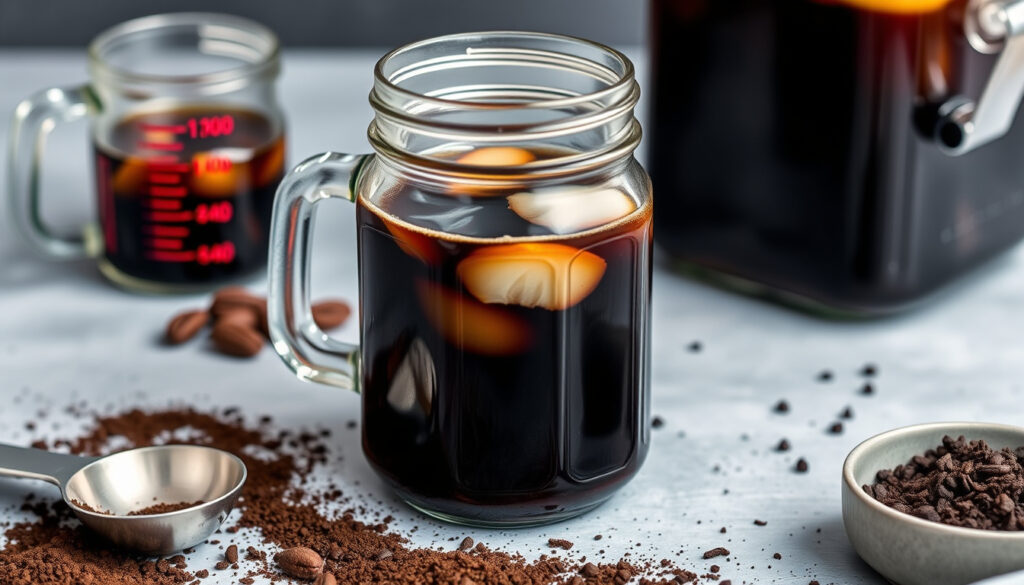
How to Make Cold Brew Coffee: Perfect Ratio & Storage Tips
Anyone who has paid a small fortune for bottled cold brew has thought about making it at home, then watched a first attempt turn bitter and murky. The fix comes down to three dials: ratio, grind, and time, and the numbers are more forgiving than most recipes suggest.
Ideal steeping time: 12-24 hours ·
Common ratio: 1:8 coffee to water ·
Typical fridge shelf life: 7-14 days
Quick snapshot
- Cold brew is just ground roasted beans steeped in cold water — ordinary coffee is the true ingredient (Municipality of Anchorage (public health department)).
- Retail cold brew is held at 41°F or colder with a 7-day date mark (Minnesota Department of Agriculture (state regulator)).
- The standard steep runs 12 to 24 hours before the batch is refrigerated (Canadian Food Inspection Agency (federal regulator)).
- The “perfect” ratio is a moving target: the National Coffee Association’s guide says 1:4 to 1:5 for concentrate (National Coffee Association), while Bon Appétit’s home formula lands near 1:8 (Bon Appétit).
- Health claims about lower acidity outpace the evidence; the peer-reviewed findings that exist are mostly about freshness and contamination risk (2021 peer-reviewed study).
- Whether the 12-24 hour steep is safe for all home conditions; the CFIA describes it as standard but the 2021 study suggests extraction after 7 hours is unnecessary (Canadian Food Inspection Agency; 2021 peer-reviewed study).
- 0 hours: coffee meets water and the steep begins.
- 12-24 hours: filter and refrigerate — about 12 hours is typical, up to 24 for a stronger pull (National Coffee Association).
- Day 7: the regulatory date-mark limit for retail cold brew (Minnesota Department of Agriculture).
- Dilute the concentrate to taste — equal parts water or milk is a common starting point (Bon Appétit (recipe-testing kitchen)).
- Adjust the next batch: stronger ratio, longer steep, or a coarser grind, one variable at a time (Food Republic (food media outlet)).
- Mark the container with the brew date and respect the 7-day line (Minnesota Department of Agriculture). (Bon Appétit (recipe-testing kitchen))
Seven numbers, one pattern: cold brew rewards patience and cold temperatures more than expensive gear.
| Fact | Value | Source |
|---|---|---|
| Ideal steeping time | 12-24 hours | Canadian Food Inspection Agency |
| Common home ratio | 1:8 coffee to water by weight | Bon Appétit (recipe-testing kitchen) |
| Concentrate style (NCA) | About 1:4 to 1:5 coffee to water | National Coffee Association |
| Retail storage | 41°F (5°C) or colder | Minnesota Department of Agriculture |
| Retail date mark | 7 days | Minnesota Department of Agriculture |
| Over-steep ceiling | About 24 hours | Food Republic (food media outlet) |
| Extraction research | Longer than 7 hours is typically unnecessary | 2021 peer-reviewed study (PubMed Central) |
Can you use normal coffee to make cold brew?
Yes — and the definition of the drink is on your side. Public health guidance in Anchorage describes cold brew simply as a coffee concentrate made by steeping ground roasted coffee beans in cold water for several hours (Municipality of Anchorage (public health department)). No special “cold brew blend” is required, and the most expensive bag in the shop won’t save bad technique.
What “normal coffee” means for cold brew
- Any ordinary roasted coffee you already brew works: the method is what makes it cold brew, not the bean’s label.
- Pre-ground or whole, the same bag you use for drip is the same ingredient regulators describe in their definition of cold brew (Municipality of Anchorage).
- Roast style is a taste call, not a safety call — pick what you like to drink.
What actually matters is what you do to the coffee before it meets water. Grind size and ratio do more work than bean origin, which is why the same beans can make a sublime batch or a bitter one depending on the next few steps.
The trade-off: if your batch tastes bad, the beans are the easiest thing to blame and the least likely culprit. Technique — especially grind — fails more often than origin.
What is the perfect ratio for cold brew coffee?
There isn’t one number; there’s a range, and picking the right end of it depends on whether you want a ready-to-drink batch or a concentrate you can stretch.
Standard cold brew ratio
- The National Coffee Association’s consumer guide recommends about 1:4 to 1:5 coffee to water for concentrate-style cold brew (National Coffee Association).
- Bon Appétit’s test kitchen uses one pound of ground coffee to one gallon of water — that’s about 1:8 by weight (Bon Appétit (recipe-testing kitchen)).
- For a smaller home batch, Bon Appétit scales that down to a quarter-pound of beans to four cups of water (Bon Appétit).
Adjusting strength to taste
- 1:4 to 1:5 is concentrate logic: you will dilute it after brewing, so it should taste intense.
- 1:8 drinks closer to a normal cup after filtering, with no dilution step needed.
- Weigh coffee in grams rather than measuring by volume; grind density varies enough to make scoops unreliable.
The practical difference between the two camps is smaller than it looks. A 1:8 batch that you drink straight and a 1:4 batch that you cut with water end up in a similar place in the cup.
The “perfect” ratio is a preference with a guardrail: 1:8 is forgiving enough for a first attempt, while 1:4 to 1:5 is for drinkers who want a concentrate that holds up to ice and milk. If you only remember one number, make it 1:8.
The trade-off: a stiff concentrate gives you more control over each cup but uses more beans; a 1:8 batch is simpler but fills a bigger jar. Pick the one that matches how you actually drink coffee.
What are the common cold brew mistakes?
Most ruined batches come down to the same three variables: grind size, ratio, and time. Each one is easy to fix once you know what went wrong.
Using the wrong grind size
- Cold brew grounds should be coarse precisely because they steep for upwards of 12 hours, according to Bon Appétit (Bon Appétit).
- Fine grind over-extracts: too much surface area over too many hours pulls bitter compounds you never taste in a fast hot brew.
- The fix: set the grinder to its coarsest setting, closer to peppercorn than table salt, before you measure anything.
Incorrect ratio
- Too little coffee yields a weak, watery jar that no steeping time can fix.
- Too much coffee produces a syrupy concentrate that is easy to over-pour and over-caffeinate.
- Weigh the coffee once, write the number on the bag, and keep the ratio fixed while you change other variables.
Steeping too long or too short
- The 12-to-24-hour window comes from the Canadian Food Inspection Agency’s description of standard cold brew production (Canadian Food Inspection Agency).
- Steep much less than 12 hours and you get sour, thin, under-extracted coffee.
- Steep much past 24 hours and over-extraction takes over; Food Republic warns that the flavor turns bitter (Food Republic).
- The 2021 study adds a useful calibration: extraction beyond 7 hours is typically unnecessary to make the coffee, which means the last few hours of a long steep are about strength, not quality (2021 peer-reviewed study).
How to diagnose a bad batch
- Bitter → grind too fine, steep too long, or beans roasted too dark.
- Sour or thin → under-extraction; steep longer or grind slightly finer.
- Flat and dull → old beans; buy fresher coffee than the bag you forgot in the pantry.
The pattern: every mistake is a dial pushed too far in one direction. Once you know which dial, the next batch is already better.
Is it better to make cold brew in the fridge or on the counter?
Both methods work, but they run on different clocks and different risk profiles.
Countertop method
- A room-temperature steep extracts faster; Food Republic reports roughly 12 hours on the counter versus about 18 in the fridge (Food Republic).
- Canadian federal guidance describes cold brew as a 12-to-24-hour ambient-temperature soak before the batch goes into the refrigerator (Canadian Food Inspection Agency).
- The risk is time plus warmth: the longer and warmer the counter steep, the more you rely on conditions the safety research has to cover.
Fridge method
- Fridge steeping is slower but simpler: set the jar in the cold, come back in about 18 hours, filter, and it is already stored.
- Minnesota’s Department of Agriculture treats cold brew as a temperature-controlled food that must be brewed and stored at 41°F or colder (Minnesota Department of Agriculture).
- The fridge method keeps the whole process inside that rule.
The safety variable
- The National Coffee Association’s white paper notes local health departments may still consider retail cold brew a time/temperature-control food because the Food Code has no specific cold brew designation (National Coffee Association white paper (industry safety analysis)).
- The same white paper says its study supports the safety of black cold brew under common conditions — refrigerated, short-window conditions (National Coffee Association white paper).
- With a warm kitchen, choose the fridge; with a cool one, the counter is the classic route.
A warm counter is the variable most recipes ignore. If your batch sits out past 24 hours in a warm kitchen, you’ve left the conditions the safety research covers — move the next batch to the fridge and treat the counter steep as a cool-room-only option.
Is cold brew healthier than regular iced coffee?
The honest answer: in one narrow sense, maybe, but not for the reason most marketing suggests.
Acidity levels
- The standard pitch is that cold brew is lower in acidity than hot-brewed coffee, which is why it feels easier on sensitive stomachs.
- That acidity difference is real in tasting terms, but hard evidence that it produces a meaningful health gap is thinner than the marketing.
- If acidic coffee upsets your stomach, cold brew is worth trying; if you’re expecting a medical win, the research isn’t there yet.
Caffeine content
- Cold brew concentrate has more caffeine per ounce than regular brewed coffee because it’s concentrated — but you dilute it before drinking.
- Per finished cup, caffeine depends on your ratio and pour, not on the brewing method itself.
- Drinking a double-strength concentrate straight is the fastest way to find out why dilution matters.
The evidence gap
- What peer-reviewed research does document is a storage effect: the 2021 study warns that storing cold brew for several days to weeks increases the risk of microbial contamination and affects taste (2021 peer-reviewed study).
- The same study recommends cold brew be freshly made and consumed the same day (2021 peer-reviewed study).
- The National Coffee Association’s white paper adds that its food-safety study supports the safety of black cold brew under common conditions — refrigerated and consumed on a normal timeline (National Coffee Association white paper).
Cold brew gets pitched as “kinder to your stomach” and “stronger caffeine,” but both claims come with asterisks. The health variable with actual evidence behind it is temperature: brew cold, store cold, drink fast.
The implication: if you’re drinking cold brew for health, the highest-value habit isn’t a rare bean — it’s a fresh batch and a cold fridge.
Is it safe to drink my Stok cold brew if I left it out overnight?
Short answer: no, pour it out. This is one of those questions where the brand on the bottle doesn’t change the food-safety math.
What regulators say about room temperature
- Minnesota’s Department of Agriculture treats cold brew as a temperature-control food that must be held at 41°F or colder (Minnesota Department of Agriculture).
- The National Coffee Association’s white paper notes local health departments may still consider retail cold brew a TCS food because the Food Code has no specific cold brew designation (National Coffee Association white paper).
- Overnight on the counter means the product spent hours outside the cold-holding zone that rule requires.
When in doubt, discard
- A wasted bottle costs less than a bad night from a gamble you didn’t have to take.
- If the bottle stayed refrigerated, the next question is age: check the date mark and treat 7 days as the line for retail cold brew (Minnesota Department of Agriculture).
- When in doubt, the conservative call is the cheap one: throw it out.
The pattern: commercial cold brew is regulated like a perishable refrigerated product, not a shelf-stable pantry item. Overnight at room temperature is a failed cold chain — treat it that way.
How long until cold brew coffee goes bad?
Cold brew doesn’t spoil on a fixed schedule; it slides downhill, and taste is the first thing to notice.
The 7-day rule
- Minnesota’s retail guidance requires a 7-day date mark on cold brew, the clearest shelf-life line in the regulatory literature (Minnesota Department of Agriculture).
- The 2021 study is more conservative: drink it the same day if you can, and don’t treat the refrigerator as a time machine (2021 peer-reviewed study).
- Recipe guidance often stretches storage longer than a week, but the gap between common practice and the regulatory line is where the risk lives.
Signs it’s past it
- Smell first: a flat, sour, or funky nose means the coffee has turned.
- Taste is the second witness: sharp, hollow, or dusty flavors are the end of the road.
- Visible cloudiness or separation beyond normal sediment is a red flag, not a style choice.
How to make the window last
- Store sealed in the coldest part of the fridge, not the door.
- Decant into smaller containers so each pour opens a fresh, sealed portion.
- Skip the room-temperature storage phase entirely: the steep can start there, but the storage clock runs cold.
The takeaway: the 7-day date mark is your safety line, and same-day is your quality line. Everything between is a compromise you can taste.
Upsides and downsides of cold brew
Upsides
- Smooth, low-sharpness flavor that drinks well black, with milk, or over ice.
- Concentrate logic: one steep covers several days of coffee.
- No hot water, no machine — a jar, a filter, and a fridge are the whole kit.
- The 12-to-24-hour window is forgiving enough for a busy week (Canadian Food Inspection Agency).
Downsides
- It’s a next-day drink; you have to plan ahead instead of pressing a button.
- Temperature-sensitive: regulators treat it as a food that needs cold holding at 41°F or colder (Minnesota Department of Agriculture).
- Concentrate is deceptively strong, and skipping the dilution is an easy over-caffeine mistake.
- A concentrate-style batch uses more coffee by weight than the same volume of drip.
The trade-off: cold brew buys smoother flavor with more planning, more beans, and a stricter cold chain. For most people that’s a fair deal once a week, not every morning.
How to make cold brew coffee, step by step
The full recipe is seven steps, and only the first four need your attention on brew day.
- Grind coarse. Set your grinder to its coarsest setting — closer to peppercorn than table salt. Fine grounds over a 12-hour steep turn bitter, which is why coarse is the rule Bon Appétit’s test kitchen emphasizes (Bon Appétit).
- Weigh 1:8. For a drink-ready batch, use one part coffee to eight parts water by weight — the same ratio as Bon Appétit’s pound-to-gallon formula (Bon Appétit). For concentrate, use the National Coffee Association’s 1:4 to 1:5 range (National Coffee Association).
- Combine and stir. Put the grounds in a jar, pour in cold filtered water, and stir until no dry pockets remain.
- Steep 12 to 24 hours. Shorter end on the counter, longer end in the fridge: about 12 to 18 hours is the difference Food Republic notes between the two (Food Republic).
- Filter twice. Pour through a fine-mesh strainer, then through a paper filter or clean cloth for a clear, clean cup.
- Dilute to taste. Concentrate needs water or milk; start with equal parts and adjust from there.
- Date it and refrigerate. Store the finished cold brew cold and follow the 7-day date-mark line regulators use for retail batches (Minnesota Department of Agriculture).
The pattern: the active work takes ten minutes; the rest is waiting and a little discipline about temperature.
Cold brew facts vs. cold brew folklore
Some cold brew claims are settled by regulators and peer review; others are preference dressed up as science. Here’s the scorecard.
Confirmed facts
- Cold brew is lower in acidity than hot-brewed coffee — the chemical difference is real, even if the health payoff is debated.
- 12 to 24 hours is the standard steep window used in Canadian federal food-safety guidance (Canadian Food Inspection Agency).
- Retail cold brew is held at 41°F or colder with a 7-day date mark (Minnesota Department of Agriculture).
- Multi-day storage raises contamination risk and degrades flavor (2021 peer-reviewed study).
What’s unclear
- Whether cold brew’s lower acidity creates a real medical advantage for sensitive stomachs.
- Which ratio is best: regulators and recipe writers land on 1:4 to 1:5 for concentrate versus about 1:8 for home batches.
- Whether a countertop steep beyond 24 hours in a warm kitchen is safe for home brewers; the research covers standard conditions, not extreme ones.
- How strictly retail cold brew rules apply across every state; the National Coffee Association notes enforcement varies at the local level (National Coffee Association white paper).
- Whether extracting past 7 hours adds anything desirable besides more caffeine and more bitterness (2021 peer-reviewed study).
The pattern: the confirmed side is about temperature and timing; the unclear side is about health claims and personal taste. Trust the first, experiment with the second.
What the sources actually say
Three statements, from three different kinds of authority, capture most of what matters in cold brew.
“Cold brewed coffee is generally made by soaking coarse ground coffee in water at ambient temperatures for 12 to 24 hours, then straining, bottling or canning, and refrigerating until consumed.”
Canadian Food Inspection Agency (federal regulator), food-safety testing report
“Extraction times longer than 7 hours are typically not necessary to prepare cold brew coffee.”
PubMed Central (National Library of Medicine), 2021 study
“Cold brew steeped in the fridge usually takes about 18 hours instead of 12 at room temperature, and going much past 24 hours invites over-extraction.”
Food Republic (food media outlet), cold brew mistakes guide
The pattern across all three: cold brew is simpler than it looks, slower than espresso, and more perishable than it tastes.
The takeaway
Make it simple: coarse grounds, a 1:8 ratio (Bon Appétit), 12 to 24 hours of patience, and a fridge that respects the 41°F rule (Minnesota Department of Agriculture). Everything else — the expensive gear, the single-origin pitch, the “steeped for two days” label — is optional or actively counterproductive. For the home brewer who wants café results without the café price, the choice is clear: weigh the coffee, date the jar, and start the next batch before day seven — or you’ll be pouring last week’s experiment down the sink.
Related reading: National Coffee Association / About Coffee · Bon Appétit
foodie.com, coffeecraftguide.com, ncausa.org, lowkeycoffeesnobs.com
Frequently asked questions
Can you use regular coffee grounds for cold brew?
Yes, if they’re ground coarse. The standard definition of cold brew is simply ground roasted beans steeped in cold water (Municipality of Anchorage), and fine “regular” drip grounds will over-extract over a long steep (Bon Appétit).
What is the best coffee-to-water ratio for cold brew?
Start at 1:8 coffee to water by weight for a drinkable batch, or 1:4 to 1:5 if you want a concentrate to dilute (Bon Appétit; National Coffee Association).
How long should you steep cold brew?
About 12 to 24 hours: roughly 12 on the counter and closer to 18 in the fridge, per Food Republic.
Should cold brew be made in the fridge or at room temperature?
Both work. The fridge is slower and carries a lower safety risk; the counter is faster but depends on a cool kitchen and a shorter window (Minnesota Department of Agriculture).
Is cold brew less acidic than iced coffee?
Cold brew is generally described as lower in acidity than hot-brewed coffee, which is why it’s a common choice for sensitive stomachs. The clinical difference is less settled, and the strongest documented health advice is to drink it fresh (2021 peer-reviewed study).
How long does cold brew last in the refrigerator?
Regulators set the retail line at 7 days with cold storage at 41°F or colder (Minnesota Department of Agriculture); the peer-reviewed advice is more conservative, recommending same-day freshness when possible (2021 peer-reviewed study).
Why is my cold brew bitter?
Usually three causes: grind too fine, steep too long (past about 24 hours), or stale beans. Fix the grind first (Food Republic).
More related posts
 Isabel May Movies and TV Shows: Full List and Roles
 Cast of Hysteria TV Show: Who’s Who in Peacock Horror Comedy
 Seahawks vs Patriots Score: History, 2026 & 28-3 Myth
 I Know What You Did Last Summer: Watch Order, Killer, Box Office
 Cox Cu tomer Service Number: 24/7 Support and Hour
 Amoxicillin and Clavulanate Potassium: Uses, Side Effects, Dosage
 Hairstyles for Women Over 60: Flattering Medium & Short Cuts
 Massage Parlor Near Me: Find Safe Spas in Dublin & Avoid Scams