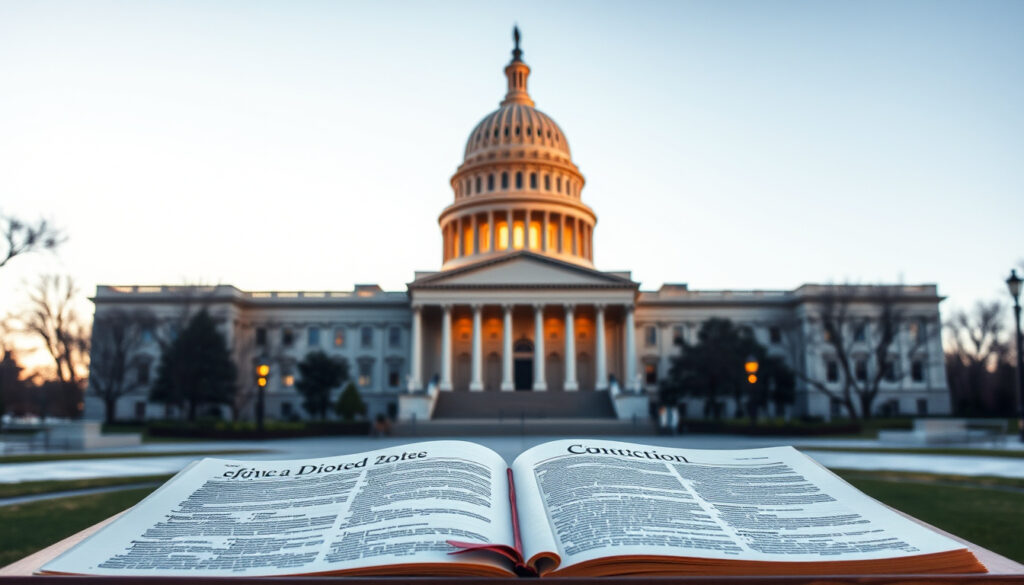
Consent of the Governed: Meaning, Origins, and Why It Still Matters
Ask a room full of Americans where government gets its authority, and someone will quote the Declaration of Independence before finishing the sentence. That 1776 promise — that just governments derive their powers from the governed — still anchors debates about elections, protests, and presidential power.
Declaration phrase: “deriving their just powers from the consent of the governed” ·
Declaration adopted: July 4, 1776 ·
Locke’s key text: Second Treatise of Government, 1689 ·
Gettysburg Address: November 19, 1863 ·
Constitution’s opening: “We the People”
Quick snapshot
- The Declaration of Independence says governments derive “their just powers from the consent of the governed” (U.S. National Archives (official federal archive)).
- John Locke argued that legitimate political power originates in individual consent (Hanover College history department).
- The founders treated consent as a condition of legitimate power, not a ceremonial formality (Library of Congress (national library of the United States)).
- When a government becomes destructive of its purposes, the Declaration gives the people the right to alter or abolish it (U.S. National Archives (official federal archive)).
- What counts as meaningful consent in a large modern republic: voting alone, or ongoing accountability.
- Whether “consent of the governor” is a genuine separate concept or a misspelling of the standard phrase.
- The exact source context of Lincoln’s “rightful masters” quote; it is widely attributed but hard to pin to one speech.
- Whether ratification in 1787–1788 can bind later generations who never personally agreed to it.
- 1689 — John Locke publishes the Second Treatise of Government (University of Chicago Press (scholarly documentary edition)).
- July 4, 1776 — The Continental Congress adopts the Declaration of Independence (U.S. National Archives (official federal archive)).
- 1787–1788 — The Constitution is drafted and ratified; the Preamble opens with “We the People” (U.S. National Archives (official federal archive)).
- November 19, 1863 — Lincoln delivers the Gettysburg Address (Library of Congress (national library of the United States)).
- Every generation reopens the question of who counts as “the governed.”
- Fights over elections, voting rules, and executive power are modern tests of consent.
- The original texts — Declaration, Constitution, Gettysburg Address — remain the standard each side invokes.
Six facts anchor the whole debate, from Locke’s treatise to Lincoln’s address. The table below compresses the core data points into a single reference.
| Label | Value |
|---|---|
| Core phrase | consent of the governed |
| Declaration sentence | “Governments are instituted among Men, deriving their just powers from the consent of the governed.” |
| Locke publication | 1689 — Second Treatise of Government |
| Gettysburg phrase | “government of the people, by the people, for the people” |
| Gettysburg date | November 19, 1863 |
| Preamble opening | “We the People of the United States…” |
What is the meaning of consent of the governed?
Consent of the governed is the principle that legitimate political authority flows from the people, not from a dynasty, a conqueror, or a self-appointed elite. The Declaration of Independence compresses the entire theory into one clause: governments are “instituted among Men, deriving their just powers from the consent of the governed.”
Consent is easy to assert and hard to verify. In a large republic, “the governed” never speaks with one voice, so the founders built elections and representative bodies to convert scattered public opinion into law.
The phrase makes the people the source of authority and the government the borrower. Citizens are the principals; officials are the agents. When that relationship flips — when rulers treat the public as subjects — the government can still hold power, but it loses its claim to be just.
What is another way of saying consent of the governed?
- Popular sovereignty — the people, not a monarch, hold final political authority.
- Government by consent — rule is justified only by the approval of the governed.
- Rule by the governed — ordinary citizens, not a hereditary class, are the source of power.
- Social contract — the agreement among free people that creates political society.
These terms move in the same direction: they shift the location of power from the ruler to the ruled. “Popular sovereignty” is the closest formal synonym, and it appears throughout the debates over the Constitution. The Declaration’s phrasing is the better-known version because it is attached to a specific, dramatic act — a revolution justified in the people’s name.
What does consent of the governor mean?
“Consent of the governor” inverts the principle. In the founding texts, the governed do the consenting; a governor who grants consent would be the ruler granting legitimacy to the ruled — the opposite of what Locke and Jefferson argued.
Search for “consent of the governor” and most results are really about the governed. There is no standard concept in political theory by that name. When the Declaration says “the governed,” it means the people at large, not a specific official. The distinction protects the core claim: authority belongs to the public, not to the officeholder.
What is an example of consent of the governed?
- Voting in regular elections — the most routine act of consent in a modern republic.
- Ratifying the Constitution in 1787–1788 — state conventions approved the new frame of government in the people’s name.
- Protesting and petitioning — citizens publicly withhold approval and demand change.
- A sentence example: “The new republic rested its legitimacy on the consent of the governed, not on the crown’s approval.”
Notice what these examples share: consent is expressed through institutional channels — elections, ratifying conventions, public argument — rather than as a single, one-time yes. For the founders, the people’s approval had to be built into the machinery of government, which is why the Constitution opens with “We the People of the United States.”
Consent is the dividing line between authority and force. A government that rules without it is not merely unpopular; it has changed its moral category.
What did John Locke say about the consent of the governed?
John Locke gave the idea its philosophical backbone in the Second Treatise of Government, published in 1689. Locke starts from a radical premise: people are naturally free and equal, which means no one is born with a divine right to rule anyone else. Political power has to be manufactured, and the only factory is consent.
Locke turned rebellion into a legal argument rather than an act of force: if a ruler breaks the trust placed in government, the people are entitled to withdraw consent. That move made revolution a matter of right, not merely of strength.
In Locke’s account, individuals leave the state of nature by agreeing to join a community and authorize a government to protect their lives, liberties, and property. That agreement is the social contract. The government is a trustee, not an owner — and trustees can be removed.
Who came up with the idea of consent of the governed?
- John Locke is the thinker most directly behind the founders’ phrasing: legitimate political power originates in the consent of individuals.
- Earlier writers gestured at the idea, but Locke gave it a systematic structure in 1689.
- Jefferson and the Continental Congress turned Locke’s theory into an official legal claim in 1776.
Locke did not invent the concept of popular approval out of nothing — English debates over the limits of royal authority had been simmering for decades. His achievement was to organize those ideas into a clear argument: legitimate power originates in the consent of individuals rather than in hereditary rule. That claim became the load-bearing wall under the Declaration of Independence.
How did Locke’s ideas reach the American founders?
- Locke’s Second Treatise circulated among American founders as a major source of arguments about natural rights and resistance.
- Revolutionary writers used Locke’s logic — consent gives power, abuse withdraws it — to justify breaking with the Crown.
- The Continental Congress adopted the argument as a formal political position in July 1776.
The Library of Congress notes a crucial editorial choice buried in that borrowing: Jefferson did not reproduce Locke’s emphasis on property, and he gave the right to rebel a prominent place instead (Library of Congress (historical documents exhibit)). Locke’s trio of life, liberty, and property became the Declaration’s “Life, Liberty and the pursuit of Happiness.” The consent principle stayed; the list of protected rights changed.
What is the social contract?
A social contract trades unlimited freedom for secure freedom. You give up the right to do anything you want; you gain a government strong enough to protect your life, liberty, and property from anyone who would take them.
The social contract is the agreement that turns a collection of individuals into a political community. In Locke’s version, people consent to be governed in exchange for protection — and a government that fails to provide it breaks the agreement. Later thinkers built competing versions of the same idea, but the American founders read Locke’s version.
- Express consent — openly joining a political community.
- Tacit consent — enjoying the protection of a government’s laws and property within its territory.
Locke treated both as binding, which is how a government can claim the consent of people who never signed anything.
Locke gave the founders a vocabulary — trust, compact, consent, resistance — that made revolution thinkable as a legal argument, not just an act of force.
Why does a just government need the consent of the governed?
Because power alone cannot justify itself. An army can occupy a territory, but occupation does not create obligation — citizens obey just laws because they have a hand in making them, not because they fear the consequences of refusal. That is the difference between a government and a garrison.
Without consent, the only remaining foundation is fear. A state that rules by force can command compliance, but it cannot claim the loyalty that makes laws hold when no soldier is watching.
For Locke, the same logic ran through the whole system. People consent to government in order to protect their natural rights; when a government violates that trust, the people are entitled to resist. The Declaration repeats the structure: rights come first, government comes second, and consent is the bridge between them.
What makes government legitimate?
- The people’s approval, expressed through representatives and institutions.
- Protection of natural rights — life, liberty, and property in Locke’s list.
- Continuing accountability — consent renewed through elections, not assumed to last forever.
The founders’ answer was procedural and moral at once: legitimate government is government that the governed have authorized. That is why the Declaration spends so much space listing grievances — the list was evidence that consent had been withdrawn in practice, not just in theory.
Why is consent necessary to avoid tyranny?
- Tyranny begins when rulers stop deriving their power from the people and start treating the people as property.
- Consent creates a standard for judging rulers: the people can name what was broken.
- Without consent, resistance has no legal language — it becomes rebellion rather than the enforcement of a contract.
Consent is also what makes law compatible with freedom. A free person is not someone who never obeys; a free person is someone whose obedience is self-chosen. When the people are the authors of the laws, obeying the law is not the same as submitting to a master.
Does voting alone satisfy consent?
Elections are the floor, not the ceiling. A government that wins one election and then ignores the governed is relying on past consent, not living consent. Accountability between elections is what keeps the phrase honest.
Most modern republics treat voting as the core expression of consent, and for good reason: it is equal, regular, and verifiable. But the founders did not think the people’s role ended at the ballot box. The Declaration’s language of ongoing rights — to alter, to abolish, to institute new government — suggests that consent is a continuous relationship, not a one-time transaction.
Consent is easy to invoke and hard to measure. That gap between the ideal of popular approval and the mechanics of elections is where most modern arguments about legitimacy begin.
Who said government by the consent of the governed?
Thomas Jefferson drafted the line, and the Second Continental Congress adopted it on July 4, 1776. The Declaration’s second paragraph contains the full claim: “That to secure these rights, Governments are instituted among Men, deriving their just powers from the consent of the governed.” Congress approved the text after edits, and the phrase has served as the standard citation for government by consent ever since.
What did the Declaration of Independence say about consent of the governed?
- All men are created equal and endowed with unalienable rights, including life, liberty, and the pursuit of happiness.
- Governments are instituted to secure those rights and derive their just powers from the consent of the governed.
- When a government becomes destructive of those ends, the people have the right to alter or abolish it.
The Declaration makes consent a structural requirement, not an ornament. It does not say that the people merely approve of good government; it says that just powers come from consent. That grammatical choice is the whole philosophy in miniature: power flows upward from the people, not downward from the crown.
How does the Constitution reflect consent of the governed?
- The Preamble opens with “We the People of the United States,” placing the people, not the states or the Crown, as the source of authority.
- The Constitution became law only after ratification by special state conventions, not by state legislatures or royal approval.
- Regular elections, representation, and amendment procedures institutionalize ongoing consent.
The Constitution does not repeat the phrase “consent of the governed,” but it is built from it. Ratification was the founders’ machinery for turning a philosophical claim into a legal fact: delegates approved the frame of government in the people’s name, and the Preamble says who was acting. The Bill of Rights later added explicit limits, protecting the individual rights that consent was meant to secure.
Who said, “We the people are the rightful masters of both Congress and the courts”?
The line is widely attributed to Abraham Lincoln, and it fits his democratic theory. But the exact speech or letter is harder to verify than the Gettysburg Address, so treat the attribution as broadly accepted rather than precisely sourced.
Lincoln’s “rightful masters” quote makes an aggressive claim in a small package: Congress and the courts work for the people, and the people can correct them — not by overthrowing the Constitution, but by overturning the officials who pervert it. The sentence is a reminder that consent, for Lincoln, had teeth: it meant the public could remove those who misused their trust.
The founders put consent at the door of the regime twice — first as a revolutionary claim in 1776, then as a constitutional structure in 1787–1788. The phrasing changed, but the subject stayed the same: the people.
Did the founding fathers say we can overthrow the government?
Yes, with conditions. The Declaration says that whenever a government becomes destructive of the ends for which it was created, “it is the Right of the People to alter or to abolish it, and to institute new Government.” That is an explicit right of revolution.
The founders wrote a document that both permits and disciplines revolution: grievances must be serious and repeated, but when they are, the people’s right to act is absolute.
The founders were not inviting random rebellion. The same sentence warns that governments should not be changed “for light and transient Causes,” and that people are more disposed to suffer while evils are sufferable than to right themselves by abolishing the forms to which they are accustomed. Rebellion, in this framework, is a last resort — justified by a long train of abuses.
What did the Declaration say about abolishing government?
- The people may alter or abolish any government that becomes destructive of its purposes.
- They can institute a new government on principles that seem most likely to secure their safety and happiness.
- Prudence requires patience: change is justified by a long train of abuses, not by temporary inconvenience.
The 1776 grievance list — the long catalog of specific charges against the British Crown — was the colonists’ evidence that the threshold had been met. The Declaration was not a general theory of permanent revolution; it was a specific indictment with a general principle attached.
What did John Locke say about revolution?
- Locke argued that government is a trust, and a ruler who betrays it forfeits the people’s obligation.
- Resistance is legitimate when the violation is clear and the abuse is systematic.
- Locke’s right of appeal extended to “Heaven” in extreme cases — an appeal to force when no earthly judge existed.
Locke’s contribution was to make resistance a legal category. The people are not subjects who happen to rebel; they are parties to a contract who are enforcing its terms. That way of thinking runs directly into the Declaration’s “Right of the People to alter or to abolish” — the Americans were not asking for permission; they were declaring that the compact had been broken.
When is overthrow justified?
The founders’ answer: when abuses are long, repeated, aimed at absolute despotism, and when every peaceful remedy has failed. Revolution is not the first option; it is the last check.
The constitutional system was designed to make violent overthrow unnecessary. Elections, separation of powers, federalism, and impeachment are pressure valves that let the people replace rulers without breaking the state. The right to abolish government remains in the background — a standing warning rather than a routine tool.
The founders made revolution a legal last resort and a constitutional contingency. They denied that citizens must obey without question, then built institutions so that abuses would rarely accumulate to the point of armed revolt.
What was Abraham Lincoln’s most famous quote about democracy?
Lincoln’s most quoted line on democracy comes at the end of the Gettysburg Address, delivered on November 19, 1863, at the dedication of a military cemetery in Pennsylvania.
“…that government of the people, by the people, for the people, shall not perish from the earth.”
Abraham Lincoln, Gettysburg Address, November 19, 1863
Lincoln used the address to redefine what the Civil War was for: not just preserving the Union, but proving that a government built on consent could endure. The opening — “Four score and seven years ago” — pointed back to 1776, and the “proposition that all men are created equal” came straight from the Declaration’s second paragraph.
What did Abraham Lincoln say in his Gettysburg Address in 1863?
- The address opened by summoning the founding: “Four score and seven years ago our fathers brought forth on this continent, a new nation, conceived in Liberty.”
- It called the war “a great civil war, testing whether that nation, or any nation so conceived and so dedicated, can long endure.”
- It closed with the resolve “that government of the people, by the people, for the people, shall not perish from the earth.”
The three most-quoted passages form a single argument: a nation founded on freedom must prove that such a nation can survive. Lincoln’s audience heard a funeral speech; his readers today hear a theory of democracy in three lines.
How did Lincoln connect consent to democracy?
- Government “of the people” identifies the source of authority — the governed.
- Government “by the people” describes the mechanism — representation and participation.
- Government “for the people” defines the purpose — the public good.
Lincoln’s three prepositions cover the whole structure of consent. Of: the people are the owners. By: the people are the operators. For: the people are the beneficiaries. In one sentence, Lincoln fused the Declaration’s consent principle with a working definition of democracy.
Lincoln turned consent from a founding moment into an ongoing test. A democracy that stops being of, by, and for the people has stopped being a democracy — regardless of how regularly it holds elections.
For Lincoln, consent was the core of democracy. The question “who governs?” always had one answer: the governed. Constitutions, courts, and elections were machinery for making that answer real.
Consent of the governed: a timeline from Locke to Lincoln
Four moments turned consent from a radical theory into the operating system of American government. The sequence tells a story of how an idea became a institutional reality.
| Date | Milestone |
|---|---|
| 1689 | John Locke publishes the Second Treatise of Government, arguing that legitimate government rests on the consent of free people (University of Chicago Press (scholarly documentary edition)). |
| 1776 | The Continental Congress adopts the Declaration of Independence, grounding just government in “the consent of the governed.” |
| 1787–1788 | The Constitution is drafted and ratified; the Preamble begins “We the People,” and the frame of government is built around representation. |
| 1863 | Lincoln delivers the Gettysburg Address, defining democracy as “government of the people, by the people, for the people.” |
The sequence tells a story: Locke supplied the theory, 1776 declared it, the Constitution institutionalized it, and Lincoln defended it. Each step made consent more concrete — from a philosophical claim to a legal foundation to a test of national survival.
The idea did not stay frozen in 1776. Every generation since has used the same phrase to argue about who the governed are and what their consent requires — which suggests the phrase is less a settled definition than a standing question.
What’s confirmed and what’s unclear
Separating the settled facts from the open questions keeps the phrase from becoming a slogan. Here is where the evidence stands and where the arguments remain unresolved.
Confirmed facts
- The Declaration of Independence includes “consent of the governed” in its second paragraph.
- John Locke’s Second Treatise argues that legitimate government is based on the consent of free people.
- The U.S. Constitution’s Preamble begins with “We the People.”
- Lincoln’s Gettysburg Address includes “government of the people, by the people, for the people.”
What’s unclear
- How to define “consent” practically in large modern states: voting alone versus ongoing accountability.
- Whether “consent of the governor” is a separate concept or a misspelling of “consent of the governed.”
- The exact source context of Lincoln’s “rightful masters” quote; attribution is widely repeated but the specific speech or letter is hard to verify.
- Whether ratification in 1787–1788 binds later generations who never personally agreed to it.
The quotes that define consent of the governed
Four passages, spanning 174 years, show the idea moving from philosophy to revolution to democratic creed.
“Men being, as has been said, by nature, all free, equal, and independent, no one can be put out of this estate, and subjected to the political power of another, without his own consent.”
John Locke, Second Treatise of Government, 1689
“We hold these truths to be self-evident, that all men are created equal, that they are endowed by their Creator with certain unalienable Rights, that among these are Life, Liberty and the pursuit of Happiness. That to secure these rights, Governments are instituted among Men, deriving their just powers from the consent of the governed.”
Declaration of Independence, adopted July 4, 1776
“…that government of the people, by the people, for the people, shall not perish from the earth.”
Abraham Lincoln, Gettysburg Address, November 19, 1863
Read together, the passages draw a straight line: Locke says consent is the root of legitimate power; the Declaration makes it the foundation of a new nation; Lincoln turns it into a test of democratic endurance. The “rightful masters” line, attributed to Lincoln, gives the same idea a sharp edge — officials serve the people, not the other way around.
Why consent of the governed still matters
Every major American argument about legitimacy reaches back to the same phrase. Whether the debate is about voting rights, executive authority, or the meaning of democracy itself, the question underneath is always the same: who counts as the governed, and what does their consent require? The founders answered it once with a declaration and once with a constitution; Lincoln answered it with a war and a speech. The phrase has never been a settled definition — it is an ongoing test. For American voters, the job is clear: keep measuring every election, every court, and every law against the standard Lincoln set — government of, by, and for the people — or let “consent of the governed” shrink into a phrase we recite instead of a standard we enforce.
Frequently asked questions
What did John Locke mean by tacit consent?
Tacit consent is consent expressed through actions rather than a formal promise. Locke held that a person who enjoys the protection of a government’s laws and property rules within its territory has agreed to its authority, even without signing anything. Express consent, by contrast, is an open act of joining a political community.
Does consent of the governed mean everyone has to vote?
No. The founders built a representative system in which consent is exercised through elected officials, and voting is the most visible routine act of consent. The idea also includes accountability: citizens can withdraw approval between elections through protest, petition, and organizing. Voting is the floor, not the whole contract.
Can people withdraw consent from a government?
The Declaration says yes: when a government becomes destructive of its purposes, the people have the right to alter or abolish it and to institute new government. Locke argued the same — government is a trust, and a ruler who breaks that trust forfeits the people’s obligation to obey.
How does consent of the governed relate to majority rule?
Consent explains where authority comes from; majority rule is one method for making decisions once that authority exists. A minority that loses an election is bound by the decision, but it does not lose its rights, and the system protects its ability to become the majority later.
What is a good sentence using “consent of the governed”?
Example: “The legitimacy of the new republic rested on the consent of the governed, not on the crown’s approval.” Another: “Elections are the most direct institutional expression of the consent of the governed in a modern democracy.”
Why did the founders use “consent of the governed” instead of “democracy”?
In the eighteenth century, “democracy” often meant direct rule by the people, which many founders distrusted. “Consent of the governed” let them claim the people’s authority while building a republic of elected representatives, and it made the case for independence as an act of the people.
More related posts
 Song Sung Blue Movie: True Story, Cast, and Where to Watch
 How Many Days Till Christmas 2025? The Real Countdown Explained
 Social Security Payments Beneficiaries: Full Guide
 How Much Is a Galaxy on TikTok? Cost & Creator Payout
 Rufus Sewell Movies and TV Shows: Roles and Highlights
 How to Reset Network Settings on iPhone: Step-by-Step Guide
 Atlanta Falcons vs Tampa Bay Buccaneers Match Player Stats
 Boyz n the Hood: True Story, Controversy & Legacy