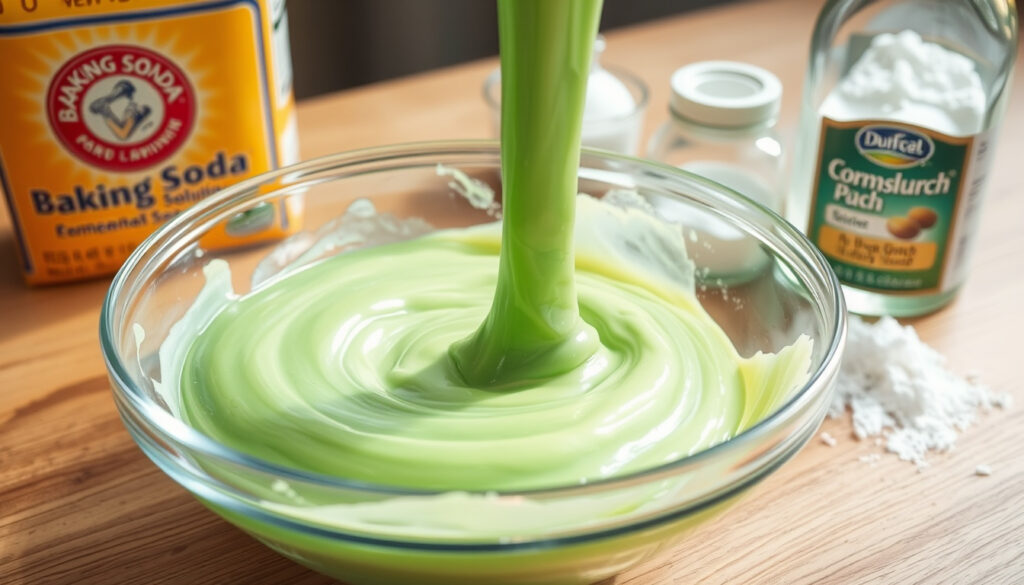
How to Make Slime Without Activator: 5 Easy Recipes
Anyone who’s tried making slime with a kid already knows the drill: you grab the glue, search for the borax or saline solution, and then realize you’re out of both. The good news is that you can still make perfectly good slime without a traditional activator using ingredients already in your kitchen.
Common borax-free slime base: White PVA glue ·
Typical baking soda ratio: 1/2 teaspoon per 1 cup glue ·
Common household activator substitutes: Salt, baking soda, dish soap, shampoo, hand sanitizer ·
Popular 2-ingredient slime formula: Dish soap + cornstarch ·
Average slime prep time: 5–10 minutes
Quick snapshot
- Uses white glue (DIY.org (creative project platform))
- Needs water or lotion (DIY.org (creative project platform))
- Firm texture (DIY.org (creative project platform))
- Uses clear glue (Kids Fashion Care (kids lifestyle blog))
- May be sticky (Kids Fashion Care (kids lifestyle blog))
- Stretchy if ratios correct (Kids Fashion Care (kids lifestyle blog))
- Needs cornstarch
- Quick to make
- Smooth consistency
- Single bowl (Kids Fashion Care (kids lifestyle blog))
- Includes cornstarch (Kids Fashion Care (kids lifestyle blog))
- Soft and fluffy (Kids Fashion Care (kids lifestyle blog))
Four popular no-activator methods, one pattern: each relies on a different household ingredient to create the crosslinking effect that turns glue into slime.
The contrast between methods comes down to texture versus safety: glue-based recipes give the most satisfying stretch, while glue-free options prioritize simplicity and taste-safety for younger children.
| Label | Value |
|---|---|
| Typical glue for slime | PVA-based white or clear school glue (DIY.org (creative project platform)) |
| Most common no-activator ingredient | Baking soda (Arm & Hammer recipe) |
| Minimum ingredients for slime | 2 (e.g., dish soap + cornstarch) |
| Approximate slime shelf life | 3–7 days in sealed container |
The pattern here: baking soda is the most reliable no-activator substitute, while the minimum-ingredient methods trade longevity for speed.
Can You Make Slime Without an Activator?
What qualifies as a slime activator?
- Traditional activators like borax powder, saline solution, and contact lens solution contain ions that crosslink the polymer chains in PVA glue.
- Without these ions, glue remains a liquid. The crosslinking process is what gives slime its stretchy, non-sticky texture.
- National Geographic Kids (children’s education site) notes that eco-friendly slime recipes are often framed as options that avoid glue, borax, and activator entirely.
The role of borax and saline solution
- Borax (sodium borate) and saline solution provide borate ions that link polymer chains together.
- Household substitutes like baking soda, salt, and dish soap can create a similar effect, though the chemistry differs.
- DIY.org (creative project platform) explains that about 1/2 cup of glue is enough for its no-activator slime recipe, and letting the mixture sit for a few minutes helps the ingredients bind.
The key insight: you don’t need borate ions to make slime. Any ingredient that thickens or gels the polymer chains in PVA glue can work as a substitute — and many are already in your pantry.
The implication: families who avoid borax for safety reasons still have several viable paths to homemade slime, each with different trade-offs in texture and longevity.
What Can I Use Instead of a Slime Activator?
Baking soda as an activator
- Baking soda mixed with PVA glue and a liquid (water or lotion) can create a stretchy slime.
- DIY.org (creative project platform) recommends about 1/2 cup of glue, baking soda, warm water, and optional food coloring for its no-activator recipe.
- The mixture should sit for a few minutes so the ingredients bind and the texture becomes smoother.
Salt as an activator
- Salt can thicken glue but may not create stretchy slime on its own.
- Kids Fashion Care (kids lifestyle blog) describes a salt-and-shampoo method that requires a freezer step — mixing thick shampoo with 1–2 teaspoons of salt, then freezing for 10–15 minutes.
- Results vary depending on the glue type and salt concentration.
Dish soap as an activator
- Dish soap often requires a thickener like cornstarch or flour to reach slime consistency.
- A popular 2-ingredient formula uses dish soap and cornstarch in a 1:2 ratio (1 tablespoon dish soap to 2 tablespoons cornstarch).
- This method produces a smooth, slightly stretchy slime that’s quick to make.
Shampoo as an activator
- Thick shampoo mixed with cornstarch can form a soft, fluffy slime.
- Kids Fashion Care (kids lifestyle blog) suggests using thick shampoo, 1–2 teaspoons of salt, and a 10–15 minute freezer rest to achieve the right texture.
- The result is typically softer than glue-based slime and less stretchy.
Hand sanitizer as an activator
- Whether hand sanitizer alone can replace a traditional activator remains unclear.
- The alcohol in hand sanitizer evaporates quickly, which can dry out the slime rather than crosslink the polymers.
- Some sources report that mixing hand sanitizer with glue creates a sticky, short-lived slime, but the results are inconsistent.
Each substitute offers a different texture and shelf life. Baking soda slime tends to be firmer and longer-lasting, while shampoo and dish soap slimes are softer but degrade faster. For a child who wants stretchy, long-lasting slime, baking soda plus glue is the most reliable no-activator option.
How to Make a 2-Ingredient Slime Without Activator
Dish soap and cornstarch method
- Start with 2 tablespoons of cornstarch in a bowl. Add 1 tablespoon of dish soap.
- Stir until the mixture comes together into a dough-like consistency.
- If too sticky, add more cornstarch. If too crumbly, add a few drops of dish soap.
- Knead for 1–2 minutes until smooth and stretchy.
Shampoo and cornstarch method
- Combine 2 tablespoons of thick shampoo with 1 tablespoon of cornstarch in a bowl.
- Stir until no dry cornstarch remains. The mixture will be paste-like.
- Place the bowl in the freezer for 10–15 minutes, as recommended by Kids Fashion Care (kids lifestyle blog).
- Remove and knead gently. The slime will be soft and fluffy.
Two-ingredient slimes are the fastest option — ready in under 5 minutes — but they trade stretchiness for simplicity. A child who wants a classic slime pull will get more satisfaction from a baking soda or glue-based recipe.
What this means: if speed is the priority, the dish soap and cornstarch method wins; if texture matters more, invest the extra minute in a glue-based recipe.
How to Make Slime Without Activator at School
No-borax slime for classroom settings
- School-safe slime avoids borax and saline solution entirely, as these can irritate skin and eyes.
- National Geographic Kids (children’s education site) offers a cornstarch-based recipe: mix 1/2 cup cornflour with 18–20 teaspoons of colored water, adding gradually until the mixture becomes gooey.
- This eco-friendly slime uses no glue, borax, or activator — it’s essentially a non-Newtonian fluid that feels solid when squeezed and liquid when left alone.
Using baking soda and glue
- For a more traditional slime texture in a classroom, mix 1/2 cup PVA glue with 1/2 teaspoon of baking soda and a few drops of food coloring.
- Add warm water a tablespoon at a time, stirring until the slime pulls away from the bowl.
- DIY.org (creative project platform) recommends letting the mixture sit for a few minutes so the ingredients bind fully.
- This method avoids borax and saline, making it appropriate for most school settings.
Even glue-free slime recipes can leave residue on desks and clothing. National Geographic Kids (children’s education site) advises testing a small amount first and using a play mat or tray to contain the mess.
The pattern: classrooms that ban borax still have two workable options — a glue-based recipe for older kids who want stretch, or a cornstarch-based one for younger groups where mess control matters more.
How to Make Slime Without Activator or Glue
Fluffy slime from shampoo and cornstarch
- This glue-free method uses thick shampoo and cornstarch to create a soft, fluffy texture.
- Mix 2 tablespoons of shampoo with 1 tablespoon of cornstarch. Stir until a dough forms.
- Kids Fashion Care (kids lifestyle blog) suggests adding 1–2 teaspoons of salt and freezing for 10–15 minutes to improve the texture.
- The result is lightweight and airy, but not as stretchy as glue-based slime.
Edible slime with marshmallow and powdered sugar
- Hey Toys (toy and activity blog) describes a marshmallow-and-cornstarch method that creates a no-glue slime-like dough.
- Microwave a handful of marshmallows for 10–15 seconds, then stir in cornstarch until the mixture becomes a pliable dough.
- This is a taste-safe option for very young children, though it’s more of a dough than a stretchy slime.
For parents looking for a taste-safe alternative, Mama Instincts (parenting and family blog) offers a psyllium husk recipe: boil 3 cups of water, add food dye, then stir in psyllium husks until the mixture thickens into a gel-like slime — about 5 minutes of stirring. This is the only no-activator, no-glue method that produces a genuinely stretchy, gel-like texture.
“The psyllium-husk mixture takes about 5 minutes of stirring to become a very thick gel-like mixture.”
“A cornstarch-and-water mixture is one of the simplest no-activator slime-style recipes for kids.”
National Geographic Kids (children’s education site)
Confirmed facts
- Baking soda mixed with glue and a liquid can create a stretchy slime. (DIY.org (creative project platform))
- Salt can thicken glue but results vary. (Kids Fashion Care (kids lifestyle blog))
What’s unclear
- Whether hand sanitizer alone can replace a traditional activator. Results are inconsistent and short-lived.
- The long-term safety of repeated slime play with certain homemade recipes, especially those using salt or shampoo near the eyes.
For parents and teachers, the choice between these methods comes down to a single trade-off: glue-based recipes (baking soda + PVA glue) deliver the most stretchy, satisfying slime, while glue-free options (cornstarch, psyllium husk, marshmallow) prioritize safety and simplicity. For a child in a classroom setting where borax and saline are not allowed, the baking soda and glue method is the best balance of texture and safety. For a toddler who still puts things in their mouth, the psyllium husk or marshmallow options are the only responsible choice.
Related reading: how to make slime without activator · how to make slime without activator for kids
kidsfindshub.com, youtube.com, wikihow.com, earlyfinder.com, deltafairfun.com, ecocraftyliving.com, en.fmyly.com
Frequently asked questions
Is slime without activator safe for kids?
Most no-activator slime recipes are safer than traditional borax-based slime, but not all are edible. Glue-based recipes (baking soda + glue) are non-toxic but should not be eaten. Taste-safe options like psyllium husk slime or marshmallow dough are better for very young children. Always supervise slime play and wash hands afterward.
How long does homemade no-activator slime last?
Most no-activator slimes last 3–7 days when stored in a sealed container at room temperature. Glue-based slimes tend to last longer (up to a week), while cornstarch and shampoo slimes may dry out faster. Refrigeration can extend the life of some recipes by a day or two.
Can you use hand sanitizer and glue to make slime?
Hand sanitizer can be mixed with glue to create a slime-like consistency, but the results are inconsistent. The alcohol in hand sanitizer evaporates quickly, often leaving a sticky, short-lived slime. It is not a reliable substitute for traditional activators.
What is the easiest no-activator slime recipe?
The easiest no-activator slime recipe is the 2-ingredient dish soap and cornstarch method. Mix 1 tablespoon of dish soap with 2 tablespoons of cornstarch, stir, and knead for 1–2 minutes. No heat, no freezer, no special ingredients — just pantry staples.
Why does my no-activator slime turn out sticky?
Sticky slime usually means there is too much liquid relative to the thickening agent. Add more cornstarch, baking soda, or salt in small increments (1/2 teaspoon at a time) and knead well. If the slime is glue-based, letting it rest for 5–10 minutes can also help the ingredients bind.
Can you make slime with only glue and water?
Glue and water alone will not create slime — they will just form a watery glue solution. You need a crosslinking agent (like baking soda, salt, or dish soap) to thicken the mixture into a stretchy slime. Without an activator or substitute, the glue remains liquid.
Does baking soda expire for slime making?
Baking soda does not expire in the sense of becoming unsafe, but old baking soda loses its leavening power and may produce less effective slime. For best results, use baking soda that is within its printed expiration date. If it no longer fizzes when mixed with vinegar, it is too old for reliable slime.
More related posts
 Rufus Sewell Movies and TV Shows: Roles and Highlights
 Sun Mountain Golf Bags Review: Worth It or Not
 6 Minute Solar Eclip e 2027: Be t Place and Safety Guide
 Dick Van Dyke Show: Cast, Episodes & Streaming Guide
 Hearing Aids Near Me: Cost, Coverage & Local Pros
 Hindi to English Translation: Free Tools and Grammar Tips
 How to Deal with a Narcissist: Expert Strategies and Tips