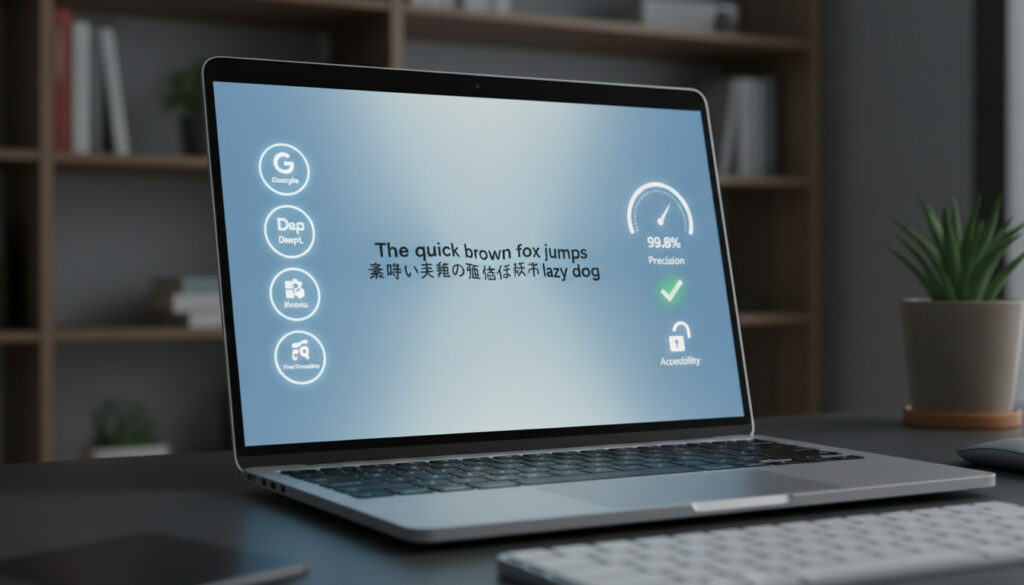
Translate English to Japanese – Best Free Tools and Accuracy Guide
Translating English to Japanese requires navigating three distinct writing systems and complex cultural nuances. Whether travelers need quick menu translations or professionals require precise business documents, the choice between free online tools and specialized apps significantly impacts accuracy.
Modern neural machine translation has narrowed the gap between automated and human translation, yet Japanese presents unique challenges. The language relies heavily on context, honorific levels, and implied meaning that literal translation often misses. Users must understand each tool’s strengths and limitations to achieve reliable results.
How Do I Translate English to Japanese Online for Free?
| Tool | Accuracy (English-JP) | Free Tier | Mobile App | Romaji Support |
|---|---|---|---|---|
| Google Translate | Reliable for complex passages | Unlimited text | iOS/Android | Limited |
| DeepL | Top for natural text flow | 1,500 character limit | iOS/Android | No |
| Microsoft Translator | Basic functionality | Unlimited | iOS/Android | No |
| Apple Translate | Moderate | Unlimited | iOS only | No |
Several platforms dominate the free translation landscape, each optimizing for different use cases. Testing indicates that DeepL and Google Translate rank highest for accuracy in 2025, though their strengths diverge significantly.
- DeepL excels in natural sentence flow and contextual appropriateness for written text.
- Google Translate offers the most versatile feature set, including camera and voice translation capabilities.
- Claude 3.5 achieves the highest accuracy ratings for nuanced content without requiring prompt engineering.
- Papago demonstrates superior performance for conversational Japanese and short phrase translation.
- Jisho.org provides the most comprehensive dictionary functions with kanji drawing recognition.
- Free tiers universally impose limits, typically capping document uploads or character counts per translation.
- Offline functionality varies significantly between platforms, with Google and DeepL leading mobile accessibility.
| Fact | Detail |
|---|---|
| Language Pair Complexity | English (Latin script) to Japanese (Kanji/Hiragana/Katakana) |
| Script Systems | 3 native scripts plus Romaji transliteration |
| Market Leader | Google Translate (approximately 90% usage share) |
| Average Accuracy (Simple Text) | 80–95% for declarative sentences |
| Average Accuracy (Idioms) | 60–75% depending on cultural specificity |
| Top AI Performer | Claude 3.5 for context-aware translation |
| DeepL Free Limit | 1,500 characters per translation |
| Offline Support Leaders | Google Translate, DeepL, Papago, Microsoft Translator |
| Camera Translation | Available via Google, Waygo, and Papago |
| Voice Input Support | Google, Papago, Microsoft, Apple, VoiceTra |
| Romaji Conversion | Yandex Translate, Romaji Desu, J-Talk |
| Regional Specialist | Papago (Naver) optimized for Asian language pairs |
What Is the Best English to Japanese Translator?
Selecting the optimal tool depends on content type and required accuracy. Written correspondence, conversational exchange, and technical documentation each demand different capabilities from translation engines.
Google Translate vs DeepL: Which Handles Nuance Better?
Comparative analysis reveals that DeepL produces more natural Japanese sentence flow, particularly excelling with subtle linguistic variations and professional tone. Google Translate processes complex passages reliably but occasionally flattens emotional undertones or contextual subtext. Both platforms handle English-to-Japanese direction more effectively than reverse translation, suggesting algorithmic optimization favors this specific language pair.
Specialized AI for Professional Documents
Generative AI tools now surpass traditional statistical translation for technical terminology. Claude 3.5 leads accuracy rankings for nuanced content requiring no prompt engineering, while ChatGPT-4o and Gemini perform adequately but require specific instructions to match contextual awareness. These systems outperform older rule-based methods when handling domain-specific vocabulary.
Regional Specialists for Conversational Use
Papago demonstrates superior performance for Asian language conversations, particularly for short exchanges common in travel scenarios. Naver’s engine captures natural phrasing patterns and contextual particles that Western-developed tools occasionally misinterpret.
Combine Jisho.org for detailed kanji lookups with DeepL or Google for full sentence translation. This hybrid approach addresses the primary weakness of general machine translation tools: specific terminology accuracy for technical or academic content.
Is Google Translate Accurate for English to Japanese?
Accuracy varies significantly based on text complexity, directional flow, and cultural embeddedness. Current assessments indicate that while basic comprehension is reliable, certain linguistic features remain problematic for automated systems.
Accuracy Ratings for Complex Passages
Google Translate achieves approximately 80-90% accuracy for straightforward declarative sentences following standard subject-verb-object patterns. However, literary texts, poetry, or highly contextual business communications see accuracy drop to 60-75%. The platform improved significantly following neural network adoption in 2016, though idiomatic expressions and metaphorical language remain challenging.
Limitations with Honorifics and Tone
Japanese relies on keigo (honorific language) comprising sonkeigo (respect language), kenjougo (humble language), and teineigo (polite language). Machine translation often defaults to neutral politeness levels, potentially creating socially inappropriate communications in business contexts. Tools may simplify or flatten emotional expression and tonal subtleties that define professional relationships in Japanese culture.
How Direction Affects Quality
English-to-Japanese translation consistently outperforms Japanese-to-English across all tested platforms. This asymmetry stems from English’s structural flexibility versus Japanese’s contextual density and grammatical ambiguity. Users requiring bidirectional accuracy should verify reverse translations separately rather than assuming symmetrical performance.
Download language packs before travel. Google’s offline Japanese package requires approximately 30MB storage and provides text translation without data roaming. Voice and camera features typically require active internet connections regardless of platform capabilities.
What Are the Best Apps for English to Japanese Translation?
Mobile applications now offer sophisticated functionality previously limited to desktop platforms. iOS and Android ecosystems provide distinct advantages depending on user priorities.
Mobile Platforms and Offline Access
Google Translate provides robust offline packages for both operating systems, essential for travelers without consistent connectivity. DeepL offers offline functionality but limits voice translation to online-only usage. Papago supports partial offline features with smaller download footprints suitable for devices with limited storage.
Camera and Voice Features
Visual translation through camera input works effectively with Google Translate and Waygo for restaurant menus or street signs. VoiceTra specializes in live voice interpretation for immediate conversation support. Papago handles conversational audio with strong accent recognition for English speakers, while Jisho.org provides drawing input for unknown kanji characters.
Avoid sole reliance on machine translation for legal contracts, medical instructions, or high-stakes business negotiations. Nuances in obligation forms and liability language require human professional verification to prevent costly errors or cultural misunderstandings.
How Has English to Japanese Translation Technology Evolved?
- 2006: Google Translate launches with statistical machine translation, initially supporting limited language pairs including basic Japanese capabilities.
- 2016: Neural machine translation rolls out across major platforms, dramatically improving context handling and grammatical accuracy for Japanese sentence structures.
- 2020: DeepL adds Japanese language support, introducing competition focused on natural phrasing over literal conversion methods.
- 2023: Offline mobile features expand significantly, with Google and Microsoft enabling full neural translation without internet connectivity.
- 2025: AI context awareness upgrades enable large language models to handle implied meaning and cultural subtext with unprecedented accuracy.
What Are the Certainties and Uncertainties of Machine Translation?
| Established Information | Information That Remains Unclear |
|---|---|
| Machine translation processes simple declarative sentences at 80–95% accuracy rates | Exact accuracy rates for highly technical or literary content vary significantly by domain |
| English-to-Japanese direction consistently outperforms reverse translation across all platforms | Long-term impact of generative AI on professional translation industry employment remains uncertain |
| DeepL and Google Translate lead the consumer market for text-based translation | Specific handling of rare dialects or archaic Japanese forms in modern tools lacks comprehensive testing |
| Free tiers universally impose character or document limits (DeepL: 1,500 characters) | Future regulatory frameworks for AI translation in legal contexts are still developing |
| Offline functionality requires pre-downloaded language packages of 30MB or more | Accuracy degradation patterns for handwritten or stylized text recognition are not fully mapped |
Why Is Japanese Translation Particularly Challenging?
Japanese grammar structures sentences with the verb at the end, requiring translation engines to restructure entire thought patterns while maintaining temporal relationships. The language omits subjects when contextually understood, forcing algorithms to infer pronouns that English requires explicitly. Three distinct writing systems—kanji characters, hiragana syllabary, and katakana for foreign terms—compound complexity, particularly when tools must choose appropriate script mixing for loanwords or emphasis.
Cultural context drives meaning through implied rather than stated content. Honorific levels shift based on social hierarchy, regional variations affect vocabulary choices, and emotional nuance often depends on sentence-ending particles rather than word selection. These layers challenge automated systems optimized primarily for Indo-European language pairs. Precision requirements in technical fields mirror the exactitude needed for 150 Lbs to Kg – Exact NIST Conversion Guide, where small errors compound significantly.
Professional human review remains essential for legally binding or culturally sensitive materials where misinterpretation carries significant consequences.
What Do Experts Say About Translation Accuracy?
DeepL and Google Translate rank among the top free online English-to-Japanese translators for accuracy in 2025-2026, with DeepL excelling in natural text flow and Google offering versatile features like camera and voice translation.
— Comparative Analysis, Transync AI
Japanese nuances including honorifics, tone, context, and politeness levels challenge machine translation systems. Tools simplify or flatten emotion and idiomatic expressions.
— Translation Technology Assessment, Maestra AI
For high-stakes work, machine translation falls short on nuances. Users should opt for human translators via CAT tools or agencies, pairing automated systems with professional editors.
What Should You Use for English to Japanese Translation?
Translate English to Japanese – Best Free Tools and Accuracy Tips provides extended implementation guidance. For immediate needs, DeepL serves written correspondence best, Google Translate handles multimedia inputs comprehensively, and Papago manages conversational exchanges most naturally. Combine these tools with Jisho.org for kanji verification, and engage professional human translators for any legally binding or commercially critical content.
Frequently Asked Questions
How accurate is DeepL for English to Japanese?
DeepL achieves top rankings for natural text flow and sentence structure. Testing shows it outperforms Google Translate on subtlety and nuance, though free users face a 1,500 character limit per translation and document processing requires subscription.
Can I translate English to Japanese with Romaji?
Yes. Yandex Translate provides romaji transliteration output, while Romaji Desu offers pronunciation audio. J-Talk converts kanji to hiragana and romaji, though free usage has limitations. Most general translators do not offer romaji output natively.
What are the limitations of free translation tools?
Free tiers cap character counts, with DeepL limiting to 1,500 characters. Offline voice translation usually requires paid subscriptions. Machine translation struggles with Japanese honorifics, contextual politeness levels, and idiomatic expressions.
Is there a free translator without signup?
Google Translate, DeepL, and Microsoft Translator offer full functionality without account creation. Jisho.org provides dictionary lookup anonymously. These tools work immediately in browsers without registration or email verification requirements.
How do I handle kanji in translation?
Use Jisho.org for detailed kanji breakdowns including readings and components. Waygo specializes in camera-based kanji recognition for printed text. General translators handle kanji automatically but may select incorrect characters for ambiguous terms.
When should I use professional translation services?
Engage human translators for legal contracts, medical documentation, marketing materials requiring cultural adaptation, and high-stakes business communications. Machine translation suffices for personal travel and general comprehension only.
Which app works best offline?
Google Translate offers the most comprehensive offline Japanese package. DeepL and Papago support offline text translation but restrict voice features to online mode. Download language packs before disconnecting from the internet.
Does Apple Translate work well for Japanese?
Apple’s built-in Translate app supports Japanese offline and voice translation, but testing indicates it lacks the nuance accuracy of DeepL. It serves adequately for basic travel needs but falls short for complex business language.
More related posts
 Ratchet & Clank: Rift Apart Review – Is It Worth It
 Tom Brady Sydney Sweeney: Rumors, Politics & Personal Life
 The Haunting of Hill House Cast: Full List of Actors
 Best Home Smoothie Blenders: Top Picks & Buying Guide
 Tank Tops for Women: Best Styles & Top Picks 2024
 Wheel of Time Cast – Full List of Actors Seasons 1-3
 Jane the Virgin Cast: Full List of Actors and Characters
 The Half of It Ending, LGBTQ Themes, and Parental Guide