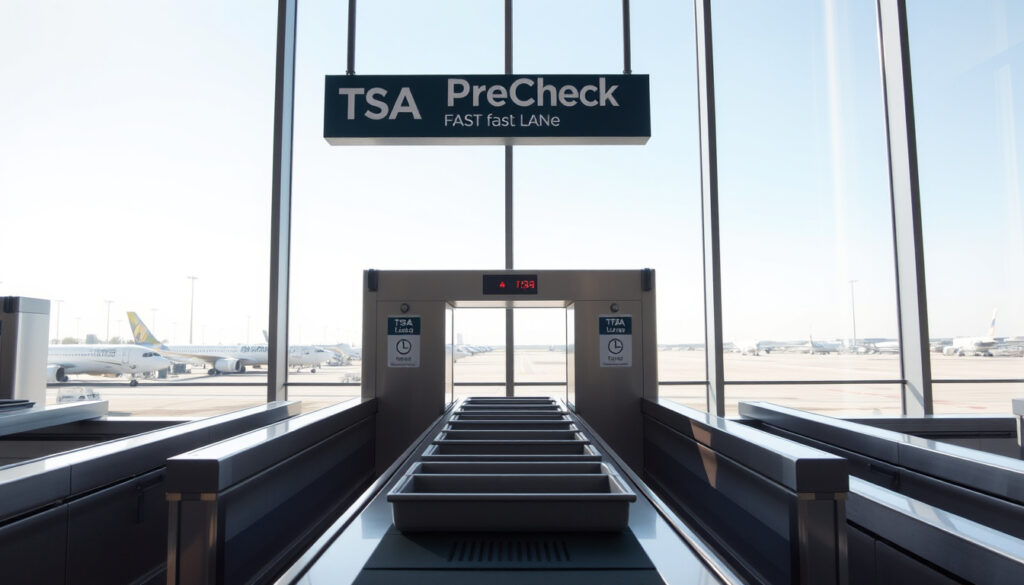
How to Get TSA PreCheck: Steps, Cost, Eligibility Guide
Anyone who’s waited in a long security line while watching the PreCheck lane zip past already knows: that little “TSA PreCheck” indicator on your boarding pass changes everything. No shoe removal, no laptop shuffling, no 3-1-1 liquid juggling. The catch is getting enrolled in the first place—and the process is simpler than most people assume.
Online application time: as little as 5 minutes · Primary enrollment partner: IDEMIA · Membership length: 5 years · Who qualifies: U.S. citizens, nationals, and lawful permanent residents
Quick snapshot
- U.S. citizens, nationals, and lawful permanent residents are eligible (IDEMIA North America)
- IDEMIA charges $76.75 for new enrollment (5-year membership) (TSA Enrollment by IDEMIA)
- Global Entry, NEXUS, SENTRI, and active TWIC holders automatically receive PreCheck access (TSA Enrollment by IDEMIA)
- Exact processing time varies — some applicants receive their Known Traveler Number within days; others wait weeks
- Non-U.S. citizen pathways beyond lawful permanent resident status remain limited and inconsistently documented
- IDEMIA: $76.75 new, $58.75 online renewal (Chase Bank fee listing)
- Telos: $85 new enrollment (higher cost for similar service) (Chase Bank fee listing)
- CLEAR: $77.85 new enrollment, operates at fewer airport locations (Chase Bank fee listing)
- Complete online pre-enrollment → schedule IDEMIA appointment → attend 10-minute in-person session → receive KTN via mail or online account
- Add KTN to airline booking and PreCheck lanes appear on your boarding pass
The enrollment details at a glance reveal IDEMIA’s dominance as the primary provider and the fee structure across all enrollment types.
| Detail | Value |
|---|---|
| Program Manager | Transportation Security Administration (TSA) |
| Primary Enrollment Partner | IDEMIA (operating since 2013) |
| Enrollment Locations | 650+ across the United States |
| Online Pre-Enrollment Time | As little as 5 minutes |
| New Enrollment Fee | $76.75 for 5-year membership |
| Online Renewal Fee | $58.75 |
| Children Eligibility | Ages 17 and under when traveling with enrolled parent |
What is the best way to get TSA PreCheck?
The fastest route to TSA PreCheck runs through IDEMIA, the program provider that has handled enrollment since 2013 and operates over 650 enrollment centers across the country. The process breaks into two stages: an online pre-enrollment form and a brief in-person appointment.
Start your application online
Navigate to the official TSA PreCheck enrollment portal and fill out the initial form. According to the Chase Bank guide on PreCheck enrollment, this online step takes as little as five minutes. You’ll enter basic personal details, confirm your eligibility, and select your enrollment provider—IDEMIA is the default and most widely available option. Before submitting, verify that a participating location exists near you; IDEMIA publishes a location finder on its website.
Find an IDEMIA enrollment center
After submitting your online pre-enrollment, you’ll schedule an in-person appointment at an IDEMIA location. These centers operate in airports, shopping malls, and standalone offices. The appointment itself takes roughly 10 minutes. Bring a government-issued photo ID and your payment method—the fee is $76.75 for new enrollments, payable by credit card, debit card, company check, money order, or certified/cashier’s check, according to the Chase Bank fee breakdown.
Schedule your appointment
The in-person session covers fingerprinting, document verification, and photo capture. IDEMIA staff confirm your identity and run a background check. If everything checks out, you’ll receive your Known Traveler Number (KTN)—the 9-digit identifier you add to airline reservations. Most applicants get their KTN within a few business days, though processing can take longer depending on volume.
The implication: scheduling your appointment at least two weeks before any major trip is the only way to guarantee PreCheck access when you need it.
Who qualifies for TSA PreCheck?
TSA PreCheck eligibility is tightly scoped to U.S. citizens, U.S. nationals, and lawful permanent residents. This is not a program for occasional visitors or tourists from other countries—the official enrollment site from IDEMIA North America confirms this restriction explicitly. If you hold one of these three statuses, you can apply regardless of how frequently you fly.
U.S. citizens and lawful permanent residents
The primary eligibility group covers anyone with American citizenship or lawful permanent resident (LPR) status. Both groups undergo the same enrollment process and pay the same $76.75 fee. No minimum number of flights per year applies—you qualify based on your status alone.
Military members and their families
Active-duty U.S. military personnel and their immediate family members may qualify for fee waivers or expedited enrollment through the Defense Department. In practice, many military travelers discover they already have PreCheck access through other credentials: Global Entry, NEXUS, and SENTRI all grant PreCheck eligibility automatically. A current Common Access Card (CAC) or military ID may also streamline the in-person appointment, according to guidance from the TSA Enrollment by IDEMIA portal.
Children traveling with enrolled parents
Children 17 and under can pass through PreCheck lanes alongside an enrolled parent, provided the child’s boarding pass displays the PreCheck indicator. No separate enrollment is required for minors traveling with a qualifying adult.
Global Entry, NEXUS, SENTRI, and TWIC holders
If you already hold Global Entry, NEXUS, SENTRI, an active Transportation Worker Identification Credential (TWIC), or a Commercial Driver’s License with a Hazardous Materials Endorsement (CDL with HME), you receive TSA PreCheck access automatically. There’s no need to enroll separately—the PreCheck indicator appears on your boarding pass once your existing KTN is attached to your reservation. The official TSA enrollment portal confirms this applies to all five programs.
What this means: if you already carry any of these credentials, paying the $76.75 enrollment fee would be pure waste—check your existing KTN before anything else.
How much does TSA PreCheck cost?
The standard enrollment fee across all providers centers around $76.75 for a new five-year membership, though costs vary slightly between IDEMIA, CLEAR, and Telos. Renewal fees are lower, and several premium credit cards offset the cost entirely.
The provider comparison shows how fees stack up across the three enrollment options currently available to U.S. travelers.
| Provider | New Enrollment | Online Renewal | In-Person Renewal |
|---|---|---|---|
| IDEMIA | $76.75 | $58.75 | $66.75 |
| CLEAR | $77.85 | ~$70 | — |
| Telos | $85 | ~$58.75–$70 | — |
These figures come from the Chase Bank updated fee listing (March 2025) and have been cross-referenced against the official IDEMIA portal. Costs can shift slightly depending on when you enroll and which provider you choose, so verifying current pricing on the TSA or IDEMIA website before scheduling your appointment is smart.
Discounts and fee reimbursements
Several premium travel credit cards reimburse TSA PreCheck fees automatically. The Chase Sapphire Reserve covers up to $120 every four years for PreCheck, Global Entry, or NEXUS. American Express offers up to $85 in credit every four years for PreCheck fees on select cards, per the American Express travel benefits page. If you carry one of these cards, your PreCheck enrollment can effectively cost nothing out of pocket.
Military enrollment costs
Active-duty military members and their spouses may be eligible for fee waivers through the Defense Department or their installation’s-pass office. The base enrollment process is identical, but the cost may be reduced or eliminated depending on the branch and the specific program available at your duty station.
The pattern: most travelers with premium travel cards pay nothing for PreCheck, while those without reimbursement benefits face the full $76.75 baseline.
How long does it take for TSA PreCheck to be approved?
The timeline from completing your in-person appointment to receiving your Known Traveler Number typically spans a few business days, though processing times can vary during peak enrollment periods. According to Chase Bank’s fee and process guide, applicants can expect to receive their KTN within days of the enrollment appointment rather than weeks.
From application to approval
The online pre-enrollment takes five minutes. The in-person appointment takes about 10 minutes. After that, the background check and processing run behind the scenes. Most applicants see their KTN appear in their account or receive it by mail within one to two weeks. If you have an urgent trip approaching, scheduling your appointment well in advance is advisable—aim for at least two weeks before any critical travel date.
Checking your status online
After your appointment, you can check enrollment status through the official TSA/IDEMIA portal. You’ll need your applicationLocator number (printed on your appointment confirmation) to pull up your status. Once approved, you can access your KTN online, add it to your airline frequent flyer profile, and start seeing PreCheck lanes appear on your boarding passes.
Interim period and what to do
Until your KTN arrives, you cannot use PreCheck lanes. There’s no temporary credential or interim pass available. Plan your enrollment timing accordingly—don’t schedule an appointment the week before a major trip unless you’ve already verified your KTN is active.
The catch: travelers who discover PreCheck value only when they’re already at the airport have no recourse—there is no way to fast-track your approval or obtain a temporary pass.
Is TSA PreCheck worth it?
Whether TSA PreCheck delivers value depends heavily on how often you fly and how much you value your time at the airport. For frequent travelers, the math is compelling. For occasional flyers, the cost-benefit calculation is closer.
Upsides
- No shoe, belt, or jacket removal at security checkpoints
- Laptops and 3-1-1 compliant liquids stay in your bag
- PreCheck lanes operate at approximately 200 U.S. airports
- Membership covers five years at $76.75 — roughly $15.35 annually
- Credit card reimbursements can eliminate the cost entirely
- Children 17 and under join PreCheck lanes with enrolled parents at no extra charge
Downsides
- Only works at U.S. airport security checkpoints — not international airports or customs
- Only U.S. citizens, nationals, and LPRs are eligible
- PreCheck indicator on boarding pass depends on airline and specific flight
- Processing time means no last-minute enrollment before a trip
- Some travelers report inconsistent lane availability during peak hours
The comparison that frequently arises is TSA PreCheck versus Global Entry. The NerdWallet travel guide clarifies the distinction: PreCheck handles domestic airport security, while Global Entry covers U.S. customs for international arrivals and automatically grants PreCheck access. Global Entry costs $120 for five years versus PreCheck’s $76.75. If you travel internationally even once every two years, Global Entry may offer better overall value.
Global Entry charges $120 for five years but includes PreCheck access and skips customs lines on international arrivals. Frequent international travelers get more value from Global Entry despite the higher upfront cost.
Global Entry holders don’t need PreCheck
This point deserves emphasis because it’s widely misunderstood. If you hold an active Global Entry membership (which costs $120 for five years), your Known Traveler Number automatically qualifies you for PreCheck lanes. Paying the $76.75 PreCheck fee separately would be a waste of money. Always verify your Global Entry status is current before enrolling in PreCheck.
Worth it in 2026 and beyond
TSA has continued expanding PreCheck eligibility and enrollment infrastructure. The program’s stability is solid—IDEMIA has operated as the primary provider since 2013 with over 650 locations nationwide. For anyone flying four or more times per year, PreCheck membership pays for itself in time saved within the first two to three uses. The real value compounds most visibly during holiday travel periods, when standard security lines routinely stretch past 30 minutes while PreCheck lanes remain short.
For frequent flyers who are U.S. citizens or permanent residents, the decision is clear: enroll through IDEMIA, add your KTN to every airline reservation, and never remove your shoes at a security checkpoint again. For occasional travelers or those who already hold Global Entry, the $76.75 enrollment fee may be unnecessary—check your existing credentials first. The one group that should move quickly: anyone with a major trip booked within the next month should enroll now and budget two to three weeks for processing, since there’s no way to fast-track your KTN.
The fastest and easiest way to enroll in TSA PreCheck is to start the application online. — TSA Enrollment by IDEMIA
IDEMIA has the most active locations compared to other enrollment providers. — Chase Bank enrollment guide
After approval, retrieve your Known Traveler Number—essential for checkpoints—using KTN lookup guide to verify or recover it quickly.
Frequently asked questions
Can non-U.S. citizens get TSA PreCheck?
TSA PreCheck is limited to U.S. citizens, U.S. nationals, and lawful permanent residents. Non-citizens who do not hold LPR status are generally not eligible. Some foreign nationals with specific visa types and frequent international travel may explore Global Entry or NEXUS (for U.S.-Canada border travel), but PreCheck itself requires U.S. citizenship or residency.
How to get TSA PreCheck free?
Several premium credit cards reimburse TSA PreCheck fees automatically. The Chase Sapphire Reserve covers up to $120 every four years for PreCheck or Global Entry. American Express offers up to $85 in credit every four years on select cards. If you carry either of these cards, enroll through IDEMIA and submit the charge for reimbursement—many cardholders get the full fee refunded within days.
How to get TSA PreCheck military?
Active-duty military members and their families may qualify for fee waivers through their branch’s travel program or installation pass office. Additionally, many military travelers already qualify automatically through Global Entry, NEXUS, or SENTRI credentials. Check your existing membership status before paying the $76.75 enrollment fee—your DoD-issued credentials may already carry PreCheck access.
How to get TSA PreCheck military spouse?
Military spouses follow the same eligibility rules as the servicemember: if the spouse holds U.S. citizenship or LPR status, they can enroll through IDEMIA. Some installations offer on-base enrollment events that streamline the process. Like active-duty members, spouses should verify whether they already hold Global Entry or another Trusted Traveler credential before paying the standard fee.
How to get TSA PreCheck and Global Entry?
You don’t need both—they serve different purposes. Global Entry costs $120 for five years and covers airport security (PreCheck) plus U.S. customs for international arrivals. Enroll in Global Entry through the official CBP portal, and you’ll automatically receive PreCheck access with the same KTN. If you never travel internationally, PreCheck alone at $76.75 is sufficient.
What is the TSA PreCheck status check?
The TSA PreCheck status check is an online tool available through the IDEMIA/TSA enrollment portal. After your in-person appointment, use your application locator number to retrieve your enrollment status. Once approved, your Known Traveler Number will appear in your online account and you can add it to your airline profiles.
What documents are required for TSA PreCheck enrollment?
Bring a valid government-issued photo ID (typically a U.S. passport or state driver’s license) and proof of U.S. citizenship or lawful permanent resident status if different from your primary ID. For military or government credentials, check with IDEMIA ahead of your appointment to confirm which documents they’ll accept for your specific situation.
More related posts
 Amoxicillin and Clavulanate Potassium: Uses, Side Effects, Dosage
 How Old Is the Earth? 4.54 Billion Years & Human Timeline
 Hail Holy Queen Prayer – Full Text, Meaning and History
 Where is Notre Dame? Location of Cathedral & University
 Criminal Minds Season 18: Release Date, Cast, Episodes Guide
 Canker Sore on Lip: Causes, Treatment, and When to Worry
 Best Water Filtration System for Home: Costs, Types & Benefits
 24 Hour Plumbers Near Me – Emergency Costs and How to Choose