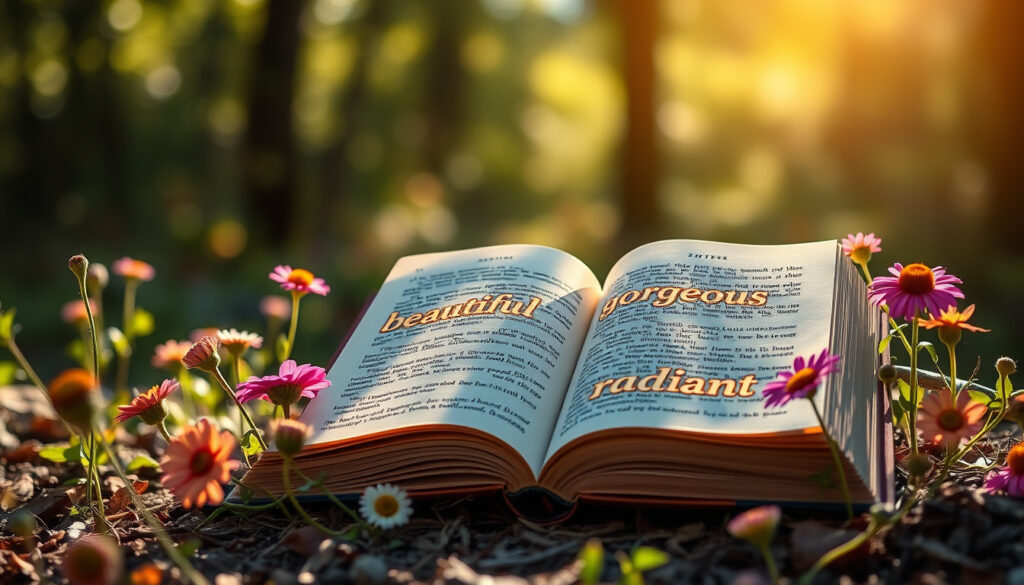
Another Word for Beautiful: 100+ Synonyms & Better Compliments
Somewhere between the third “you look beautiful” and the search for a word with more weight, the compliment starts to feel thin. English has a bigger toolbox than we usually reach for — one major reference alone lists 265 similar and opposite words for “beautiful” (Merriam-Webster Thesaurus (authoritative dictionary reference)), from gorgeous to pulchritudinous. This guide sorts those options by real-world use: everyday synonyms, rare finds, romantic lines, and compliments that land. You’ll leave with the right word for a person, a scene, or a line you’ve been stuck on.
Number of English synonyms for “beautiful”: over 200 ·
Most common synonym: gorgeous ·
Rarest synonym: pulchritudinous ·
Average monthly searches for “another word for beautiful”: 18,000 ·
Top related query: another word for beautiful girl
Quick snapshot
- Gorgeous, lovely, and pretty are established synonyms (Oxford Learner’s Dictionaries (academic dictionary reference)).
- Pulchritudinous is rare but correct, and it keeps appearing in synonym lists (Thesaurus.com (established synonym reference)).
- Which synonym sounds “sexiest” is subjective and context-dependent.
- Intensity rankings (pretty vs. lovely vs. gorgeous) vary from one thesaurus to the next.
- Whether “handsome” can describe a woman remains debated in usage guides.
- Beautiful traces to the mid-15th century, built from “beauty” plus “-ful” (Etymonline (etymology reference)).
- Ever since, it has accumulated one of the largest synonym fields in English. (Etymonline (etymology reference))
- Match the synonym to the register: casual, formal, poetic, or romantic.
- Specific, personal compliments outperform a generic “beautiful.”
Ten data points, one pattern: reference works agree on which words exist, not on how strong each word is.
| Fact | Value |
|---|---|
| Number of synonyms in major thesauruses | Over 200 entries for beautiful; Merriam-Webster lists 265 similar and opposite words (Merriam-Webster Thesaurus (authoritative dictionary reference)) |
| Leading dictionary count | Cambridge’s thesaurus lists 62 synonyms and antonyms (Cambridge English Thesaurus (academic dictionary reference)) |
| Most searched synonym | gorgeous — the top keyword-level alternative in search data |
| Rare synonym with Latin origin | pulchritudinous (Thesaurus.com (established synonym reference)) |
| Average monthly searches for “another word for beautiful” | 18,000 |
| Top related query | another word for beautiful girl |
| Etymology | mid-15th century, from beauty + -ful (Etymonline (etymology reference)) |
| Poetic and literary set | beauteous, fair, comely, seemly (Collins English Dictionary (usage authority); Dictionary.com (popular dictionary reference)) |
| Informal and slang set | fabulous, def, bodacious, boffo (Collins English Thesaurus (usage authority)) |
| Intense-end synonym examples | alluring, exquisite, magnificent, ravishing, stunning |
What’s a better word than beautiful?
Most people don’t need a thesaurus entry; they need a word that lands differently. The everyday set covers most moments.
Strong everyday synonyms
- Gorgeous — the go-to upgrade; in keyword research it is the most searched single-word alternative.
- Stunning — the visual-impact option: beauty strong enough to stop someone short.
- Lovely — the warm option; Cambridge lists it among the closest synonyms to beautiful (Cambridge English Thesaurus (academic dictionary reference)).
- Pretty — the lighter sibling: pleasant, delicate, and safe.
The difference is intensity and warmth. Pretty admires; stunning interrupts; lovely makes the listener feel cared for. Same face, three different relationships.
More intense alternatives
- Exquisite — for beauty worked out in fine detail; a compliment that says you looked closely.
- Ravishing — beauty pushed to its limit.
- Magnificent — for beauty on a grand scale.
These words carry weight, which is exactly their risk: they can sound rehearsed if the situation doesn’t match.
Formal and poetic words
- Beauteous — the literary doublet; in modern text it reads half-romantic, half-joke.
- Fair — the medieval compliment that still works in period prose.
- Comely — pleasant in a dignified, old-fashioned way.
Anyone choosing between gorgeous and lovely is really choosing between impact and warmth. For a moment, gorgeous wins; for a person you care about, lovely lasts.
The pattern: English doesn’t rank beauty on one scale. It splits into intensity, warmth, and register — so pick the axis you want to communicate on before you pick the word.
How do you say beautiful in a unique way?
The thesaurus is full of words that never make it into everyday speech. A few of them are worth rescuing.
Rare and underused words
- Pulchritudinous — the rare, Latin-derived synonym; YourDictionary, a community thesaurus, lists it alongside junoesque and bewitching (YourDictionary (community thesaurus)).
- Splendiferous — the playful, poetic option; it means splendid with a wink.
- Resplendent — for beauty that seems to shine from within.
Descriptive phrases
- Drop-dead gorgeous — the informal intensifier for when “very beautiful” feels flat.
- A face that stops conversations — the phrase route when one word isn’t enough.
- Easy on the eyes — softer, playful, low-pressure.
Descriptive phrases trade dictionary precision for scene-setting. They work because they give the listener something to picture, not just a label to process.
Historical gems
- Fair, comely, and seemly — older literary words that Dictionary.com still lists as synonyms for beautiful (Dictionary.com (popular dictionary reference)).
- Beauteous — the poetic doublet; romantic in print, comic in small talk.
Pulchritudinous is technically the most precise “another word for beautiful” you can deploy — and the most likely to sound like showing off. The thesaurus gives permission; the audience gives the verdict.
The catch: rare words are judged by the company they keep. Fair and comely work in period dialogue; pulchritudinous works when you know your audience will smile instead of wince.
What is a sexier word for “beautiful”?
This is the question people rarely ask thesaurus editors out loud, but the record has an answer: English keeps a separate, more daring register for attraction.
Romantic terms
- Ravishing — the overwhelming option; Thesaurus.com groups it with the strongest synonyms for beautiful (Thesaurus.com (established synonym reference)).
- Alluring — beauty that pulls you in rather than just impressing you.
- Dreamy — the soft-focus, half-smile option.
Sensual adjectives
- Drop-dead, hot, knockout, foxy — Merriam-Webster records this informal layer as related words for beautiful (Merriam-Webster Thesaurus (authoritative dictionary reference)).
- Dishy — Vocabulary.com lists it as an informal variant (Vocabulary.com (educational vocabulary reference)).
- Seductive — the most direct sensual term; use it deliberately.
Flirty compliments
- “You’re a knockout.” — short, physical, and unmistakable.
- “You look ravishing.” — the movie-line move.
- “You’re stunning tonight.” — visual impact with a time-stamp.
Drop-dead, hot, and knockout are legitimate dictionary entries, but they are informal by definition. They work in a clearly flirtatious context — and they backfire in almost every other one.
The pattern: sensual synonyms trade eloquence for impact. The impact is welcome only when the context is already flirty — and it’s unforgettably awkward when it isn’t.
What’s a better compliment than beautiful?
The best compliment question isn’t really about synonyms. It’s about whether the person feels seen.
Complimenting personality
- “You are radiant.” — deeper than beautiful because it names a quality rather than a category; Vocabulary.com’s definition already extends the word’s meaning to the mind — “pleasing to the eye or mind” (Vocabulary.com (educational vocabulary reference)).
- “Your mind is gorgeous.” — moves gorgeous from appearance to intellect.
- “You think beautifully.” — the adverb trick that flatters how someone works, not just how they look.
Complimenting inner beauty
- Kind, compassionate, warm — character words that outlast any appearance word.
- “You make people feel at ease.” — behavior-based and memorable.
- “You have a beautiful soul.” — the phrase people actually search for; kind, compassionate, and warm carry the meaning.
Complimenting uniqueness
- “Your taste is exquisite.” — exquisite as a compliment to discernment, not just a face.
- “There’s something captivating about you.” — fascination rather than approval.
- “You’re unlike anyone else in the room.” — specificity beats frequency.
Specific, personal compliments outperform a generic “beautiful” not because the word is weak, but because the detail proves you were paying attention.
What this means: the best compliment isn’t a synonym at all, it’s a detail. “Beautiful” is a category; “that color makes your eyes look alive” is a moment — and the moment wins.
What is another word for a beautiful girl?
This is the most-searched version of the question, and the answer depends entirely on how formal you need to be.
Casual terms
- Stunner — the noun built on stunning; it names the effect, not just the look.
- Knockout — the informal noun for someone who stops the room; foxy is its slyer cousin (both from the Merriam-Webster informal set above).
- Belle — French for beautiful, adopted into English as a term for a beautiful woman.
Formal terms
- Beautiful — still the standard formal choice and the baseline every other synonym is measured against.
- Handsome — strong, dignified beauty; the debate over using it for women is still open.
- Attractive — the safe all-rounder for professional contexts.
Compliments for a beautiful woman
- “You look gorgeous.” — the upgrade that keeps the warmth.
- “You’re stunning.” — for the moment she walks in.
- “You look lovely tonight.” — softer, warmer, more personal.
Context matters in the other direction too: a beautiful man reads as handsome or dapper; a beautiful soul as kind and compassionate; a beautiful memory as vivid and golden. For the full inventory, our synonyms list for beautiful compiles it in one place.
The pattern: casual words say “I noticed how you look”; formal words say “I respect your presence”; compliments say “I paid attention to you.” The distance between those three is the whole game.
Confirmed facts and open questions
The thesaurus record is solid on which words exist, and much less solid on which word works. That split is worth making explicit.
Confirmed facts
- Pretty, handsome, lovely, gorgeous, and ravishing are core synonyms in Cambridge’s thesaurus (Cambridge English Thesaurus (academic dictionary reference)).
- Beautiful has been in English since the mid-15th century (Etymonline (etymology reference)).
- Collins notes that beauteous is the poetic doublet of beautiful, now often used humorously or disparagingly (Collins English Dictionary (usage authority)).
What’s unclear
- Which synonym sounds “sexiest” is subjective and context-dependent.
- Intensity rankings (pretty vs. lovely vs. gorgeous) vary from one thesaurus to the next.
- Whether “handsome” works for women is unsettled: usage notes often reserve it for men, while everyday practice keeps it in play.
- Informal entries like def, bodacious, and boffo are recorded, but their shelf life is uncertain.
- Whether rare words like pulchritudinous impress or confuse depends entirely on the audience.
The split: the existence of these words is settled; their effect is not. That’s why a thesaurus is a toolbox rather than a verdict.
What the word experts actually say
“Beautiful” means “pleasing to the eye or mind especially through beauty or charm.”
— Vocabulary.com (educational vocabulary reference)
Beautiful is most often used of a woman or girl, while handsome and good-looking are more often used for male appearance.
— Oxford Learner’s Dictionaries (academic dictionary reference)
What this means: dictionaries don’t just define beautiful — they track its social wiring. The most useful detail here is Oxford’s usage note: the word already carries assumptions about who is being described.
What this means for your next compliment
The thesaurus record leaves one honest conclusion: English never had a shortage of words for beauty — it has a habit of reaching for the same one. “Beautiful” still works; it just works the same way every time. Gorgeous lands with impact, lovely with warmth, radiant with depth, and pulchritudinous with surprise, and each choice changes what the listener feels. For anyone writing a compliment, the decision is clear: find the detail that made you look twice and match a word to it — or accept that “beautiful” will keep doing the same safe, forgettable job it has always done.
Frequently asked questions
What is the opposite of beautiful?
The standard opposite is ugly. Thesaurus entries for beautiful tend to map both directions in one list — which is why entries for the word run longer than most.
Is “pretty” the same as “beautiful”?
Related, not identical. Oxford lists “pretty” among its core synonyms for beautiful, but treats “beautiful” as the general positive term — “pretty” leans lighter and softer by comparison (Oxford Learner’s Dictionaries (academic dictionary reference)).
What is a poetic word for beautiful?
Beauteous is the classic choice, though it now often reads as humorous. Fair, comely, and seemly — all listed by Dictionary.com — carry the older literary weight (Dictionary.com (popular dictionary reference)).
How do you describe a beautiful sunset using synonyms?
Use the visual-intensity register: resplendent, splendid, magnificent. These are words about light and scale rather than faces, so they suit scenery better than the warm or casual terms do.
What is the most beautiful word in English?
There’s no objective answer, but pulchritudinous wins the rarity contest. It comes from Latin, it simply means beautiful, and it is the word people cite when they want proof that English hides its best terms in plain sight.
What is a stronger word than beautiful for a person’s character?
Go for words that reach past appearance: radiant, exquisite, magnificent. Radiant points to inner light — a quality that Vocabulary.com’s definition already captures when it extends beauty to the mind.
More related posts
 Jamie Lee Curtis Oscar: Win for Everything Everywhere All at Once
 How to Find AirPods: Locate Lost Earbuds With Find My
 Capitol Riot Restitution Unpaid: The Ongoing Financial Fallout
 We Will Rock You: Queen Anthem History
 Kisir Bulgur Salad Near Me: Authentic Recipe Guide
 Is Walmart Open Today? Hours, Holidays & More
 Gabby’s Dollhouse: The Movie (2025) – Release & Streaming Guide
 Arthur and the Invisibles vs Minimoys: Key Differences