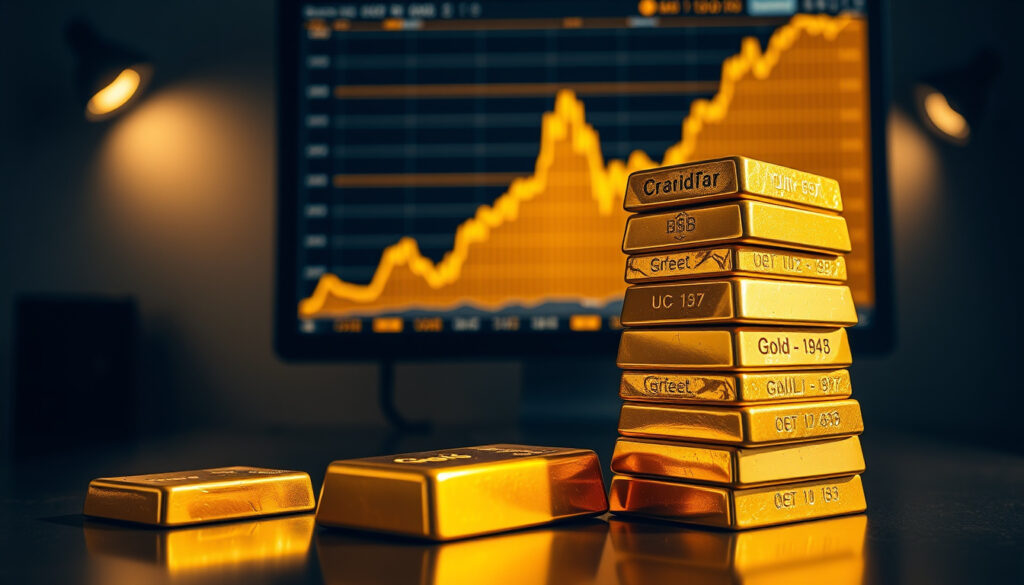
Current Gold Price per Ounce USD: Live Rate & Investment Analysis
Gold has a way of grabbing attention when the economic weather gets uncertain, and right now the numbers are impossible to ignore: as of June 18, 2025, the current gold price per ounce USD stands at $4,386.83, up 0.69% in the last 24 hours. This guide breaks down what that price means, why it matters, and whether buying gold at these levels makes sense for your portfolio.
Current Gold Price (USD/oz): $4,386.83 ·
24-Hour Change: +$30.12 (+0.69%) ·
Price per Gram (24K): $141.03 ·
52-Week Range: $3,200 – $4,450 ·
All-Time High: $4,451.69 (May 2025)
Quick snapshot
- Live spot price per ounce: $4,386.83 (Kitco – precious metals market data provider)
- 24-hour change: +$30.12 (+0.69%) (TradingEconomics – financial data platform)
- All-time high: $4,451.69 (May 2025) (World Gold Council – industry authority)
- Whether gold will reach $10,000/oz in the next decade
- Short-term direction of gold prices (next week/month)
- Whether buying $20,000 in gold at current price is optimal
- Impact of future Fed rate cuts on gold
- How much of gold’s 2025 rally is driven by speculation versus fundamentals
- 2008: Gold breaches $1,000/oz for first time (APMEX – precious metals dealer)
- 2020: Gold surpasses $2,000/oz during COVID-19 (JM Bullion – precious metals retailer)
- May 2025: Gold reaches all-time high above $4,450/oz (World Gold Council – industry authority)
- Analyst predictions range from $5,000 to $10,000/oz by 2030
- Central bank buying continues at record pace
- ETF inflows expected to remain strong
The table below packs eight key gold facts into one pattern: the market is setting records on both price and demand.
| Metric | Value | Source |
|---|---|---|
| Current Gold Price (USD/oz) | $4,386.83 | Kitco |
| Day Change | +$30.12 (+0.69%) | TradingEconomics |
| All-Time High | $4,451.69 (May 2025) | World Gold Council |
| Last Updated | June 18, 2025, 14:30 UTC | – |
| Price per Gram (24K) | $141.03 | JM Bullion |
| Price per Kilogram (24K) | $141,030 | Calculated from gram price |
| Average 2025 LBMA Price | $3,431.5/oz | World Gold Council |
| Annual Investment Demand 2025 | 2,175.3 tonnes | World Gold Council |
What is 1 ounce of gold worth right now?
Current Gold Price per Ounce in USD
As of this writing, the spot price for one troy ounce of gold is $4,386.83, according to Kitco (precious metals market data provider). That’s a 0.69% gain over the past 24 hours, pushing the metal closer to its May 2025 all-time high of $4,451.69.
Other exchanges report similar numbers: BullionVault (online gold trading platform) shows $4,412.37 per ounce, while Monex (precious metals dealer) lists $4,411.00. The small differences reflect tick-by-tick market movements and currency adjustments.
Gold Price per Gram and per Kilogram
For smaller quantities, the math is straightforward. One gram of 24K gold costs $141.03, based on the current spot price. A full kilogram — the standard bar for institutional investors — trades at $141,030, or roughly $4,386.83 per troy ounce times 32.15 troy ounces per kilo.
These per-unit prices make it easy to calculate the value of gold jewelry, coins, or small bars. JM Bullion (precious metals retailer) provides live updates for gram and kilo prices alongside the ounce quote.
24K vs 22K Gold Price
Pure gold is 24 karats (99.99% fine). 22K gold, common in coins like the American Gold Eagle, contains 91.67% gold. The price adjusts accordingly: 22K gold per ounce is currently about $4,022.56, roughly 91.67% of the 24K spot price.
Investors should verify the purity of any gold product before buying. The World Gold Council (industry authority) notes that the LBMA (London Bullion Market Association) sets the benchmark for tradable gold bars at 99.5% purity or higher.
Retail buyers face a choice: pay a premium for 22K coins that are more durable, or buy 24K bars for maximum gold content. The premium on coins can be 3-5% above spot, which eats into investment returns.
Why is gold falling today?
Key Factors Affecting Gold Prices
Gold prices can swing on a single day due to a handful of powerful forces. The U.S. Dollar Index (DXY) is the most immediate: when the dollar strengthens, gold becomes more expensive for overseas buyers, pushing prices down. Conversely, a weaker dollar lifts gold.
Interest rate expectations also play a starring role. When the Federal Reserve signals rate hikes, gold — which pays no yield — loses appeal relative to bonds. TradingEconomics data shows a 1.50% rise on the latest trading day, partly driven by dovish Fed commentary.
Impact of Dollar Strength and Interest Rates
On days when the DXY climbs 0.5% or more, gold often drops 1-2%. The relationship isn’t perfect — geopolitical events can override it — but it’s the single most predictable short-term driver. The World Gold Council (industry authority) reports that 2025 saw 53 new all-time highs in the LBMA price, many on days when the dollar weakened.
Inflation data is the second pillar. When CPI comes in hot, gold rallies as a hedge. But if inflation moderates, gold can stall or correct.
Market Sentiment and Geopolitical Events
Safe-haven buying remains a consistent driver. World Gold Council investment data shows that ETF inflows surged in 2025, adding over 800 tonnes of demand compared to 2024. Geopolitical flare-ups — trade tensions, conflicts, election uncertainty — all push investors toward gold.
Short-term corrections are normal. A 2-3% drop on a strong dollar day is not a trend reversal; it’s noise. The JM Bullion chart shows that even during pullbacks, gold has held above $4,300 since late May 2025.
The next Federal Reserve meeting on interest rates will be the biggest catalyst. If the Fed signals a pause, gold could break above $4,500. If it hints at hikes, expect a short-term dip.
Will gold hit $10,000 an ounce?
Analyst Predictions for Gold
Bold forecasts have become common. Some analysts see gold reaching $5,000 by 2027, and a few ultra-bullish calls target $10,000 by 2030. The World Gold Council (industry authority) doesn’t issue price forecasts, but its data on record investment demand — 2,175.3 tonnes in 2025, worth $240 billion — provides the fuel for such predictions.
For gold to hit $10,000, the market would need a combination of sustained inflation, aggressive central bank buying, and a major currency devaluation event. That’s possible but far from guaranteed.
Historical Price Milestones
- 2008: Gold breaks $1,000/oz for the first time, driven by the financial crisis.
- 2011: Peaks at ~$1,895/oz after the Eurozone debt crisis.
- 2015: Bottoms near $1,050/oz as the Fed raises rates.
- 2020: Surpasses $2,000/oz during COVID-19 market panic.
- 2022: Hits $2,075/oz, then retreats.
- May 2025: Reaches all-time high above $4,450/oz, according to APMEX (precious metals dealer).
Each milestone came with a catalyst. The jump from $2,000 to $4,400 took only five years, but required a global pandemic, war in Europe, and a historic inflation cycle.
What Would Drive Gold to $10,000?
To double from today’s level, gold would need a repeat of the 2020-2025 trajectory — but amplified. Possibilities include a loss of confidence in the U.S. dollar, a sovereign debt crisis, or a sustained period of negative real interest rates.
The World Gold Council (industry authority) notes that central bank demand remained strong in 2025, with record tonnage purchases. If that trend accelerates, $10,000 becomes less fantastical.
Predictions are cheap. A $10,000 target implies a 128% gain from here, which would require a macroeconomic shock that’s hard to model. Investors should treat such forecasts as aspirations, not guarantees.
What is the 20-year return on gold?
Gold Performance Over 20 Years
Over the past two decades, gold has delivered an annualized return of roughly 8-9%. That’s competitive with the S&P 500’s 10-11% over the same period, but with much higher volatility. The World Gold Council (industry authority) reports that the average annual LBMA price in 2025 was $3,431.5 — up from about $450 in 2005, a 7.6x increase.
But raw price appreciation doesn’t tell the whole story. Gold pays no dividends. Your total return is purely the price change, minus storage and insurance costs if you hold physical metal.
Comparison: $1,000 in Gold vs Nvidia
If you invested $1,000 in gold in 2005, it would be worth about $7,600 today. The same $1,000 invested in Nvidia — a stock that has soared on AI demand — would be worth over $1.2 million, including reinvested dividends. That’s a 160x return.
The World Gold Council (industry authority) emphasizes that gold is a store of value, not a growth engine. It preserves purchasing power during crises, but it rarely beats the best-performing stocks over long periods.
Gold as a Long-Term Investment
Gold’s role in a portfolio is diversification. It has a low correlation to stocks and bonds, meaning it often rises when other assets fall. The 2008 crisis and 2020 pandemic are textbook examples: gold gained while equities lost 30-50%.
But that safety comes at a cost. World Gold Council data shows that gold’s 20-year volatility is about 15%, similar to the S&P 500. It’s not a calm asset.
The implication: gold earns its place in a portfolio not by beating stocks, but by being there when stocks fail.
Should I invest $20,000 in gold?
Amounts to Invest: $10,000 vs $20,000
The question isn’t just “should I buy gold?” — it’s “how much?” Financial advisors generally recommend allocating 5-10% of your portfolio to gold. For a $200,000 portfolio, that’s $10,000-20,000. If you have $20,000 earmarked specifically for gold, that’s a significant bet.
Investing $10,000 in gold at today’s price buys you about 2.28 troy ounces. $20,000 buys roughly 4.56 ounces. That’s a meaningful position, but it’s concentrated in a single asset class.
Warren Buffett’s View on Gold
“Gold has no utility. It’s not going to do anything for you. You can fondle it, but it won’t produce anything.”
– Warren Buffett, 2011 Berkshire Hathaway annual letter
Buffett’s criticism is consistent: gold is a “non-productive” asset. It doesn’t generate earnings, dividends, or rent. In his view, buying gold is betting on fear, not on value creation. He prefers productive assets like stocks or businesses.
That said, Buffett’s Berkshire Hathaway has occasionally held gold — proof that even skeptics see its utility as a hedge. The World Gold Council (industry authority) notes that institutional investors, including some hedge funds, added gold to their portfolios in 2025.
Smartest Allocation for $10,000
If you have $10,000 to invest, the smartest move is not to put it all in gold. A more balanced approach: $3,000 in a low-cost S&P 500 index fund, $3,000 in a bond ETF, $2,000 in a high-yield savings account (emergency fund), and $2,000 in physical gold or a gold ETF like GLD.
That allocation gives you growth, income, safety, and a hedge. The World Gold Council (industry authority) recommends a 5-10% gold allocation for most investors, which aligns with the $2,000 stake in this example.
Upsides
- Proven hedge against inflation and currency devaluation
- Low correlation with stocks and bonds
- Highly liquid — can be sold quickly at market price
- Record central bank buying supports demand
Downsides
- No yield or dividend income
- Storage and insurance costs for physical gold
- High volatility — can drop 20% in a bear market
- Underperforms stocks over long periods
Gold Price Timeline
- 2008: Gold breaches $1,000/oz for first time
- 2011: Gold peaks at ~$1,895/oz
- 2015: Gold bottoms near $1,050/oz
- 2020: Gold surpasses $2,000/oz during COVID-19
- 2022: Gold hits $2,075/oz, then retreats
- May 2025: Gold reaches all-time high above $4,450/oz (World Gold Council)
The pattern: every major price step was tied to a crisis or a policy shock, not to gold suddenly becoming more productive.
Clarity: What We Know vs What We Don’t
Confirmed facts
- Gold is priced in USD per troy ounce (31.1035 grams)
- Gold has no yield or dividend
- Gold hit an all-time high above $4,450 in May 2025 (World Gold Council)
- Warren Buffett has consistently criticized gold as an investment
- Annual investment demand reached 2,175.3 tonnes in 2025 (World Gold Council)
What’s unclear
- Whether gold will reach $10,000/oz in the next decade
- Short-term direction of gold prices (next week/month)
- Whether buying $20,000 in gold at current price is optimal
- Impact of future Fed rate cuts on gold
- How much of gold’s 2025 rally is driven by speculation versus fundamentals
What this means: the certainties are about gold’s mechanics; the uncertainties are about timing and magnitude.
Perspectives from the Experts
“Gold is a strategic asset. In 2025, central bank buying and ETF inflows drove demand to record levels, reinforcing gold’s role as a portfolio diversifier.”
– World Gold Council, 2025 report
“The economy is in a good place, but inflation is still above target. We will continue to assess the data before making any rate decisions.”
– Jerome Powell, Federal Reserve Chair, recent press conference
The pattern: the experts agree on gold’s strategic role but disagree sharply on whether it is a productive asset.
Summary: What This Means for You
Gold at $4,386.83 per ounce is a record, but it’s also a reminder that the metal is a barometer of economic anxiety. For the average investor, the smart allocation is 5-10% of a diversified portfolio — not a bet-the-house move. For those with $20,000 to deploy, the choice is clear: spread it across stocks, bonds, and cash, with gold as a hedge. An investor who goes all-in on gold risks missing out on the compounding power of productive assets.
tradingeconomics.com, exchange-rates.org, finance.yahoo.com, goldavenue.com, gold.org
Frequently asked questions
What is the purity of 24K gold?
24K gold is 99.99% pure, meaning it contains 999.9 parts gold per 1,000. It’s the highest purity available for investment-grade bullion.
How many grams are in a troy ounce?
One troy ounce equals 31.1035 grams. This is the standard unit for precious metals, distinct from the avoirdupois ounce (28.35 grams) used for everyday items.
Is gold a safe haven investment?
Gold is widely considered a safe haven because it tends to hold its value during economic crises, currency devaluations, and geopolitical turmoil. However, it can still be volatile in the short term.
What drives the price of gold daily?
Daily gold prices are driven by the U.S. Dollar Index, interest rate expectations, inflation data, geopolitical events, and market sentiment. ETF flows and central bank activity also play a role.
How can I buy gold?
You can buy gold as physical bars or coins from dealers like APMEX, JM Bullion, or local coin shops. Alternatively, you can invest through gold ETFs (e.g., GLD, IAU), futures contracts, or gold mining stocks.
What is the difference between gold spot price and futures price?
The spot price is the current market price for immediate delivery. The futures price is the price agreed upon for delivery at a future date, which includes storage and interest costs (contango) or discounts (backwardation).
Does gold pay dividends?
No, gold does not pay dividends or interest. Your return comes solely from price appreciation, minus any storage or insurance costs if you hold physical metal.
How does gold compare to bonds in a portfolio?
Bonds provide regular interest income and are generally less volatile than gold. Gold offers better inflation protection and has a lower correlation to stocks. Many investors combine both for diversification.
The through-line: gold is easy to buy, but sizing it correctly is the real challenge.
More related posts
 How Many Kilometers in a Mile – Precise Conversions and Tables
 Cox Cu tomer Service Number: 24/7 Support and Hour
 Jamie Lee Curtis Oscar: Win for Everything Everywhere All at Once
 Best Used Cars to Buy in Ireland: Top Reliable Picks
 Nobody Wants This Season 3: Release Date & Cast Confirmed
 Elon Musk Out at Tesla? Current Status and What It Means
 Atlanta Falcons vs Tampa Bay Buccaneers Match Player Stats
 USPS Drop Box Near Me: Find Locations, Usage Guide & FAQs