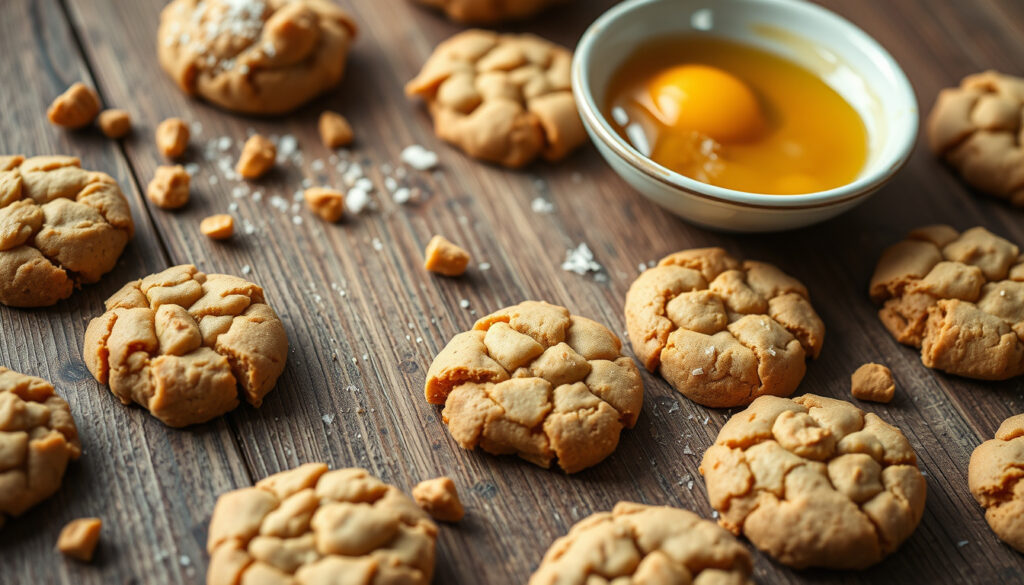
3 Ingredient Peanut Butter Cookies: Easy Recipe & Troubleshooting
You know the feeling: you want cookies, but you don’t want to pull out a dozen ingredients and spend an hour cleaning up. That’s exactly where 3-ingredient peanut butter cookies come in. With just peanut butter, sugar, and an egg (or sometimes flour), you can have warm, chewy cookies in under 20 minutes. But that simple ratio holds a secret: the balance of fat and sugar decides whether your batch turns out soft and chewy or dry and crumbly — and that’s what this guide unpacks.
Number of Ingredients: 3 ·
Baking Temperature: 350°F (175°C) ·
Gluten-Free Option: Yes (with certified ingredients) ·
Sugar Ratio Variation: 1 cup or ¾ cup per 1 cup peanut butter
Quick snapshot
- Three ingredients: peanut butter, sugar, egg (The First Year Blog (recipe resource))
- Baking at 350°F is standard (Savvy Saving Couple (budget recipe site))
- Cookies are gluten-free with certified ingredients (The First Year Blog (recipe resource))
- Exact sugar ratio (some use 1 cup, some ¾ cup) changes texture (The Buttery Fairytale (home baking site))
- Whether natural peanut butter works as well as commercial (The Buttery Fairytale (home baking site))
- Exact baking time depends on cookie size (The First Year Blog)
- Prep: 10 minutes (Savvy Saving Couple)
- Bake at 350°F for 10–12 minutes (Savvy Saving Couple)
- Cool on sheet for 5 minutes before moving (Savvy Saving Couple)
- Try variations: add 1 tbsp cocoa powder, swap egg for banana, use sugar substitute
- Experiment with ratios for chewier vs. crisper results
Six key data points you need to know before starting: the base ingredients, the most common ratio, temperature, yield, and timings.
| Label | Value |
|---|---|
| Base Ingredients | Peanut butter, sugar, egg |
| Common Ratio | 1 cup peanut butter : 1 cup sugar : 1 egg |
| Baking Temperature | 350°F (175°C) |
| Yield | 12–18 cookies (varies) |
| Preparation Time | 10 minutes |
| Baking Time | 10–12 minutes |
What do I need for 3 ingredient peanut butter cookies?
The classic lineup is deceptively short, but each ingredient plays a non-negotiable role.
Peanut butter: smooth or crunchy?
- Smooth, commercial peanut butter gives the most consistent results. Momcrieff (family recipe blog) recommends regular over all-natural because stabilizers help the cookie hold shape.
- Crunchy peanut butter works but may create pockets of air that lead to cracking.
Sugar: granulated white or brown?
- Granulated white sugar is standard; brown sugar adds moisture and a deeper flavor but may shift texture toward chewier. The Buttery Fairytale (home baking site) uses ¾ cup white sugar per 1 cup peanut butter for a less sweet, denser cookie.
- Some recipes call for 1 cup; the difference is dramatic — more sugar = more spread and crispiness.
Egg: the binding agent
- One large egg binds the fat (peanut butter) and sugar into a cohesive dough. Savvy Saving Couple (budget recipe site) calls the egg “the essential glue” for the classic formula.
- No-egg versions replace the egg with ¼ cup flour plus a splash of water, as seen in Yishi Foods (plant-based pantry brand).
Skipping the egg changes everything — you lose moisture and binding. If you go no-egg, be ready to add flour or water to prevent crumbling.
The trade-off: With an egg you get a richer, chewier cookie. Without it, you get a denser, more fragile cookie that leans crumbly unless you adjust the ratio carefully.
How to make easy simple peanut butter cookies?
Mix the three ingredients
Place 1 cup peanut butter, 1 cup granulated sugar, and 1 large egg in a bowl. Allrecipes (trusted recipe database) directs: “Mix peanut butter, sugar, and egg together in a bowl using an electric mixer until smooth and creamy.” The Kitchn (lifestyle resource) uses a spatula and says go until “well-combined.”
Form the dough into balls
- Scoop tablespoon-sized portions and roll into balls. If the dough feels too sticky, chill for 15 minutes (Yishi Foods). If too crumbly, add a splash of water or more peanut butter.
Press with a fork
Place balls on a parchment-lined baking sheet about 2 inches apart. Flatten each with a fork in a crisscross pattern — this helps even baking and gives the classic look.
Bake until golden
- Bake at 350°F for 10–12 minutes. The First Year Blog (recipe resource) notes the cookies look underdone when you pull them out — that’s fine. Let them cool on the baking sheet for 5 minutes before transferring.
The carryover heat on the sheet finishes baking the centers. Moving them too early leaves you with cookies that fall apart.
The pattern: The egg-based formula produces soft, chewy interiors. The no-egg flour-added formula (1 cup peanut butter, ¾ cup sugar, ¼ cup flour, splash of water) yields a fudgier, denser crumb — closer to a shortbread texture.
Why are my 3 ingredient peanut butter cookies falling apart?
Too much sugar
Excess sugar spreads the dough thin; when it cools, it cracks. Stick to 1 cup or less per 1 cup peanut butter.
Not enough egg
The egg is the primary binder. Without it (The Buttery Fairytale (home baking site) adds flour instead) or with a smaller egg, the dough lacks cohesion.
Overbaking
Every minute past 12 minutes at 350°F dries out the cookie. The internal moisture evaporates, leaving a brittle structure.
Using natural peanut butter
Natural peanut butter separates and contains no preservatives or stabilizers. Momcrieff (family recipe blog) warns: “Regular commercial peanut butter is best — natural brands cause the cookies to spread too much and fall apart.”
If your dough is crumbly before baking, add 1–2 tablespoons of water or milk and mix again. If crumbly after baking, next time reduce sugar by 2 tablespoons and add 1 tablespoon of peanut butter.
The implication: Crumbly cookies are almost always a ratio problem. Measure precisely — the margin for error in three-ingredient baking is thin.
What makes cookies chewy instead of crispy?
Sugar type and ratio
- More sugar (1 cup per cup of peanut butter) promotes spread and a crisper edge because sugar liquefies in the oven. Less sugar (¾ cup) leaves more fat and egg relative to sweetener, creating a denser, chewier center. The Buttery Fairytale (home baking site) uses ¾ cup and calls the texture “soft, crumbly, fudgy with a slight crisp.”
- Brown sugar (with its molasses) retains more moisture than white — swap half the white sugar for brown for a chewier result.
Peanut butter fat content
Higher fat peanut butter (i.e., not reduced-fat) contributes to a tender, chewy crumb. Fat coats flour proteins (if any) and limits gluten formation, keeping cookies soft. The egg-based formula with full-fat peanut butter consistently produces the chewiest outcome.
Baking time
Removing the cookies at 10 minutes yields a very soft, chewy interior. Pushing to 12 minutes gives a firmer, more cake-like crumb. Beyond 12 minutes, the edges begin to crisp and the interior dries out.
If you want chewy: use ¾ cup white sugar (or half brown), pull the tray at 10 minutes, and let them rest on the sheet a full 5 minutes. For crispy: use 1 cup white sugar, bake 12 minutes, and cool on a rack immediately.
Why this matters: The ratio of sugar to peanut butter isn’t just about sweetness — it’s the primary lever for texture. Knowing how to move that lever means you can customize one simple recipe to two very different outcomes.
Are 3 ingredient peanut butter cookies actually good?
Texture and flavor
When made correctly — with the right ratio and commercial peanut butter — these cookies deliver rich peanut butter flavor and a soft, satisfying chew. The First Year Blog (recipe resource) describes them as “soft and chewy, with deep peanut butter taste.” The Kitchn (lifestyle resource) praises their simplicity: “It’s hard to believe something this easy tastes this good.”
Comparison to traditional recipes
Standard peanut butter cookie recipes add vanilla, baking soda, and sometimes butter. Those extras add complexity but not necessarily superiority. The 3-ingredient version stands out for speed and minimal cleanup. The trade-off is less airy texture — you get a denser, almost fudge-like cookie when egg-based.
Popularity and reviews
Allrecipes (trusted recipe database) lists the recipe as one of its most-visited, with thousands of user ratings averaging 4.5 out of 5 stars. Commenters consistently note how quickly the cookies disappear.
Three-ingredient peanut butter cookies are genuinely good — not just “good for only three ingredients.” They solve a real need: a fast, reliable dessert with a short ingredient list that even novice bakers can master.
The trade-off: If you crave a light, cakey cookie, this isn’t it. But if you want a dense, intensely peanut-buttery treat in under 25 minutes, this recipe is hard to beat.
Upsides
- Only three ingredients needed
- Ready in under 25 minutes
- Naturally gluten-free with certified peanut butter
- Easy to customize (add cocoa, swap sugars, no-egg option)
- High success rate with proper ratio
Downsides
- Crumbly if ratio is off
- Natural peanut butter causes spreading/cracking
- No-egg versions require extra flour or water
- Less airy than traditional butter-based cookies
- Baking time window is narrow (10–12 minutes)
“Mix peanut butter, sugar, and egg together in a bowl using an electric mixer until smooth and creamy.”
“Place 1 cup smooth peanut butter, ¾ cup granulated sugar, and 1 large egg in a large bowl. Mix with a flexible spatula until well-combined.”
For a baker staring down a 6 p.m. cookie craving, the difference between a batch that holds together and one that crumbles is literally two tablespoons of sugar or five minutes of oven time. Mastering that margin is all it takes to turn a pantry shortfall into a reliable dessert standby.
Frequently asked questions
What are the best 3 ingredient peanut butter cookies?
The classic egg-based formula (1 cup peanut butter, 1 cup sugar, 1 egg) is the most popular and produces soft, chewy cookies. For a no-egg option, use 1 cup peanut butter, ¾ cup sugar, and ¼ cup flour plus a splash of water.
How to make peanut butter cookies with only two ingredients?
A two-ingredient version uses 1 cup peanut butter and 1 cup sugar (no egg). The cookies are very crumbly and fragile — expect a shortbread-like texture.
What are the 3 ingredient no peanut butter cookies?
If you omit peanut butter, you’re making a different cookie. “No peanut butter” three-ingredient cookies use butter, sugar, and flour, but that’s a separate recipe.
Can I make 3 ingredient peanut butter cookies without egg?
Yes. Replace the egg with ¼ cup all-purpose flour (or a splash of water) to bind the dough. The texture becomes denser and more fudge-like.
Can I use crunchy peanut butter?
Yes — crunch works, but the cookie may have more air pockets and can crack more easily. Smooth peanut butter gives the most consistent results.
How long do 3 ingredient peanut butter cookies last?
Store in an airtight container at room temperature for up to 5 days. For longer storage, freeze baked cookies for up to 3 months.
Can I add cocoa powder to 3 ingredient peanut butter cookies?
Yes. Add 1 tablespoon unsweetened cocoa powder to the dry ingredients. You may need to add 1 extra tablespoon of peanut butter to maintain the right moisture balance.
For a home baker looking for a quick, reliable cookie, the choice is clear: stick with the egg-based ratio (1:1:1) for chewy success, or go flour-and-water for a denser, no-egg alternative. Both deliver deep peanut butter flavor — just pick your texture.
If you enjoyed this guide, you might also like our Best Sugar Cookie Recipe: No-Chill Cut-Out Guide and How Many Grams in a Tablespoon – Complete US UK Guide.
More related posts
 USMNT v Mexico Lineup : 2025 Gold Cup Final Re ult & Hi tory
 We Will Rock You: Queen Anthem History
 Chiari Malformation Type 1: Causes, Symptoms, and Prognosis
 How Many Days Till Christmas 2025? The Real Countdown Explained
 Cast of The Thursday Murder Club (Film): Full List & Roles
 Why Was Nikki Killed Off Alert: Missing Persons Unit? Season 4
 Boasberg Reverses Restitution Order for Jan. 6 Defendants
 How to Copy and Paste: Keyboard Shortcuts and Mobile Gestures