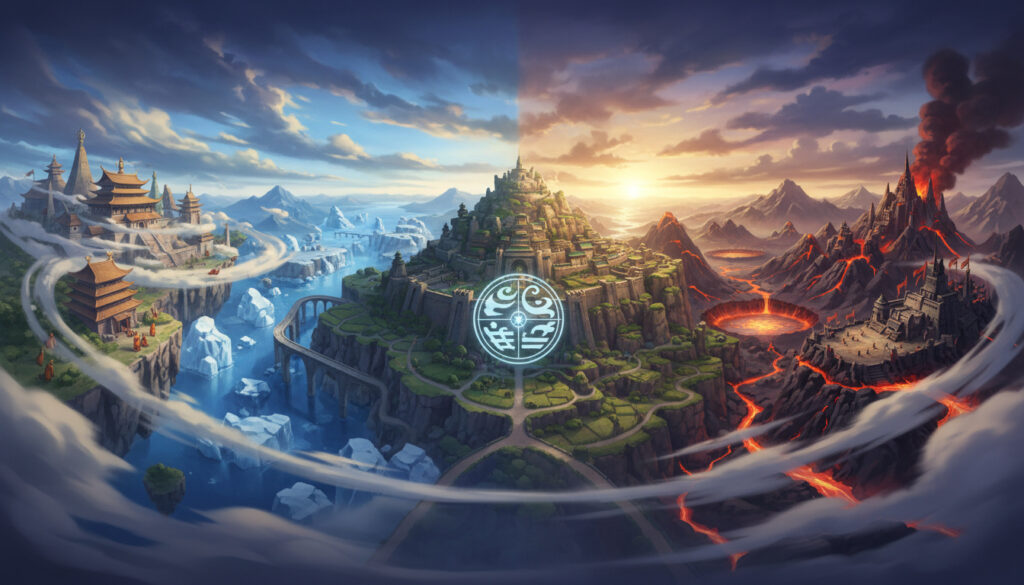
Avatar The Last Airbender – Guide to Elements and Nations
The Enduring Legacy of Avatar: The Last Airbender
More than fifteen years after its finale, Avatar: The Last Airbender continues to dominate cultural conversations, drawing millions of viewers to streaming platforms and inspiring new generations through its intricate world-building and mature storytelling. The animated series, which originally aired on Nickelodeon between 2005 and 2008, transcended its Saturday morning cartoon origins to become a touchstone for serialized television.
Unlike typical children’s programming of its era, the series tackled complex themes including genocide, colonialism, and spiritual redemption while maintaining accessibility for younger audiences. This delicate balance catapulted the show into rarefied air, where it currently enjoys a 100% critical rating on Rotten Tomatoes across all three seasons.
By the Numbers
The series comprises 61 episodes divided into three “Books,” each corresponding to the elements Aang must master. The production spanned four years, utilizing a blend of traditional anime influences and Western animation techniques that creators Michael Dante DiMartino and Bryan Konietzko developed specifically for the project.
- Total Episodes: 61 across three seasons
- Original Run: February 2005 – July 2008
- Streaming Performance: 39 consecutive days in Netflix’s Top 10 upon 2020 release
- Creators: Michael Dante DiMartino and Bryan Konietzko
Why the Series Resonates
Central to the show’s longevity is its treatment of trauma and responsibility. Protagonist Aang carries the burden of being the last surviving Air Nomad while facing expectations that he defeat the Fire Lord and restore balance to a war-torn world. The narrative refuses simple solutions, instead presenting pacifist philosophy as strength rather than weakness.
The supporting ensemble—including Water Tribe siblings Katara and Sokka, earthbending prodigy Toph, and conflicted Fire Nation prince Zuko—receive individual arcs that rival the protagonist’s journey in complexity. Zuko’s redemption narrative, in particular, has become a masterclass in character development, frequently cited in IMDb user reviews as the standard against which animated antagonists are measured.
The Four Nations
| Nation | Element | Key Characteristics | Real-World Influences |
|---|---|---|---|
| Water Tribe | Water | Adaptability, healing, moon-based power | Inuit and Indigenous Arctic cultures |
| Earth Kingdom | Earth | Stability, endurance, subterranean cities | Imperial China and Korean dynasties |
| Fire Nation | Fire | Industry, ambition, solar power | Imperial Japan and Southeast Asia |
| Air Nomads | Air | Spirituality, detachment, pacifism | Tibetan Buddhism and Shaolin monks |
Production Philosophy
DiMartino and Konietzko conceived the series while brainstorming ideas for a new animated project, drawing inspiration from their shared interest in Asian mythology and martial arts cinema. They hired Sifu Kisu, a master of Northern Shaolin kung fu, to choreograph bending movements, ensuring that elemental manipulation reflected real fighting styles. Firebending derives from Northern Shaolin, waterbending from tai chi, earthbending from hung gar, and airbending from baguazhang.
This commitment to authenticity extended to the voice cast, which featured predominantly Asian and Indigenous American actors—a rarity for early 2000s animation. The creators maintained strict oversight of the series bible, ensuring cultural consultants reviewed scripts to avoid stereotyping while celebrating diverse traditions.
Chronological Milestones
- : Series premieres on Nickelodeon with “The Boy in the Iceberg”
- : Season Two concludes with “The Crossroads of Destiny,” introducing significant plot twists
- : Four-part series finale “Sozin’s Comet” airs to 5.6 million viewers
- : M. Night Shyamalan’s live-action film adaptation releases to critical failure
- : Original series arrives on Netflix, immediately trending globally
- : Nickelodeon launches Avatar Studios, expanding the franchise with new animated content
- : Netflix releases live-action series reboot
Clarifying the Adaptations
Confusion often arises regarding the relationship between the original animation and subsequent live-action attempts. The 2010 film adaptation deviated significantly from the source material, compressing twenty episodes into ninety minutes while altering pronunciation of character names and fundamental bending mechanics. This version holds a 5% rating on Rotten Tomatoes and is generally disregarded by the fan community.
The 2024 Netflix series represents a separate adaptation, developed with higher production values and extended episode counts allowing for deeper character exploration. While initial seasons cover the same narrative ground as the animated series, producers have indicated plans to expand beyond the original timeline if subsequent seasons are approved.
Cultural Impact and Critical Analysis
Academic discourse surrounding the series has increased significantly since its streaming availability introduced the show to demographics too young for its original broadcast. Gender studies scholars frequently analyze Katara’s role as both healer and warrior, while political scientists examine the Fire Nation’s industrialization as commentary on imperialism and resource wars.
The series also pioneered serialization in American children’s television. Unlike episodic cartoons where status quo resets weekly, Avatar maintained continuous storylines where actions carried permanent consequences. This narrative structure influenced subsequent animated dramas including Steven Universe and The Dragon Prince.
Creator Perspectives
“We wanted to create a fantasy world that wasn’t medieval European-based. Drawing from Asian cultures felt natural and allowed us to explore spiritual ideas that don’t always fit into Western fantasy traditions.”
— Bryan Konietzko, Co-Creator
“The show was always about balance—between humor and drama, action and character moments, ancient traditions and modern storytelling.”
— Michael Dante DiMartino, Co-Creator
Where to Watch
Currently, the complete animated series streams exclusively on Netflix, alongside the 2024 live-action adaptation and sequel series The Legend of Korra. For viewers seeking additional viewing options, our streaming guides provide comprehensive platform comparisons.
Physical media collectors can access the series through Blu-ray collections released by Paramount Home Entertainment, which include commentary tracks and behind-the-scenes documentaries unavailable on streaming platforms.
Summary
Avatar: The Last Airbender represents a watershed moment in animation history, proving that children’s programming can address sophisticated themes without sacrificing entertainment value. Its fusion of Eastern philosophy with Western narrative structures created a hybrid storytelling model that continues influencing media across genres. As Avatar Studios develops new animated films and series set within this universe, the original remains essential viewing—a three-season epic that balances spectacular action with genuine emotional resonance.
For additional analysis of groundbreaking animation, explore our animation reviews section.
Frequently Asked Questions
Is Avatar: The Last Airbender considered anime?
While the series draws heavily from Japanese anime aesthetics and storytelling techniques, it is technically classified as American animation. Produced by Nickelodeon Animation Studios in Burbank, California, with Korean studios handling overseas production, the series occupies a unique position as “anime-influenced” Western animation rather than true anime.
What order should I watch the Avatar franchise?
Viewers should begin with Avatar: The Last Airbender (three seasons), followed by the sequel series The Legend of Korra (four seasons). The live-action film adaptation is generally considered non-canon and optional. The 2024 Netflix live-action series serves as an alternate retelling rather than a continuation.
Will there be new animated content?
Yes. Following the launch of Avatar Studios in 2021, multiple theatrical animated films are in development, with the first scheduled for release in 2026. These projects will feature the original creators and expand the universe beyond the events of both The Last Airbender and The Legend of Korra.
Why did the original creators leave the 2024 Netflix series?
Bryan Konietzko and Michael Dante DiMartino initially joined the Netflix adaptation as showrunners but departed in 2020 citing creative differences. In a statement to Entertainment Weekly, they expressed concerns that the production would not honor the spirit of the original series, though they later endorsed the final product publicly.
More related posts
 What Was the Cold War? A Simple Explanation and Timeline
 How to Copy and Paste: Keyboard Shortcuts and Mobile Gestures
 NASA Confirms Asteroid 2025 PN7: Earth’s Two Moons Until 2083
 The Time Traveler’s Wife TV Series Canceled – Why
 Big Little Lies Cast: Complete Seasons 1, 2 & 3 List
 What Is a Compound? Chemistry & Real Estate Meanings
 Capitol Riot Restitution Unpaid: The Ongoing Financial Fallout