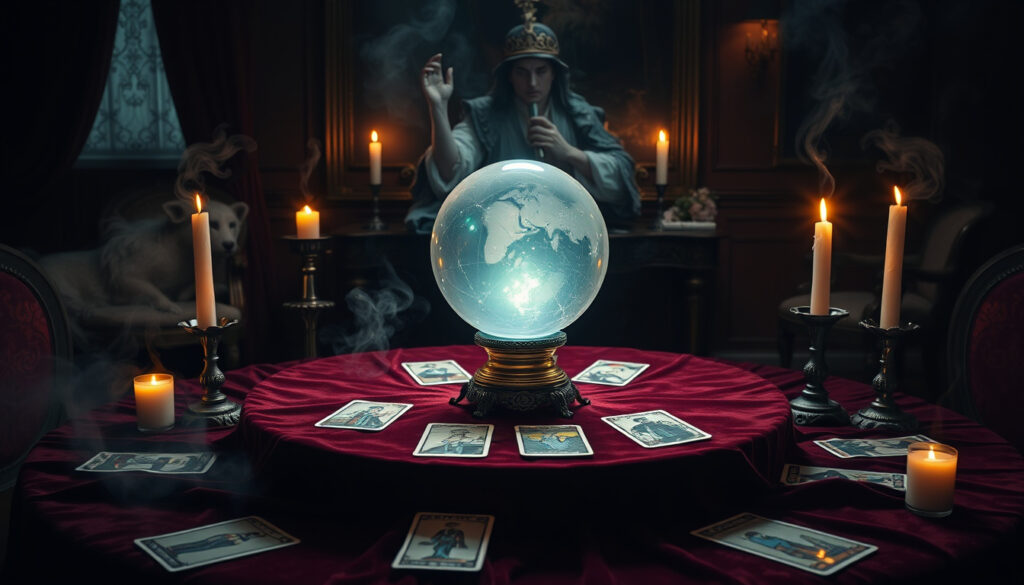
What Is a Medium – Definition, Types and Psychic Differences
A spiritual medium is a person who purportedly acts as a channel or intermediary between the physical world and spirits — including those of the deceased or spirit guides — often through trance states or intuitive perception. The practice, known as mediumship, has roots stretching back to the 19th century and continues to draw both devoted believers and firm skeptics in equal measure.
Mediumship involves receiving and relaying messages through images, sounds, sensations, emotions, or, in rarer cases, direct spirit control of the medium’s body. Whether treated as a sacred spiritual calling or dismissed as elaborate performance, the phenomenon occupies a distinct and enduring place in popular culture and personal belief systems worldwide.
From Victorian séance rooms to modern television programs, mediums have shaped conversations about death, consciousness, and the possibility of life beyond the physical. The questions surrounding what a medium actually is — and whether such abilities exist — remain as contested today as they were over a century ago.
What Is a Medium?
A person who claims to act as a channel between living people and spirits, including the deceased or spirit guides.
Purportedly channeling messages from the dead or spiritual entities, often through trance or heightened intuitive states.
Private readings, group séances, automatic writing, and channeling sessions with clients known as “sitters.”
No scientific consensus supports mediumship; it is broadly classified as pseudoscience, though personal experiences are cited by proponents.
- Mediumship is distinct from general psychic ability — it specifically involves contact with spirits or discarnate entities, not just intuitive perception about living people.
- Two primary categories exist: mental mediumship, which is the more common form, and physical mediumship, in which spirits allegedly produce tangible effects.
- The Fox Sisters of 1848 are widely credited with sparking the modern Spiritualism movement, though they later confessed to producing hoax rappings.
- Cold reading — using vague, broadly applicable statements to elicit confirmation — is the most commonly cited skeptical explanation for apparent medium accuracy.
- Trance states vary in depth, from light blending of awareness to full spirit control in deep trance, where the medium’s own consciousness reportedly steps aside.
- Modern channeling is considered an evolution of traditional mediumship, involving communication with higher selves or non-physical entities rather than deceased individuals.
- Sessions typically aim for emotional comfort, closure, or spiritual guidance for the sitter, regardless of broader questions about verifiability.
| Aspect | Details |
|---|---|
| Origin | Linked to 19th-century Spiritualism; popularized by the Fox Sisters in 1848 New York |
| Primary Skill | Purported spirit communication via trance, intuition, or extrasensory perception |
| Medium vs. Psychic | Mediums contact spirits of the deceased; psychics sense living people, future events, or energies |
| Evidence Base | Anecdotal and personal; scientifically unproven in controlled testing |
| Main Types | Mental mediumship and physical mediumship, with trance as a subcategory |
| Skeptical Explanation | Cold reading, fraud, confirmation bias, and suggestion |
| Cultural Reach | Active globally; revived by television programs from the 2000s onward |
| Legal Status | Varies by country; some jurisdictions require disclaimers for entertainment purposes |
Psychic vs. Medium: What Actually Sets Them Apart?
The terms “psychic” and “medium” are frequently used interchangeably, but they describe meaningfully different claimed abilities. Both involve extrasensory perception, yet their focus, methods, and scope diverge in important ways.
According to Omega Institute, psychics access information about living people, future events, or surrounding energies through intuition, without necessarily contacting spirits. A medium, by contrast, specifically connects with discarnate spirits from other dimensions.
How Their Abilities Break Down
Danielle MacKinnon’s resource on medium types explains that not all psychics are mediums, though all mediums are considered psychic. A clairvoyant medium, for example, is a further subset who primarily receives visual impressions from spirits.
The distinction also lies in depth of engagement. Mediumship often involves entering altered states — from mild concentration to deep trance — to access what practitioners describe as higher spiritual frequencies. General psychic work tends to stay at the mental or intuitive level without this degree of trance involvement.
| Aspect | Psychic | Medium |
|---|---|---|
| Primary Focus | Living people, future events, energies | Spirits of the deceased, spirit guides |
| Methods | Intuition, tarot, energy reading | Trance, clairvoyance, clairaudience, clairsentience |
| Depth of Practice | Mental and intuitive only | Often involves spirit control or trance states |
| Spiritual Contact | Not required | Central to the practice |
Common Misconceptions About the Two Roles
Many people assume that visiting a psychic means receiving messages from deceased relatives. In practice, a psychic may focus solely on present energies or future possibilities without any spirit contact. Expecting mediumship from a psychic reading — or vice versa — can lead to misaligned expectations.
The label “spiritual medium” specifically emphasizes the sacred dimension of the work, distinguishing practitioners who approach the role as a calling or ministry from those who operate in purely entertainment contexts. The term “psychic medium” is a combined label acknowledging that the practitioner operates in both domains.
The phrase “spiritual medium” highlights the sacred intent behind the practice, while “psychic medium” signals that the practitioner combines broader intuitive skills with spirit communication. The two terms are related but carry different emphases depending on context.
How Do Mediums Work?
The mechanics of a mediumship session, as described by practitioners and documented across spiritual traditions, follow a broadly consistent pattern. The medium enters a state of concentrated focus or trance, opens their awareness to what they describe as spiritual frequencies, and then interprets incoming impressions for the sitter.
The Communication Process
Gaia’s overview of spiritual mediumship describes the incoming information as arriving through multiple channels: images, sounds, physical sensations, or emotional impressions. Each of these corresponds to a recognized “clair” ability — clairvoyance for vision, clairaudience for hearing, and clairsentience for felt sensations or emotions.
In mental mediumship, the medium remains largely conscious, filtering and interpreting these impressions before relaying them. In deep trance mediumship, the practitioner’s own consciousness reportedly recedes entirely, allowing a spirit to communicate directly through their voice or body. The College of Psychic Studies describes this deepening spectrum as moving from partial spirit blending in light trance to full spirit control in the deepest states.
Physical mediumship operates differently again — here, spirits are said to manipulate surrounding energy to produce audible or visible phenomena, such as unexplained rapping sounds, disembodied voices, or the appearance of objects known as apports. This form is considered rarer and has historically attracted the most intense scientific scrutiny.
What Happens During a Reading or Session
A typical session involves a sitter — the client — sitting with the medium, either in person or remotely. The medium tunes in, receives impressions, and shares what they perceive with the sitter, who may confirm or deny the relevance of details provided.
The Centre of Excellence notes that while tools such as tarot cards or crystals may feature in some sessions, the core of mediumship relies on intuition and extrasensory perception rather than any physical instrument. Such tools are regarded as aids to focus rather than the source of information itself.
Sessions are generally oriented toward comfort, healing, or closure. The stated aim is to offer the sitter reassurance about a deceased loved one, evidence of continued existence beyond physical death, or guidance from a spirit guide. Whether that aim is achieved in any verifiable sense is a question that divides practitioners from skeptics sharply.
Practitioners commonly advise sitters to approach sessions with an open but discerning mindset — holding specific questions about a deceased person in mind while remaining receptive to unexpected impressions. Emotional preparedness is also frequently recommended, given the nature of content that may arise.
Are Mediums Real? Scientific Skepticism and Claimed Evidence
No scientific consensus supports the existence of mediumship as a genuine phenomenon. Wikipedia’s entry on mediumship summarizes the mainstream academic position clearly: controlled tests have not produced verifiable evidence of spirit communication, and the practice is broadly classified as pseudoscience.
What Skeptics Argue
The most frequently cited skeptical mechanism is cold reading — a technique in which a practitioner makes high-probability, vague statements and uses the subject’s reactions, body language, and verbal responses to narrow down increasingly specific-sounding claims. Critics argue this process creates the illusion of supernatural knowledge without requiring any genuine psychic ability.
Fraud has also been documented historically. In the 1920s, physical medium Mina Crandon was investigated by Scientific American, which found no verifiable evidence of genuine phenomena. The Fox Sisters — celebrated founders of the modern Spiritualism movement — confessed in 1888 to producing their famous spirit rappings through deliberate deception, though Margaret Fox later partially recanted that confession.
Ectoplasm, one of the more dramatic claimed phenomena of physical mediumship, was shown in multiple historical cases to be fabricated using materials such as cheesecloth. Hidden accomplices and stage-magic techniques accounted for other physical effects in documented exposés.
What Proponents Point To
Supporters of mediumship cite personal experiences, historical traditions spanning cultures worldwide, and the emotional relief that many sitters report following sessions. Proponents argue that the absence of scientific proof does not constitute disproof, particularly for experiences that are, by their nature, subjective. Supporters of mediumship cite personal experiences, historical traditions spanning cultures worldwide, and the emotional relief that many sitters report following sessions, and you can learn more about wat is een soft fork here. wat is een soft fork
Some practitioners and researchers have proposed that mediumship may involve forms of human perception not yet captured by existing scientific frameworks. These claims, however, remain without peer-reviewed empirical support.
Given the absence of scientific validation and the documented history of fraud within mediumship, individuals seeking sessions are advised to exercise caution — particularly when significant financial costs are involved. The emotional vulnerability of those grieving a loss can make them especially susceptible to misleading claims.
What Are the Different Types of Mediums?
Mediumship is not a single, uniform practice. It divides into distinct categories based on how contact with spirits is said to occur and what form the communication takes.
Mental, Physical, and Trance Mediumship Explained
Mental mediumship is the most widespread form. The medium remains conscious and aware, “tuning in” telepathically to spirits and translating impressions into language for the sitter. This category encompasses clairvoyance (seeing spirits or symbolic images), clairaudience (hearing voices or messages), clairsentience (feeling physical sensations or emotions associated with a spirit), and psychometry (reading impressions from physical objects).
Physical mediumship involves claimed tangible manifestations — rapping sounds, disembodied voices, the appearance of objects, or the production of ectoplasm. Unlike mental mediumship, these effects are said to be perceptible to everyone present in the room, not only the medium. This form is considerably rarer and has historically been the most scrutinized by investigators.
Trance mediumship exists along a spectrum. In lighter trance, the medium partially blends their awareness with a spirit’s presence. In deep trance — described in detail by the Britannica entry on occultism and mediumship — the medium’s own consciousness steps aside entirely, with a spirit reportedly assuming full control of speech and sometimes movement.
Other recognized forms include channeling (a modern evolution treating mediumship as communication with higher selves or non-human entities), séances (group sessions), ouija board use, and automatic writing, in which the medium allows a spirit to guide their hand without conscious control. These forms are catalogued extensively in historical and contemporary accounts of mediumship.
The intersection of spirit world mythology and popular culture is also visible in fictional portrayals — from television dramas to animated series exploring ideas about what lies beyond the physical. Concepts of intermediary figures navigating between worlds appear even in beloved pop culture contexts, such as the Avatar: The Last Airbender spirit world, where characters cross the boundary between living and spirit realms.
Key Moments in the History of Mediumship
The modern history of mediumship can be traced through a sequence of pivotal events, each shaping how the practice was understood and received by broader society.
- — Margaret and Kate Fox of Hydesville, New York, report unexplained rappings in their home and claim to communicate with a spirit through a knock-based code, effectively launching the modern Spiritualism movement.
- — Spiritualism expands rapidly across the United States and Europe; trance mediums, séance circles, and physical mediumship demonstrations attract mainstream attention and celebrity followers.
- — Margaret Fox publicly confesses to producing the famous rappings by cracking her toe joints; the confession rocks the Spiritualist community, though she later partially recanted the admission.
- — Physical medium Mina Crandon, known as “Margery,” undergoes testing by a Scientific American committee; investigators including Harry Houdini find no credible evidence of genuine phenomena.
- — Fraud exposés and the broader cultural shift following World War I contribute to a significant decline in mainstream Spiritualist organizations and séance culture.
- — Television programs featuring celebrity mediums spark a widespread public revival of interest in mediumship, bringing the practice to mass audiences in the United States and United Kingdom.
- — Online mediumship sessions and digital platforms extend the reach of practitioners globally; debate between believers and skeptics continues with no scientific resolution in sight.
What Is Established and What Remains Genuinely Uncertain
| What Is Established | What Remains Uncertain or Disputed |
|---|---|
| Mediumship has been practiced in various cultural forms for centuries and across many traditions worldwide. | Whether any mediumship ability reflects genuine contact with spirits or is entirely explicable through psychology and performance. |
| The Fox Sisters confessed in 1888 to fabricating spirit rappings, though Margaret later partially recanted. | The full extent and meaning of that recantation, and whether it invalidates or merely complicates their earlier claims. |
| Cold reading is a documented technique that can produce the appearance of specific psychic knowledge without supernatural ability. | Whether cold reading alone accounts for all reported medium accuracy, or whether other unexplained factors may be involved. |
| Controlled scientific tests of physical mediumship have not produced verified evidence of spirit communication. | Whether controlled testing conditions are adequate for evaluating subjective or consciousness-based phenomena. |
| Many sitters report meaningful emotional benefit from mediumship sessions, regardless of the question of literal truth. | Whether such benefit justifies the practice ethically, particularly for grieving individuals in vulnerable states. |
The Cultural and Psychological Weight of Mediumship
Mediumship resonates far beyond the boundaries of any single religion or belief system. Across cultures and centuries, the idea of communicating with the dead has addressed one of the most fundamental human anxieties: the finality of death and the fate of those we love. This universal dimension explains why mediumship has survived repeated exposés and sustained scientific skepticism.
Psychologically, the appeal of mediumship is closely linked to grief. The desire to receive one final message, confirmation of continued existence, or simple reassurance that a loved one is at peace is a profoundly human impulse. Research into bereavement consistently identifies meaning-making and continued bonds with the deceased as important elements of healthy mourning — a process that mediumship sessions may, for some, facilitate. Questions about grief, spiritual seeking, and emotional wellbeing also intersect in conversations about men’s mental health, where emotional expression around loss is often underexplored.
The ethical dimensions of mediumship are also significant. Practitioners who exploit vulnerable grieving clients — financially or emotionally — have drawn legitimate criticism from consumer protection advocates and mental health professionals alike. The line between spiritual service and exploitation remains an active area of concern, particularly as online mediumship removes geographic constraints and makes practitioners accessible to wider and potentially more vulnerable audiences.
What Sources and Experts Say About Mediumship
The following perspectives, drawn from the sources informing this overview, reflect the range of serious commentary on mediumship from both sympathetic and critical standpoints.
“A medium is someone who is able to communicate with souls on the other side of the veil — those who have passed on and those who exist in other planes of existence beyond our own.”
“Mediumship is pseudoscience. There is no scientific evidence that anyone can communicate with the dead, and the techniques used by professional mediums are well-documented methods of psychological manipulation.”
— Summarizing the mainstream skeptical position as documented in Wikipedia’s coverage of mediumship
“All mediums are psychic, but not all psychics are mediums — mediumship involves a specific and deeper kind of connection.”
— Paraphrasing the distinction outlined by Omega Institute’s explainer on what a medium is
What This All Comes Down To
A medium is, at its core, a person who claims to bridge the gap between the living and the dead — a role that has captured human imagination for centuries, peaked during the Spiritualism movement of the 19th century, faced significant fraud exposés, and revived again in contemporary culture. Whether mediumship reflects genuine contact with spirits or is better understood through psychology, performance, and the deep human need for connection across loss, it remains one of the more enduring and complex phenomena in the landscape of spiritual belief. Those approaching it — whether as believers, skeptics, or the curious — are best served by a clear understanding of both what practitioners claim and what the evidence, or lack thereof, actually shows.
Frequently Asked Questions About Mediums
How can someone tell if they might have mediumship ability?
Practitioners describe signs such as vivid or recurring dreams involving deceased people, strong intuitive impressions, sensing presences without visual explanation, or spontaneous receipt of information about others. These experiences are subjective and widely reported; no objective test exists to confirm or rule out mediumship ability.
Do mediums always communicate with deceased people specifically?
Not always. Some mediums claim to communicate with spirit guides, angels, or non-human entities rather than deceased individuals. Channeling, a related practice, often focuses on higher-dimensional beings or aspects of consciousness rather than the spirits of specific deceased people.
What is psychometry, and how does it relate to mediumship?
Psychometry is a claimed form of mental mediumship in which a practitioner holds a physical object — typically belonging to a deceased person — and receives impressions about that person or their life from the object. It is considered a subtype of mental mediumship rather than a separate category.
Were the Fox Sisters really the founders of Spiritualism?
Margaret and Kate Fox are widely credited with sparking the modern Spiritualism movement following their 1848 claims of spirit communication through rappings in Hydesville, New York. Their 1888 fraud confession complicated their legacy, though Margaret later partially recanted. Various spirit-contact traditions predate their role.
What is the difference between a séance and a one-on-one reading?
A séance is a group session in which participants sit together — typically in a circle — to collectively attempt spirit communication, often in low light. A one-on-one reading involves a single sitter meeting privately with a medium. Both aim for spirit contact, but differ significantly in format and social dynamics.
Is channeling the same as mediumship?
Channeling is considered a modern evolution of mental mediumship. While traditional mediumship focuses on deceased human spirits, channeling often involves contact with higher-dimensional beings, spirit collectives, or aspects of higher consciousness. The two practices overlap but are not identical in intent or claimed mechanism.
What is automatic writing in the context of mediumship?
Automatic writing is a practice in which a medium allows a spirit to guide their hand across paper without conscious direction. The resulting text is interpreted as spirit communication. It is categorized alongside séances and ouija as a physical or semi-physical expression of mediumship rather than purely mental.
More related posts
 Jean Paul Gaultier Le Male Elixir – Scent Notes, Longevity and Performance
 David Harbour Movies and TV Shows – Complete Filmography Guide
 What Is a Cold Sore? Causes, Symptoms, and Treatment
 Map of United States of America: Size, States, Cities Guide
 Social Security Payments Beneficiaries: Full Guide
 How to Find AirPods: Locate Lost Earbuds With Find My
 When Is Grandparents Day 2026? US, UK & Catholic Dates
 Ford Build and Price Ireland: Configurator & Price Lists