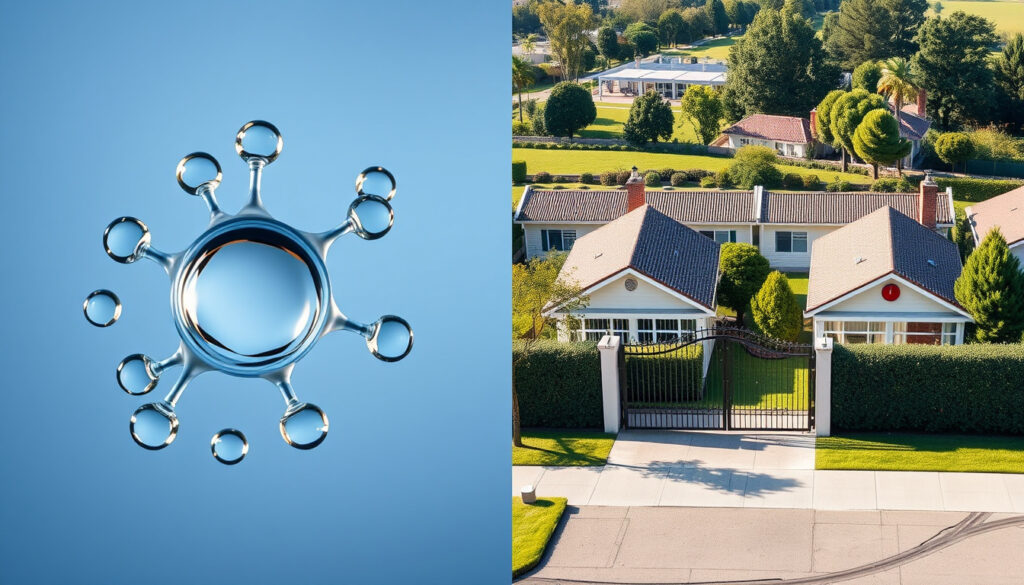
What Is a Compound? Chemistry & Real Estate Meanings
You’ve probably heard the word “compound” in science class — and maybe again when someone described their neighborhood as a “gated compound” — it’s the same term, but the meaning couldn’t be more different depending on whether you’re mixing chemicals or looking at property. This guide unpacks both definitions, giving you clear chemistry examples, real‑estate distinctions, and the context you need to keep them straight.
Minimum number of elements in a compound: 2 ·
Common example of a compound: Water (H₂O) ·
Types of chemical bonds in compounds: Ionic, Covalent, Metallic ·
Compound in real estate: Enclosed area with multiple buildings
Quick snapshot
- Made of two or more different elements chemically bonded (Encyclopaedia Britannica (authoritative science reference))
- Fixed composition and unique properties (Generation Genius (K‑8 science education))
- Examples: Water, Salt, Sugar (BYJU’S (Indian educational platform))
- Real‑estate “compound” lacks a standardised definition (Wikipedia (community‑maintained encyclopedia))
- Classification of chemical compounds can overlap across types (Encyclopaedia Britannica) (Wikipedia (community‑maintained encyclopedia))
- Water (H₂O), Sodium chloride (NaCl), Carbon dioxide (CO₂) (Encyclopaedia Britannica) (Chemtradeasia (chemical industry marketplace))
- Glucose (C₆H₁₂O₆), Ammonia (NH₃) (Chemtradeasia (chemical industry marketplace))
- Study the types of chemical bonds that form compounds (Study.com (online learning resource))
- Learn how to name compounds using IUPAC rules (LibreTexts (open‑access chemistry textbook))
Five key facts about compounds illustrate the range of definitions across chemistry and real estate.
| Fact | Value |
|---|---|
| Definition (Chemistry) | A substance composed of identical molecules containing atoms of more than one element. |
| Definition (Building) | A group of buildings enclosed by a common boundary. |
| Minimum elements required | 2 |
| Known chemical compounds | Over 60 million (PubChem) |
| Bond types | Ionic, Covalent, Metallic |
What is a compound easy definition?
Simple explanation of a compound
- A compound is any substance made from two or more different elements that are chemically combined in fixed proportions (Encyclopaedia Britannica).
- The atoms in a compound are held together by chemical bonds, giving the compound properties that are often very different from the elements that formed it (Generation Genius).
- Unlike a mixture, a compound cannot be separated into its elements by physical means — only by a chemical reaction (Study.com).
Compound vs element vs mixture
Elements are pure substances made of one type of atom. Compounds are pure substances made of two or more elements bonded together. Mixtures contain two or more substances that are not chemically bonded and can be separated physically. For example, salt (NaCl) is a compound, while salt dissolved in water is a mixture (BYJU’S).
The implication: getting the definition right helps distinguish compounds from mixtures in both lab and real estate contexts.
What is a compound in chemistry?
Chemical composition of compounds
- A chemical compound consists of identical molecules that contain atoms of at least two different elements (Encyclopaedia Britannica).
- Every compound has a unique chemical formula that tells you exactly which elements and how many atoms are present (e.g., H₂O for water) (LibreTexts).
How compounds are formed
Compounds form when atoms of different elements share or transfer electrons, creating chemical bonds. Three major bond types govern compound formation:
- Ionic bonds — electrons are transferred from one atom to another (e.g., NaCl) (Study.com).
- Covalent bonds — electrons are shared between atoms (e.g., H₂O) (Encyclopaedia Britannica).
- Metallic bonds — electrons are delocalised among a lattice of metal atoms (e.g., alloys) (Wikipedia, chemical compound).
Properties of chemical compounds
- Compounds have properties that differ completely from the elements that constitute them. For instance, sodium is a reactive metal and chlorine is a toxic gas, but together they form harmless table salt (NaCl) (BYJU’S).
- Compounds always combine in fixed mass ratios — water always has an 8:1 oxygen‑to‑hydrogen mass ratio (Generation Genius).
A student who confuses a mixture with a compound could add salt to water and think they’ve made a new substance. The difference isn’t academic — it’s the foundation of every chemical reaction they’ll ever study.
The pattern: chemical compounds are defined by bonding and fixed ratios, which is the opposite of the flexible real‑estate use.
What are 5 examples of compounds?
Common compounds in daily life
- Water (H₂O) — hydrogen and oxygen bonded covalently (Encyclopaedia Britannica).
- Carbon dioxide (CO₂) — carbon and oxygen, a key product of respiration (Encyclopaedia Britannica).
- Sodium chloride (NaCl) — table salt, the classic ionic compound (Study.com).
- Glucose (C₆H₁₂O₆) — a sugar that plants produce through photosynthesis (BYJU’S).
- Ammonia (NH₃) — nitrogen and hydrogen, widely used in fertilisers (Chemtradeasia).
How to identify compounds from formulas
A chemical formula that contains two or more different element symbols (like H₂O or NaCl) indicates a compound. If it shows only one element (like O₂ or Fe), it’s an element, not a compound. Formulas with parentheses, such as Ca₃(PO₄)₂, represent ionic compounds with polyatomic ions (LibreTexts).
What this means: recognizing chemical formulas by their element symbols is a practical skill for any science student.
What is a compound in a building?
Characteristics of a residential compound
- A compound in real estate is an enclosed area that contains multiple buildings or houses, often sharing a single entrance and security (Wikipedia, enclosure).
- Compounds typically have controlled access — a gate, a wall, or a fence that sets them apart from the surrounding streets (Reddit).
- Common amenities inside a compound may include shared gardens, parking, swimming pools, or playgrounds for residents (Encyclopaedia Britannica — context note).
Common uses of the term in real estate
“A compound can mean very different things in chemistry and real estate, so context is essential to avoid ambiguity.”
Encyclopaedia Britannica (authoritative science reference)
- Gated communities — residential developments with controlled entry and shared amenities.
- Embassy compounds — land containing multiple diplomatic buildings, often with high security.
- University campuses — many buildings on one parcel, sometimes referred to as a “campus compound.”
The catch: the same word can refer to either a gated community or a group of diplomatic buildings, so context is everything.
What is the difference between a compound, house and yard?
Key distinctions in real estate terminology
Three terms, one clear pattern: size and enclosure define the difference.
| Term | Definition | Example |
|---|---|---|
| Compound | Group of buildings on one enclosed piece of land | Gated residential community |
| House | Single dwelling unit, often on its own lot | Standalone suburban home |
| Yard | Open ground around a house, often fenced | Backyard garden |
Practical implications for property buyers
Buying a property described as a “compound” may mean higher HOA fees for shared security and maintenance, but also more privacy and community amenities. A single house with a yard gives you full autonomy but less shared infrastructure. The trade‑off is between control and convenience (Saint Investment).
The takeaway: for property buyers, the term “compound” signals a shared lifestyle with trade‑offs in control and cost.
Confirmed facts
- Compounds are formed by chemical bonding of different elements (Encyclopaedia Britannica).
- A compound has a unique chemical formula and fixed proportions (Study.com).
- Compounds can be decomposed into elements only by chemical means (Generation Genius).
- In real estate, a compound is an enclosed area with multiple buildings (Wikipedia).
What’s unclear
- The exact boundary between a compound and a mixture can be subtle for alloys and other complex substances (Wikipedia).
- The real‑estate use of “compound” is not officially standardised and varies by region (Wikipedia).
- Some substances, like polymers, can be considered molecular compounds or mixtures depending on chain length (LibreTexts).
- The definition of “compound” in a property listing may overlap with “gated community,” “estate,” or “complex” (Reddit).
Quotes from authoritative sources
“Chemical compound, any substance composed of identical molecules consisting of atoms of two or more chemical elements.”
Encyclopaedia Britannica (authoritative science reference)
“A chemical compound is a chemical substance composed of many identical molecules containing atoms from more than one chemical element.”
Wikipedia (community‑maintained encyclopedia)
For students and property seekers alike, the word “compound” carries very different baggage. In chemistry, it’s a precise term for a substance with fixed proportions and unique properties. In real estate, it’s a flexible term for an enclosed, multi‑building property. Getting these mixed up could lead to a failed exam or a misunderstanding in a property search. For anyone reading a chemistry textbook or a real‑estate listing, the choice is clear: check the context, or risk mixing up your NaCl with your neighbourhood.
youtube.com, saintinvestment.com, study.com, en.wikipedia.org, reddit.com, generationgenius.com
Frequently asked questions
What is a compound vs molecule?
A molecule is a group of atoms bonded together — it can be made of the same element (e.g., O₂) or different elements (e.g., H₂O). A compound is always made of different elements. All compounds are molecules, but not all molecules are compounds (Encyclopaedia Britannica).
What best defines a compound?
A compound is a pure substance composed of two or more different elements chemically combined in a fixed ratio, with properties distinct from those of its constituent elements (Study.com).
What are the 4 types of compounds?
Chemical compounds are often classified into ionic compounds (e.g., NaCl), molecular (covalent) compounds (e.g., H₂O), organic compounds (carbon‑based, e.g., glucose), and coordination compounds (metal complexes) (Wikipedia).
What is a compound for kids?
For kids: a compound is a new substance you get when two or more different types of atoms join together. For example, when hydrogen and oxygen atoms join, they make water (Generation Genius).
What is compound Class 9?
In Class 9 science (following many curricula), a compound is defined as a substance formed by the chemical combination of two or more elements in a fixed ratio by mass. Students learn that compounds can be broken down into elements only through chemical reactions (BYJU’S).
Is water a compound?
Yes, water (H₂O) is a chemical compound because it contains hydrogen and oxygen atoms bonded together in a fixed 2:1 ratio. It has different properties from hydrogen and oxygen alone (Encyclopaedia Britannica).
How is a compound different from a mixture?
A compound has a fixed chemical composition and cannot be separated by physical means. A mixture contains two or more substances that are not chemically bonded and can be separated using physical methods like filtering or evaporating (Study.com).
Related reading: What Is a Beneficiary? · What Is Strep Throat?
More related posts
 New York Public Library Hours, Research Centers & Digital Access
 I Know What You Did Last Summer: Watch Order, Killer, Box Office
 Mexico National Football Team Matches: Schedule, Results & Where to Watch
 Beef Rendang Malay Near Me: Taste, Differences & Local Spots
 Pay Your Metro PCS Bill: Online Guest Pay, Phone & In-Store Guide
 How Much Is a Galaxy on TikTok? Cost & Creator Payout
 Mama June Family Crisis: Latest Updates and Where to Watch
 USMNT v Mexico Lineup : 2025 Gold Cup Final Re ult & Hi tory