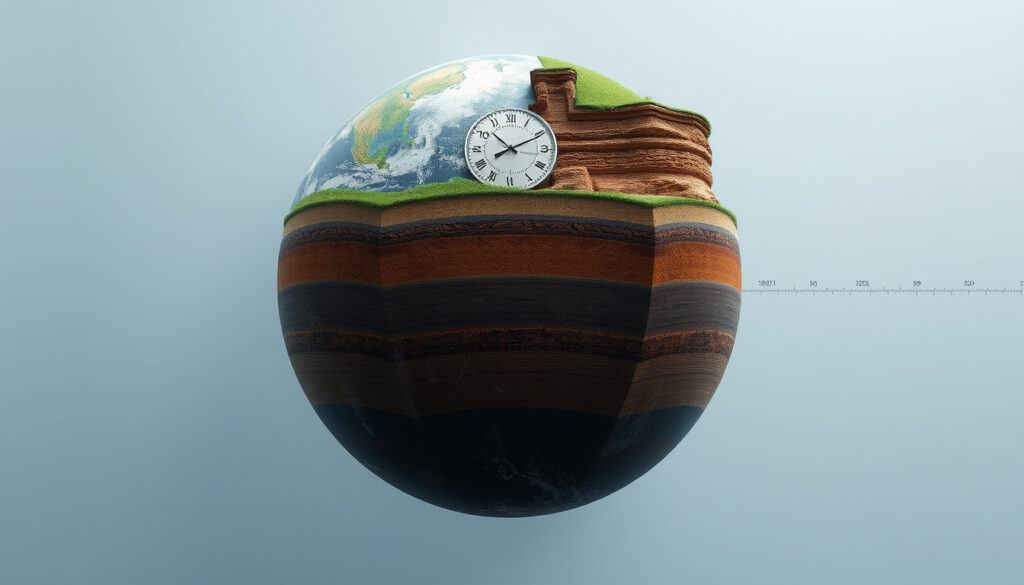
How Old Is the Earth? 4.54 Billion Years & Human Timeline
Every day we stand on a planet that is unbelievably ancient—yet most of us can’t rattle off its exact age without a quick search. The number scientists have settled on is precise: Earth is 4.54 ± 0.05 billion years old.
Age of Earth: 4.54 ± 0.05 billion years ·
Age of the Universe: 13.8 billion years ·
Age of the Sun: 4.6 billion years ·
First Homo sapiens appearance: ~300,000 years ago ·
Oldest known Earth rocks: ~4.0 billion years old
Quick snapshot
- Earth is 4.54 ± 0.05 billion years old (Wikipedia: Age of Earth)
- Exact timing of life’s first emergence (range 3.5–3.8 billion years ago)
- Big Bang 13.8 Ga → Earth accretion 4.54 Ga → first humans ~300 ka
- Humans may face habitability challenges; Venus and Jupiter remain deadliest planets
Five key facts frame the full picture: Earth’s age, universe age, Sun age, first modern humans, and oldest rocks. Here’s how they connect.
| Label | Value |
|---|---|
| Earth age (scientific) | 4.54 ± 0.05 billion years |
| Universe age | 13.8 billion years |
| Sun age | 4.6 billion years |
| First modern humans | ~300,000 years ago |
| Oldest Earth rocks | ~4.0 billion years |
How old is the Earth scientifically?
The scientific community pinpoints Earth’s age at 4.54 ± 0.05 billion years. This number comes from radiometric dating of meteorites and the oldest terrestrial rocks. In 1956, geochemist Clair Cameron Patterson used uranium-lead dating on the Canyon Diablo meteorite and arrived at 4.55 ± 0.07 billion years, a result that has since been refined but never contradicted. The US Geological Survey (U.S. government geoscience authority) confirms the accepted figure of 4.54 billion years based on lead isotopes from that same meteorite’s troilite.
How old is the Earth in years?
- In raw years: 4,540,000,000 (with an uncertainty of ±50 million years). The oldest known zircon crystals, found in Jack Hills, Western Australia, are at least 4.404 billion years old, as reported by Wikipedia: Age of Earth.
- Earth’s oldest whole rock samples are roughly 4.0 billion years old, a figure consistent with the planet’s formation age.
How old is the Earth in human years?
This question often confuses planetary age with the human presence on Earth. Earth is 4.54 billion years old—its “human age” is the same as its geological age. However, if someone means “how long have humans been around,” the answer is a tiny fraction: Homo sapiens have existed for only about 300,000 years, which is 0.0066% of Earth’s total history. The Smithsonian Human Origins Program (U.S. national museum research) places the earliest fossils at Omo Kibish and Herto in Ethiopia, dated between 200,000 and 300,000 years ago.
The implication: humans are a blink in Earth’s history, not a measure of its age.
How old is the universe?
The universe is far older than Earth. Measurements of the cosmic microwave background by the WMAP and Planck satellites give an age of 13.8 billion years. The International Planetarium Society (global astronomy education network) confirms this figure, noting that Earth formed about 9.2 billion years after the Big Bang. The Milky Way galaxy is also ancient—between 11 and 13 billion years old, according to USGS Geologic Time.
Five objects, one pattern: the universe is roughly 3 times older than Earth. The pattern: Earth is a relatively late addition to cosmic history.
How old is the Sun?
The Sun formed before Earth, at about 4.6 billion years ago. Stellar models and meteorite dating converge on this age. The Planetary Society (nonprofit space advocacy) explains that the Solar System began forming around 4.6 billion years ago, and Earth accreted from the surrounding nebula roughly 40 million years later. The Sun’s age also aligns with the uranium-lead dates from the Canyon Diablo meteorite, as the entire system condensed from the same cloud of gas and dust. For anyone comparing Earth to its star: the Sun is about 60 million years older—a blink in cosmic terms, but enough to set the stage for planet formation.
The implication: Earth formed just after the Sun, a lag of tens of millions of years in a 4.6-billion-year process.
When did human life first appear on Earth?
Modern humans, Homo sapiens, emerged in Africa around 300,000 years ago. The Smithsonian Human Origins Program points to fossils from Omo Kibish and Herto as the earliest evidence. Civilizations that built cities and practiced agriculture date back only about 12,000 years, as noted by the Encyclopædia Britannica (established reference publisher). That 12,000 years represents just 0.00026% of Earth’s 4.54-billion-year story. The pattern: humans are newcomers, yet we have reshaped the planet’s surface and atmosphere more than any species in the previous few million years.
How old is the Earth with humans?
Strictly speaking, Earth has been “Earth with humans” only since about 300,000 years ago. Before that, it was a planet teeming with other life—and before that, lifeless rock and water. So the “age with humans” is not a planetary age but a fraction of the planetary timeline. The confirmed fact: Earth existed for 4.5397 billion years before the first modern humans walked on it.
The catch: humans occupy less than 0.01% of Earth’s history, yet we now dominate its future.
Who roamed the earth before?
Long before humans, Earth was dominated by magnificent creatures. Dinosaurs roamed for roughly 165 million years, from the Triassic until their extinction 66 million years ago. Even earlier, trilobites, amphibians, and early mammals populated the land and seas. The Wikipedia Geologic Time Scale (community-maintained reference) documents this sequence.
Who roamed the earth before the arrival of human beings?
The first life—simple single-celled organisms—appeared about 3.5 to 3.8 billion years ago, as reported by The Planetary Society. That means Earth had life for over 3 billion years before any complex animals evolved. The pattern: life emerged quickly (within a few hundred million years of the planet cooling), but complex life took billions of years to develop. The catch: we have no fossil record from those first microbes; the evidence is chemical traces preserved in ancient rocks.
Humanity occupies an eye-blink of Earth’s history, yet we are the first species capable of understanding that history—and also of threatening it.
What is the deadliest planet to humans?
If you were dropped on another planet without a spacesuit, death would come in seconds or minutes. Among the candidates, Venus is often called the deadliest because of its 462°C surface temperature, sulfuric acid clouds, and crushing atmospheric pressure—92 times Earth’s. NASA Science: Venus (U.S. space agency planetary science) describes it as a “runaway greenhouse” hell. Jupiter would kill instantly through immense gravity and lethal radiation belts. Mars has deadly dust storms and a thin atmosphere, while Titan freezes at -179°C, according to NASA Science: Mars and NASA Science: Titan.
Four planets, one verdict: Venus is the most consistently deadly because it is both hot and corrosive. Yet Earth’s own deadliest features—earthquakes, volcanoes, extreme weather—arise from the same plate tectonics that makes it uniquely habitable. The Planetary Society notes that Earth’s active geology recycles carbon and maintains a stable climate, unlike Venus’s stagnant lid.
Comparison of planet deadliness: six environments, one takeaway—only Earth has the right mix of temperature, atmosphere, and tectonic activity to support complex life.
| Planet | Surface temp | Atmospheric pressure | Key hazard | Deadliness rank |
|---|---|---|---|---|
| Venus | 462°C | 92 atm | Acid clouds, extreme heat | 1 (deadliest) |
| Jupiter | -108°C (cloud top) | N/A (gas giant) | Radiation, gravity, no surface | 2 |
| Mars | -63°C average | 0.006 atm | Dust storms, thin atmosphere | 3 |
| Titan (moon) | -179°C | 1.5 atm | Extreme cold, methane rain | 4 |
| Earth | 15°C average | 1 atm | Earthquakes, volcanoes | 5 (most habitable) |
The implication: Earth’s dangerous geology is the very engine that recycles nutrients and stabilizes the climate—without it, we would be a dead planet too.
Which planet would kill you first?
If we rank by time to death (without protection): Jupiter—the atmospheric entry and radiation would kill in under a minute. But from a “worst environment” standpoint, Venus wins (or loses) because even a shielded probe only survives a few hours on the surface.
What is the most unloved planet?
Subjective, but Uranus often gets that label. It rotates on its side, has the coldest atmosphere in the solar system (-224°C), and has only been visited once, by Voyager 2 in 1986. No dedicated mission is currently planned, making it the least explored planet.
What is the most creepy planet?
Many space enthusiasts name Jupiter for its endless storms (including the Great Red Spot), its powerful magnetic field that traps deadly radiation, and its sheer size—it could swallow all other planets. Venus also earns “creepy” for its thick yellow clouds that hide a volcanic landscape hot enough to melt lead.
Timeline of Earth and Life
The following milestones trace Earth’s 4.54-billion-year journey from accretion to modern humans.
- 13.8 billion years ago – Big Bang (universe begins)
- 4.6 billion years ago – Sun forms
- 4.54 billion years ago – Earth accretes from solar nebula
- 4.0 billion years ago – Oldest known Earth rocks form
- 3.8 billion years ago – First life (microbial) appears
- 66 million years ago – Dinosaurs go extinct
- 300,000 years ago – Homo sapiens appear
Confirmed facts from The Planetary Society and Wikipedia: Age of Earth. The timeline signal: Earth has been around for nearly a third of the universe’s entire age.
Confirmed facts vs. what’s unclear
Confirmed: Earth age 4.54 ± 0.05 billion years (multiple independent methods); Universe age 13.8 billion years; first humans ~300,000 years ago.
Unclear: Exactly when life first emerged (3.5–3.8 billion years ago is a range); which planet is “most unloved” is subjective; exact deadliest planet ranking (Venus and Jupiter top contenders).
The age of Earth is estimated to be 4.54 ± 0.05 billion years.
— Wikipedia: Age of Earth (community encyclopedia)
The Earth is thought to be about 4.54 billion years old.
— The Planetary Society (space advocacy organization)
The name Earth is about 1,000 years old. All of the planets except Earth were named after Greek and Roman gods.
— NASA Earth Facts (U.S. space agency)
Why Earth’s age matters
Earth’s 4.54-billion-year age makes it the only known haven for life, while nearby planets like Venus and Jupiter are death traps. For anyone curious about our place in the cosmos, the choice between appreciating Earth’s unique habitability or taking it for granted is clear: invest in protecting the planet that spent billions of years making life possible, or risk losing it to the very forces that make it special.
For a more detailed breakdown of Earth’s age, including the methods used to arrive at the 4.54 billion year figure, see detailed breakdown of Earths age.
Frequently asked questions
How do scientists know the age of the Earth?
Through radiometric dating of meteorites and the oldest Earth rocks, mainly using uranium-lead and lead isotope methods. The USGS explains that the Canyon Diablo meteorite provided the key data.
Is the Earth older than the Sun?
No. The Sun formed about 4.6 billion years ago, roughly 60 million years before Earth. The Planetary Society confirms this.
Did humans and dinosaurs coexist?
No. Dinosaurs went extinct 66 million years ago. The first Homo sapiens appeared 300,000 years ago—a gap of 65.7 million years.
What is the exact age of the Earth in years?
4,540,000,000 years, with an uncertainty of ±50,000,000 years. The Wikipedia article provides this figure.
Why is Earth called Earth?
The name comes from Old English and Germanic words meaning “ground”. Unlike other planets named after Greek/Roman gods, Earth’s name is ancient. NASA notes the name is about 1,000 years old.
What was the Earth like 4 billion years ago?
A molten, volcanic world with no solid crust. Oceans formed around 4.3 billion years ago. The earliest life appeared sometime between 3.5 and 3.8 billion years ago, according to The Planetary Society.
How old is the Earth compared to the universe?
The universe is 13.8 billion years old, about 3 times older than Earth. Earth formed 9.2 billion years after the Big Bang.
More related posts
 Argan Oil for Hair: Benefits, Usage & Side Effects Guide
 USD to INR Exchange Rate Today: Live Rate 94.05 & Forecast
 Current Gold Price per Ounce USD: Live Rate & Investment Analysis
 How to Lose a Guy in 10 Days: Is It Worth Watching
 Harry Potter and the Chamber of Secrets: Parents Guide
 Six Flags San Antonio Guide: Hours, Rides & Tickets
 Dark Spots on Face – Causes, Treatments & Home Remedies
 Hindi to English Translation: Free Tools and Grammar Tips