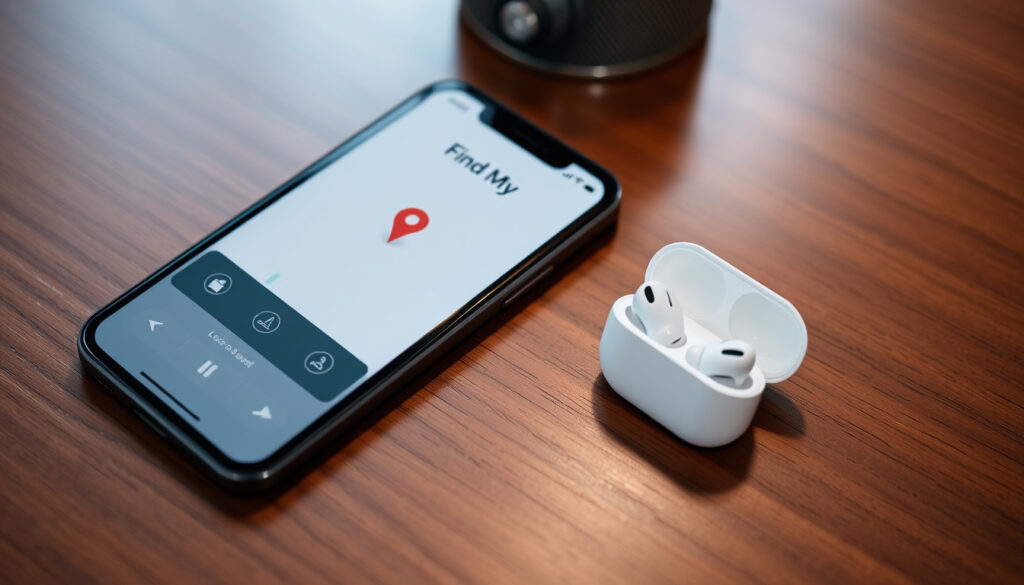
How to Find AirPods: Locate Lost Earbuds With Find My
Few feelings match the quiet panic of patting your pocket for an AirPod that just isn’t there. If you’ve lost one or both earbuds — under a couch, in a parking lot, or somewhere across town — Apple’s Find My network spans over a billion devices that can quietly help you track yours, and here’s how to put that network to work, what to do when your AirPods are offline, and the honest limits when you’re on Android.
Apple Find My network devices: over 1 billion ·
AirPods with U1 chip for precision finding: AirPods Pro (2nd generation) and AirPods Max ·
Offline tracking duration: up to 24 hours after last connection ·
Single AirPod replacement cost (approx.): $69–$89 depending on model
Quick snapshot
- Find My can locate AirPods linked to an Apple ID — and on Android, the same map appears through iCloud.com in a browser (Appuals (tech how-to guide))
- Offline AirPods can still be seen at their last known location through the Find My network (Guiding Tech (consumer tech outlet))
- If a lost AirPod appears in a Bluetooth scan, you’re close — usually within roughly 30 to 60 feet, according to audio-focused guides (Headphonesty (audio tech publication))
- Whether Bluetooth scanner apps can do more than show a signal exists — and they need location permissions just to try (Yona (practical tech blog))
- How often offline AirPods ping the Find My network — Apple doesn’t publish the interval (Apple Support (official AirPods help page))
- Whether Lost Mode deters a determined thief, or only an opportunistic one (Apple Support (lost AirPods help page))
- Offline AirPods usually keep a last known location for up to 24 hours after the battery dies (Apple Support (lost AirPods help page))
- On Android, iCloud in a browser can trigger Play Sound as long as the AirPods are still online (Guiding Tech (consumer tech outlet))
- AirPods Pro 2 and AirPods Max add Precision Finding with the U1 chip — distance and direction instead of a dot (Apple Support (official AirPods help page))
- Mark the AirPods as Lost and add a contact message in Find My (Apple Support (lost AirPods help page))
- Open iCloud.com in a browser before the battery drains to see the last map dot (Appuals (tech how-to guide))
- Use your phone’s Bluetooth settings to re-scan and see if the AirPods are nearby (MakeUseOf (consumer tech site))
Six facts, one pattern: the best AirPods recovery tools are locked behind Apple’s newest hardware, while Android users get workarounds that work on a short leash.
| Fact | Detail |
|---|---|
| Find My App Required | Yes, for full functionality |
| Offline Tracking Duration | Up to 24 hours |
| Android Support | Limited; no official app |
| Precision Finding | AirPods Pro 2 and AirPods Max only |
| Single AirPod Replacement | Available from Apple |
| Activation Lock | AirPods Pro 2 and later models |
How do I locate my lost AirPods?
Finding AirPods isn’t a single trick — it’s a workflow with five steps that split between Apple’s Find My app, the map, and a loud chirp. Two facts shape everything: the network only helps if the AirPods were signed into your Apple ID, and a live location depends on battery.
If your AirPods are in the same room, Play Sound beats map-hunting every time — the chirp works with the case closed and can hit one earbud at a time, which turns a 10-minute search into a 10-second one.
- Open Find My on your iPhone or iPad.
- Tap Devices and select your AirPods — if one earbud is out of the case, it can appear separately.
- Check the map for a live or last-known dot.
- Tap Play Sound when you’re close — it works even with AirPods in the case.
- Use Precision Finding on AirPods Pro 2 or AirPods Max for distance and direction.
Open the Find My app on your iPhone or iPad
- The app only works if AirPods are paired to your Apple ID.
- AirPods in their case appear as one entry; out of the case they can split into separate entries.
Launch Find My, tap Devices, and select your AirPods. Apple’s Find My guide explains what you’ll see next: a live map dot if they’re nearby, a last known location if they’re out of range or charging, or the word “Offline” if they can’t reach the network at all (Apple Support (official AirPods help page)).
Select your AirPods from the Devices list
- Your AirPods appear by name, with a battery icon for case and earbuds.
- If only one earbud is missing, it may show as its own row.
Most people lose AirPods in the same house or car where they last took them out. That’s why the Devices list is more useful than the map: select the missing earbud, and your phone will tell you whether it’s connected to your iPhone or being spotted by the Find My network.
Play a sound to hear them nearby
- The chirp fires even when AirPods are still inside their charging case.
- You can play the sound on a single earbud without pinging the one you already have.
Play Sound is the fastest recovery tool in the kit. It doesn’t need a map or a strong internet signal — just Bluetooth range, which is usually enough to reach across a room, under a sofa, or between car seats.
View their location on the map
- A live dot means the AirPods are currently being located.
- A gray icon with a clock means you’re looking at the last known position.
If the AirPods are in a different building or lost outdoors, the map becomes the primary tool. The difference between live and stale is battery: AirPods don’t broadcast for weeks like a tracker — they rely on juice and proximity to other Apple devices.
Use Precision Finding with AirPods Pro 2 or AirPods Max
- Only AirPods Pro 2 and AirPods Max carry the U1 chip.
- Precision Finding shows distance and direction arrows on your phone screen.
Instead of “somewhere in the bedroom,” you get guided arrows that point straight to the earbud. It’s the difference between searching a room and walking directly to the right cushion.
The pattern: the faster you move from map to sound to physical search, the less time the battery has to run out.
Can I find my AirPods without Find My?
Short answer: not as well. Find My is the only fully reliable method — everything else is a workaround with a shorter leash. But there are four options worth knowing, especially if you’re on Android or the AirPods were never paired to your iPhone.
Use iCloud.com Find My from any browser
- Works in any browser, including on Android.
- Shows the same map and Play Sound button — if the AirPods are still linked to an Apple ID.
Several Android guides point to the same trick: open iCloud.com/find in a mobile browser, sign in with the Apple ID that owns the AirPods, and you’ll get the map dot and Play Sound controls without needing an iPhone (Appuals (tech how-to guide)). The catch is the Apple ID requirement: if the AirPods were paired to a friend’s phone or the Apple ID isn’t yours, the browser route is dead.
Try third-party Bluetooth scanner apps on Android
- Apps like Wunderfind, nRF Connect, and LightBlue scan for nearby Bluetooth devices.
- They show signal strength, not a map pin.
Guides routinely recommend scanner apps as a last-resort search tool (Guiding Tech (consumer tech outlet)). The limitation is physical: the AirPods need to be within Bluetooth range, which usually works out to roughly 30 to 60 feet, according to audio-focused guides (Headphonesty (audio tech publication)). Those apps also need location permissions enabled in Android to discover Bluetooth signals; without that, the scan comes up empty.
Retrace your steps manually
- The map pin points to the last known location — the most likely spot.
- Go there, then slowly widen the circle.
Manual searching sounds like low-tech advice, but it’s the method that works when batteries die. Look where you sat, where you changed jackets, and anywhere you charged the case. If Find My stopped updating, foot traffic and weather are now your real clues.
Use a metal detector for the AirPods case
- The case is the heaviest metal-and-battery lump you lost.
- Most home metal detectors can pick it up within a few inches.
This is the niche-but-legendary option: the AirPods case is dense enough for a cheap detector to find in grass or on concrete. It works best when the map shows an outside location with no structure to search.
Android workarounds are blind search. A Bluetooth scanner confirms a signal exists within roughly 30–60 feet, but it can’t point you upstairs or toward the couch. And if the AirPods were never paired to an Apple ID, iCloud.com shows nothing at all.
The catch: every workaround without Find My depends on the earbuds still having power and being close enough to answer a Bluetooth ping.
What do I do if I lost only one AirPod?
Losing one AirPod is more common than losing both — it slips out of an ear at the gym or between seats. The good news: Find My tracks earbuds individually. The bad news: serial numbers matter, and a lost single earbud is only worth replacing if you still have the other one and the case.
Check each AirPod separately in the Find My app
- AirPods can appear as separate devices in the Devices list.
- Each earbud has its own serial number.
Select the missing earbud rather than the pair. If the case is present but the earbud is not, you’ll see the earbud’s own last-known point — which is usually the place you stopped hearing music.
Play a sound on the missing AirPod only
- Targets the individual earbud, not the pair.
- Best done after putting the remaining AirPod safely in the case.
Before you start searching, follow the step Apple’s own support community recommends: put the AirPod you still have back into the charging case, then ping the missing one (Apple Support Communities (AirPods user forum)). That removes one variable from the map and stops you from confusing the two earbuds’ signals.
Mark the lost AirPod as Lost in Find My
- Lost Mode works for AirPods the way it works for an iPhone.
- Show Contact Info is the part that matters if someone else finds them.
When you mark AirPods as lost, Find My may display a message with your contact details on a nearby Apple device. Even if the finder tries to pair the earbuds, the message gives them a reason to hand them back instead of pocketing them.
Purchase a single replacement from Apple
- A single earbud replacement is cheaper than a full set.
- Your case and remaining AirPod stay in use with the new earbud.
Apple sells individual replacement AirPods, so losing one earbud doesn’t force you into buying a whole new set. You pair the replacement with your existing case and keep the other earbud — the case acts as the pairing bridge and syncs the new earbud to your account.
Pair the new AirPod with your existing case
- Place both earbuds in the case until the light pulses amber.
- Reconnect on the iPhone — the case syncs the new earbud to your account.
Once the replacement arrives, drop it into the case with the old earbud, close the lid, and follow the on-screen pairing prompt. The case is the brain; the new earbud just needs to be introduced to it.
Losing one earbud isn’t a full-set emergency anymore — but the earlier you mark it as Lost, the better. The contact message only shows when someone with an Apple device is nearby, and that window shrinks as the battery drains.
The implication: a missing earbud is a logistics problem, not a reason to replace the whole pair.
How long can lost AirPods be tracked?
Tracking duration depends less on Apple’s servers and more on three things: whether the AirPods are in the case, whether the battery has died, and whether other Apple devices have walked past them. Most people overestimate the window.
Tracking duration when AirPods are inside the case
- The case’s battery is the clock.
- AirPods in a closed case don’t broadcast their own location; they rely on the last point from when they were removed.
If you lost the case with both earbuds inside, the Find My map shows where the case was last opened — not its current position. The case doesn’t transmit continuously the way an iPhone does.
Offline tracking via the Find My network (last known location)
- The Find My network remembers where AirPods were last seen.
- That memory lasts around 24 hours of offline time.
When AirPods are out of range or need to charge, Find My can show “No location found” or “Offline” (Apple Support (official AirPods help page)). The practical window built into Apple’s tracking features: a last known location can stay available for up to 24 hours after the AirPods drop off the network. After that, the pin freezes as a memory, and the hunt moves to the physical world.
Battery life and its impact on tracking
- AirPods need power to ping, even for a last-known update.
- Once dead, the earbuds are silent and invisible.
Battery is the invisible deadline. A dead AirPod stops responding to Find My, stops playing sounds, and stops updating any dot on the map. The Find My network can’t help a battery that’s gone to zero.
How often AirPods ping their location
- iPhones and iPads have radios that broadcast constantly; AirPods don’t.
- AirPods report when they’re connected to a device or when another Apple product passes by.
Apple doesn’t publish a fixed ping interval for AirPods, and the real behavior is opportunistic: the earbuds register when a nearby Apple device can relay their presence. That’s why urban lost-and-found works faster than rural ones — every iPhone you walk past is a potential tower.
The 24-hour clock is shorter than people assume. If Find My says “Offline,” treat the last pinned dot as a time-limited clue — and treat the battery icon like the hourglass it is.
The pattern: the 24-hour window is the real clock, and the map is just a memory of where that clock stopped.
Can thieves use stolen AirPods?
AirPods are small, expensive, and easy to pocket — which makes them a target. But Apple has closed most of the loopholes that made stolen AirPods useful, if you own one of the newer models.
Activation Lock for AirPods introduced with iOS 16
- Binds AirPods Pro 2, AirPods Max, and later models to your Apple ID.
- Blocks the earbuds from pairing with any other Apple ID.
A stolen pair of AirPods Pro 2 is about as useful to a thief as a stolen iPhone with Activation Lock: they can’t pair it to their own Apple ID, which guts the product’s main function. Apple’s support page for lost AirPods describes the protections — Lost Mode and Show Contact Info — for supported models (Apple Support (lost AirPods help page)).
How thieves can reset and pair stolen AirPods
- Old AirPods (pre-Pro 2) can be factory reset from the case.
- Newer models stay locked unless the owner removes them from Find My.
On models without Activation Lock, holding the setup button on the case wipes the pairing record, and the earbuds can pair to a stranger’s phone. On protected models, the reset doesn’t clear the Apple ID lock — the pair stays blocked until the original owner removes it from Find My.
How to mark your AirPods as lost in Find My
- Open Find My → Devices → your AirPods → Mark as Lost.
- Enter a phone number or message to display.
This is the same flow that enables Lost Mode: your contact details may appear on a stranger’s iPhone when they come near the AirPods. Even if the thief never connects them, the message remains a flag in Apple’s system.
What to do if your AirPods are stolen
- Note the serial number from your original receipt.
- Keep the AirPods on your Apple ID rather than removing them.
If you’re certain the AirPods are stolen, don’t just mark them lost: write down the serial number, consider filing a police report in your jurisdiction, and leave the AirPods attached to your Apple ID. Removing them from your account unlocks them for the next person.
Activation Lock has a generation gap: AirPods Pro 2 and AirPods Max are genuinely theft-resistant, while older AirPods can be reset from the case. The security ceiling is decided the day you bought them, not the day they vanish.
The implication: Apple’s security improvements turned stolen AirPods from a quick resale into a locked liability.
What’s confirmed, and what’s still unclear
Confirmed
- Find My can track a single AirPod separately when it’s online enough to respond (Apple Support (official AirPods help page)).
- Bluetooth scans confirm proximity — usually within roughly 30 to 60 feet (Headphonesty (audio tech publication)).
- Activation Lock blocks AirPods Pro 2 and AirPods Max from pairing with another Apple ID (Apple Support (lost AirPods help page)).
Still unclear
- Whether Bluetooth scanner apps can guide you to AirPods or just show that a signal is nearby (Headphonesty (audio tech publication)).
- How often offline AirPods ping the Find My network; Apple doesn’t publish the interval.
- Whether Lost Mode deters a determined thief, or only an opportunistic one.
- Whether iCloud-on-Android works reliably outdoors, where Bluetooth range and network lag collide.
What the sources say
Two sources bracket the AirPods recovery problem: Google’s Android guidance and Apple’s own support forum. Their advice sounds different but points the same way — preparation beats panic.
“Location and offline-finding features must be enabled before a device can be found when offline.”
Google is talking about Android phones, but the principle transfers directly to AirPods hunting on Android: without the right settings switched on ahead of time, an offline device is invisible.
“Put the AirPod you still have into the charging case first.”
The forum tip is the cheapest trick in the book: isolate the earbud you still have before you chase the one you lost.
Every hour you spend with a frozen Find My pin is an hour the battery is draining somewhere else. For iPhone owners, the winning move is immediate: open Find My, play a sound, and mark the AirPods as lost before the 24-hour offline window closes. For Android users whose AirPods were never linked to an Apple ID, the choice is clear: retrace your steps and use a Bluetooth scanner within range — or accept that a dead earbud may simply be gone.
Frequently asked questions
How do I find my AirPods if they are dead?
Dead AirPods can’t update Find My, so the map keeps whatever last known location it captured before the battery died — usually up to 24 hours. Physically retrace your steps from that pin; the earbuds are no longer transmitting.
Can I track my AirPods if someone else has them?
If they’re switched on and near any Apple device on the Find My network, the map can still show them. Mark the AirPods as Lost so a contact message can appear, and remember that AirPods Pro 2 and AirPods Max won’t pair to a different Apple ID.
Do AirPods show location when the case is closed?
Not the current location. A closed case isn’t actively transmitting, so Find My shows the last spot where the AirPods were used or moved. If they’re within Bluetooth range, Play Sound can still ring them inside the case.
How do I find my AirPods without an iPhone?
Sign in to iCloud.com/find from any browser with the Apple ID that owns the AirPods. Android users can also re-scan in Bluetooth settings or use scanner apps like Wunderfind (MakeUseOf (consumer tech site)).
Can I use a third-party tracker like Tile for AirPods?
You can attach a tracker to the charging case, but it won’t find a single earbud that fell out. Only Find My tracks individual AirPods; third-party trackers track the outside of the case at best.
What should I do if Find My says AirPods are offline?
Treat the last known location as your starting point, retrace your steps, and check the lost-and-found at that venue (Apple Support Communities (AirPods user forum)). Keep the AirPods in Find My so you get a notification if they reconnect.
Are AirPods covered under AppleCare+ for loss?
No. AppleCare+ for AirPods covers accidental damage, not lost or missing earbuds. For a lost AirPod, the realistic path is Find My first, then buying a single replacement from Apple.
More related posts
 New York, New York: Song History, Film Flop & City Name Guide
 Big Little Lies Cast: Complete Seasons 1, 2 & 3 List
 What Is an EKG? Test, Procedure, and Results Explained
 Elon Musk Out at Tesla? Current Status and What It Means
 Translate English to Japanese – Best Free Tools and Accuracy Guide
 USMNT v Mexico Lineup : 2025 Gold Cup Final Re ult & Hi tory