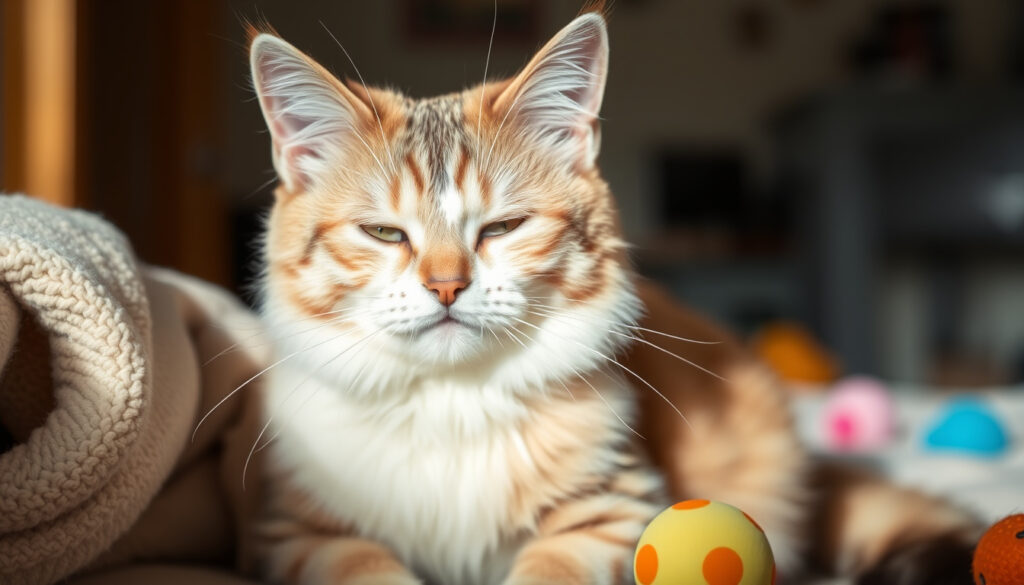
Cat With Down Syndrome? No—Special Needs Cats Are Real
Cats cannot have Down syndrome because they have 19 pairs of chromosomes, not 23, and no equivalent of chromosome 21 (Great Pet Care (pet-health editorial site)). The wobbly kitten in viral photos usually has a neurological condition called cerebellar hypoplasia, and the real name matters because it changes how you care for it.
Chromosome pairs in a cat: 19 pairs (38 chromosomes) · Chromosome pairs in a human: 23 pairs (46 chromosomes) · Human chromosome affected in Down syndrome: 21 · Can a vet diagnose Down syndrome in a cat? No · Common mislabel for “Down syndrome cat”: Cerebellar hypoplasia
Quick snapshot
- Veterinary sources do not recognize feline Down syndrome as a diagnosis (Hill’s Pet Nutrition (pet-care education publisher))
- Down syndrome is human trisomy 21; cats have 19 chromosome pairs, not 23 (Great Pet Care (pet-health editorial site)) (Hill’s Pet Nutrition (pet-care education publisher))
- Cerebellar hypoplasia is a developmental disorder of the cerebellum that causes uncoordinated movement (VCA Animal Hospitals (veterinary hospital network))
- Why one cat develops Down-syndrome-like facial features while another doesn’t — a vet must rule out several causes (Cats Protection (UK feline welfare charity))
- Tarzan syndrome and “feline autism” are colloquial labels, not formal veterinary diagnoses (Cats Protection (UK feline welfare charity))
- The exact trigger of an individual CH case often stays unknown (Cats Protection (UK feline welfare charity))
- CH is non-progressive: developmental, not degenerative (J Feline Med Surg Open Reports (peer-reviewed veterinary journal))
- Sudden or worsening incoordination is a different story — it warrants urgent veterinary evaluation, not a CH label (WebVet (online pet-health guide))
- Book a vet exam and neurological assessment before adopting or labeling a “special needs” cat
- Adapt the home: floor traction, low-entry litterbox, bowls that don’t slide
- Plan supportive care, not a cure — the goal is a safe, navigable home
Six numbers and labels, one pattern: the “Down syndrome cat” is a mismatch between human genetics and feline reality.
| Fact | Value |
|---|---|
| Cat chromosome count | 19 pairs (38 chromosomes) |
| Human chromosome count | 23 pairs (46 chromosomes) |
| Down syndrome cause | Extra copy of human chromosome 21 |
| Can cats have Down syndrome? | No |
| Most common mislabel | Cerebellar hypoplasia |
| Sundowning in cats | Nighttime confusion linked to feline cognitive dysfunction |
Can cats have Down syndrome?
Short answer: no, and that’s not a quibble — it’s a genetic dead end. The evidence is consistent: whatever a viral photo looks like, the label “Down syndrome cat” doesn’t survive a veterinary workup.
“Down syndrome cat” feels like a warm label, and that warmth is the problem: it reassures without explaining, and a cat can’t be helped by a word that isn’t a diagnosis.
None of that means the cats in those viral photos are fake news. It means they’re usually living with a condition that has a real name, real symptoms, and a real care plan — and the first step is understanding the genetics.
What is Down syndrome in humans?
- Down syndrome is associated with trisomy 21 — an extra copy of chromosome 21 (Great Pet Care (pet-health editorial site))
- In people, the diagnosis is genetic, not just visual — the extra chromosome changes development in ways that don’t map onto cat biology
When you hear “Down syndrome,” you’re hearing about a human chromosome 21 anomaly. Cats are built from a different genetic blueprint entirely, so the human condition has no feline equivalent.
How many chromosomes do cats have?
- Cat: 19 pairs of chromosomes (38 total)
- Human: 23 pairs of chromosomes (46 total)
- Human chromosome 21 has no counterpart in the cat genome
That 19-pair structure is why the math never works. Down syndrome is defined by what happens on chromosome 21, and a cat doesn’t have a chromosome 21 to copy. Great Pet Care puts it plainly: a human-style trisomy-21 diagnosis cannot simply be transferred to cats (Great Pet Care (pet-health editorial site)).
Why can’t a cat have Down syndrome?
- Veterinarians do not diagnose Down syndrome in cats (Hill’s Pet Nutrition (pet-care education publisher))
- The label is shorthand for appearance, not a clinical finding
- Apparent “Down syndrome” signs in cats have other causes
When you strip the sentiment away, the “Down syndrome cat” is a search-term collision: a human diagnosis projected onto an animal that can’t have it. Recognizing that isn’t cruel — it’s the difference between naming a condition and treating it.
The implication: a cat’s wobble, flat face, or wide-set eyes is a clue pointing somewhere real. The next question is “where” — not “does my cat have trisomy 21.”
What is the cat version of Down syndrome?
There isn’t one. The phrase “cat version of Down syndrome” is a lay label, not a medical diagnosis — and chasing it usually leads to the same place: cerebellar hypoplasia, a developmental disorder in which the cerebellum fails to develop normally (VCA Animal Hospitals (veterinary hospital network)). The real name matters because it changes the outlook and the care plan.
Veterinary guidance is also clear on what the label can hide: signs that look like CH can come from epilepsy, infectious disease, inner-ear disease, toxin exposure, injury, or other neurological disorders (Cats Protection (UK feline welfare charity)).
What conditions are mistaken for Down syndrome in cats?
- Cerebellar hypoplasia — the most common mislabel
- Head or spinal trauma
- Inner-ear and vestibular disease
- Breed-related flat faces and large eyes
- Feline cognitive dysfunction in senior cats
All of these can make a cat look or move in ways people describe as “different.” Only some are neurological, and none is a human chromosome disorder — which is why a vet exam has to come before any label, written or medical.
What is cerebellar hypoplasia?
Cerebellar hypoplasia is often the real diagnosis behind viral “Down syndrome cats,” and it’s non-progressive — the wobble doesn’t keep getting worse.
The cerebellum is the brain’s coordination center. When it fails to develop normally, the result is a cat that moves clumsily: an uncoordinated, jerky gait, swaying, high-stepping (hypermetria), and head or intention tremors that are often most visible when the cat focuses on something like food (VCA Animal Hospitals (veterinary hospital network)). Cats Protection describes the same picture from the outside: legs held unusually wide, feet lifted high, swaying, losing balance, and tremors that become more apparent during focused movement such as eating (Cats Protection (UK feline welfare charity)).
- Non-progressive: the wobble comes from abnormal development, not ongoing degeneration (J Feline Med Surg Open Reports (peer-reviewed veterinary journal))
- When imaging is needed, MRI can demonstrate a smaller-than-normal cerebellum and confirm the diagnosis (Merck Veterinary Manual (veterinary reference))
Why do some cats have Down-syndrome-like facial features?
- Breed anatomy: flat-faced breeds naturally have round heads, short noses, and wide-set eyes
- Congenital malformations that shape the face differently
- Injury or trauma that changes symmetry or expression
Facial appearance alone is a weak diagnostic signal. A Persian or Exotic Shorthair can check every “Down syndrome face” box in a search result and still be neurologically typical; a cat with severe CH can have an ordinary face. The face is a starting point for curiosity, not a basis for a diagnosis.
Four mislabeled cats, one pattern: the label shapes the care, so the label has to be right first.
| Label people use | What it actually is | Key signs | What actually helps |
|---|---|---|---|
| “Down syndrome cat” | Cerebellar hypoplasia — underdeveloped cerebellum | Wobbly gait, swaying, head tremors, high-stepping | Floor traction, accessible food and litter, safe rest areas; non-progressive (J Feline Med Surg Open Reports) |
| “Flat-faced Down syndrome look” | Breed-related facial conformation (e.g., Persian, Exotic Shorthair) | Flat face, round head, large eyes, normal coordination | No treatment; monitor breathing and eye health |
| “Sudden wobble” | Inner-ear disease, injury, infection, or toxin exposure | Abrupt incoordination, head tilt, circling, falls | Urgent veterinary workup (WebVet) |
| “Old cat going senile” | Feline cognitive dysfunction syndrome | Night vocalizing, disorientation, house soiling, changed sleep cycle | Vet-supervised treatment, predictable routine, night lights, accessibility |
The pattern: the more specific the label, the more specific the help. “Down syndrome cat” leads nowhere clinically; “cerebellar hypoplasia” leads to a floor with traction, a bowl that doesn’t slide, and a realistic prognosis.
Can cats have disabilities?
Yes — and the word matters less than the plan. A disability is a functional description, not a disease: it describes what a cat struggles to do, not why it struggles. Cats can be born with disabilities or acquire them through injury, illness, or age.
What counts as a disability in a cat?
- Blindness or deafness
- Limb loss, paralysis, or severe mobility limits
- Neurological conditions such as cerebellar hypoplasia
- Chronic conditions like advanced arthritis that change how a cat moves
Congenital disabilities appear from birth or weaning; acquired ones arrive through injury, infection, or aging. Either way, a cat’s baseline — how it moves, eats, uses the litterbox, responds to sound and sight — is what tells a vet what support it needs.
Are blind, deaf, or amputee cats disabled?
- Yes, functionally — they’ve lost a sense or a limb
- Most adapt well by leaning on their remaining senses
- “Disabled” is shorthand for what support looks like, not a verdict on quality of life
A blind cat can map a living room within a week if the furniture stays put. A deaf cat learns visual cues. An amputee cat often out-jumps its littermates. The label describes the starting point of a plan, not an expiration date.
How do cats adapt to disabilities?
A disabled cat’s quality of life depends more on the environment than on the diagnosis — the right home layout does more than most medical interventions.
Cats are sensory pragmatists. With predictable furniture, consistent routines, and accessible food, water, litter, and resting spots, most adapt quickly. Cats Protection frames the goal as supportive and environmental care: reduce fall hazards, improve traction, and make the essentials reachable (Cats Protection (UK feline welfare charity)).
How do I tell if my cat has special needs?
Special needs is a broad bucket, but the signs cluster. If you’re watching a cat and wondering, the checklist usually involves balance, behavior, senses, and the litterbox.
What are common special-needs signs in cats?
- Poor balance, swaying, or an unusual gait
- Tremors that show up when the cat focuses on food or a toy
- House soiling, or missing the litterbox despite trying
- Unusual vocalizing, hiding, or startling
- Reduced response to sound or sight
- Difficulty jumping to surfaces that used to be easy
CH cats specifically show the balance cluster: a wide-legged stance, high leg lifts, swaying, and tremors during focused movement. But those same signs overlap with injury, infection, inner-ear disease, and toxins — context is everything.
When should a vet see my cat?
- Sudden onset of wobbliness, falls, or tremors
- Rapid decline in coordination over days
- Head tilt, circling, or seizure-like activity
- Loss of appetite, weight loss, or signs of pain
Sudden or worsening incoordination should never be filed under “that’s just how she is.” WebVet advises that abrupt changes warrant veterinary evaluation (WebVet (online pet-health guide)), and the reasoning is simple: a congenital condition is stable from birth, while a sudden change is an active problem until proven otherwise.
What is the 3-3-3 rule for cats?
- 3 days to decompress
- 3 weeks to learn the routine
- 3 months to bond
The 3-3-3 rule is a rescue-community framework for newly adopted cats, not a veterinary rule. It sets honest expectations: the first days are about safety, the first weeks about routine, the first months about trust. For a special-needs cat, that timeline can stretch — and it’s normal.
Step-by-step: what to do when you suspect special needs
A structured week — vet appointment, video of the behavior, home adaptations — beats a month of watching and worrying, because trends are what vets need to see.
- Book a vet appointment and ask for a neurological check — gait, posture, and reflexes included.
- Record a short video of the behavior at home; cats often show worse coordination in familiar settings, and vets can’t see a tremor in a 10-minute exam.
- Rule out sudden causes first — injury, infection, toxin exposure, inner-ear disease. Congenital signs are stable from birth or weaning; sudden signs are an emergency.
- Adapt one room before the whole house: non-slip rugs, a low-entry litterbox, and food and water bowls that can’t slide.
- Set a baseline. Note coordination, appetite, and litterbox habits this week; compare in a month to catch progression early.
The catch: “special needs” alone won’t tell you what the cat needs — the workup will. The sequence above is how you trade worry for a plan.
Are any cats autistic?
The feline-autism search is a close cousin of the Down syndrome myth, and it lands the same way: no recognized veterinary diagnosis exists for autism in cats. The behavior people call autistic is real — it’s just better explained by other, often treatable, things.
Can cats have autism?
- No recognized autism diagnosis exists in feline medicine
- Human diagnostic criteria don’t transfer to cats
- Repetitive or withdrawn behavior in cats has other causes
Veterinary medicine diagnoses what it can name: anxiety, trauma, pain, sensory issues, cognitive dysfunction, neurological conditions. Behavior that looks “autistic” to a human eye — staring at walls, repetitive circling, extreme sensitivity to touch — is a symptom pointing at one of those, not a separate feline condition.
What cat behaviors look like autism?
- Repetitive pacing or circling
- Staring at walls or corners
- Avoiding touch or interaction
- Extreme attachment to routine
- Over- or under-reacting to sound
These behaviors show up in cats that are in pain, wired with anxiety, coping with trauma, or dealing with age-related cognitive changes. The overlap is exactly why a veterinary evaluation has to come before any human label.
How are these behaviors managed?
Calling a cat “autistic” can be a way of saying “this is just how she is” — and that stops the search for pain, anxiety, or neurological disease that might be treatable.
- Full veterinary workup to rule out pain and medical causes
- Behaviorist or trainer consult for anxiety and trauma
- Predictable routine, enrichment, and gentle handling
- Medication or supplements when a vet prescribes them
Management follows the cause. Anxiety responds to routine and environmental security; pain responds to treatment; cognitive dysfunction responds to veterinary care and adaptation. The shared thread: “autistic cat” as a label produces no treatment plan, while a diagnosis does.
What is Tarzan syndrome in cats?
Less famous than the Down syndrome myth, but familiar in rescue circles: Tarzan syndrome. The name sticks to a cat raised without other cats — “Tarzan” never learned the language of his own species.
Which cats develop Tarzan syndrome?
- Kittens raised alone, often hand-reared, with no cat siblings
- Cats that missed early socialization windows
- Single cats meeting other cats for the first time as adults
The term is colloquial, not a formal veterinary diagnosis, but shelter staff know the pattern: a cat who never learned to read feline body language finds other cats frightening. What reads as aggression is often confusion.
What are the signs of Tarzan syndrome?
- Fear or aggression toward other cats
- Inability to read or respond to cat body language
- Over-attachment to one human
- Stress behaviors when another cat appears
A Tarzan-type cat often does beautifully with people and terribly with other cats. That distinction matters because forcing a meeting — “just let them sort it out” — escalates the fear instead of resolving it.
How is Tarzan syndrome treated?
- Slow, force-free desensitization to other cats
- Controlled introductions behind a door or gate first
- A calm, socially skilled resident cat as a tutor
- Patience measured in months, not days
Treatment is about teaching a social language the cat missed. The goal isn’t to make every cat a social butterfly — it’s to reduce fear and give the cat a way to coexist without panic.
The trade-off: a Tarzan-style cat can be a wonderful solo companion, but adopting a second cat to “fix” it often backfires. The kinder path is working with the cat’s limits, not against them.
What is sundowning in cats?
If you’ve watched a senior cat get restless at dusk — pacing, yowling, staring at nothing — you’ve met sundowning. Cats get a version of it too, and it’s tied to a recognized diagnosis.
What causes sundowning in cats?
- Age-related brain changes in senior cats
- Feline cognitive dysfunction syndrome
- Sensory decline — lost vision and hearing raise nighttime confusion
Sundowning in cats refers to nighttime confusion and restlessness, most often in seniors. The underlying issue is usually feline cognitive dysfunction — an age-related condition, not Down syndrome, and not “senility” as an excuse to do nothing.
What are the signs of feline cognitive dysfunction?
- Disorientation in familiar rooms
- Altered sleep-wake cycles, night waking, and vocalizing
- House soiling or forgetting the litterbox routine
- Changed interactions — clingy or withdrawn
These signs creep in slowly and often get dismissed as “just old age.” But cognitive dysfunction is diagnosable and partly manageable, and early help preserves more quality time. The contrast with non-progressive CH is sharp: CDS is progressive and needs active management.
How can owners manage nighttime restlessness?
Sudden-onset wobbliness or confusion is the exception that breaks the CH rule — a cat that was fine last week and isn’t now needs emergency evaluation, not a soft label.
- Vet-prescribed treatment, including medication and supplements when appropriate
- Predictable daily routines and consistent feeding times
- Night lights near the litterbox and resting areas
- Daytime play and activity to shift the sleep cycle
Management targets the brain and the environment together. A cat that can find its litterbox and its bed at 2 a.m. is a cat whose owner sleeps again.
The pattern: sundowning is a signal, not a personality flaw. When a senior cat turns restless at night, the question is what’s changed in its brain — and what can be adapted in its home.
Two sources frame the split cleanly: one explains why cats can’t have the human condition, the other shows how the real diagnosis gets confirmed.
Veterinary sources do not recognize feline Down syndrome as an established diagnosis. Cats described online with this label may have other congenital, neurological, genetic, infectious, traumatic, or sensory conditions.
— Hill’s Pet Nutrition (pet-care education publisher)
MRI can demonstrate a smaller-than-normal cerebellum and may provide a diagnosis before death when imaging is needed to clarify an atypical case.
— Merck Veterinary Manual (veterinary reference)
The search for a “cat with Down syndrome” usually starts with a photo and ends with a ripple: what does this mean, is she suffering, can I help? The evidence pulls the other way — a cat can’t have Down syndrome, but it can have cerebellar hypoplasia, an injury, an infection, cognitive decline, or a social upbringing that left it terrified of its own kind. Each of those has a name, a vet workup, and a care plan. For anyone searching “cat with Down syndrome for sale,” the decision is clear: demand veterinary records and a real diagnosis before any commitment — or walk away, because every month a mislabeled kitten sits in the wrong home is a month a genuinely special-needs cat spends waiting for one that understands it.
Frequently asked questions
Can a kitten with cerebellar hypoplasia live a normal life?
Yes, with one important word: stable. CH is non-progressive, so the kitten’s coordination won’t keep declining. With floor traction, accessible food and water, and a low-entry litterbox, the wobble becomes a manageable quirk rather than a deepening illness.
Is a “Down syndrome cat” for sale a red flag?
Yes. No veterinarian can certify a cat as having Down syndrome, so the label signals marketing, not medicine. Ask for veterinary records, a neurological exam, and a written explanation of the cat’s actual condition. If the seller can’t produce them, the risk is an undocumented — possibly progressive — health problem.
Do special-needs cats need special cat food?
Not automatically. The bigger factor for CH cats is food access: a bowl that doesn’t slide, placed where the cat can eat without falling. For senior cats with cognitive dysfunction, some veterinary diets and supplements are designed to support brain health — ask your vet, and don’t buy the trend before the exam.
Are special-needs cats suffering?
Not as a rule. A CH cat’s wobble can look distressing, but the condition isn’t a progressive illness, and cats adapt quickly when the home is adjusted. Suffering appears when needs go unmet — no traction, an inaccessible litterbox, untreated pain, or no veterinary care at all.
How can I make my home safe for a blind or wobbly cat?
Start with traction: carpets, rugs, or yoga mats on slippery floors. Then accessibility: a low-entry litterbox, food and water bowls that don’t move, blocked stairs, padded corners. Keep furniture in the same arrangement so the cat can map the space by touch, sound, and memory.
What questions should I ask a vet about my special-needs cat?
Ask: Is this condition progressive or stable? What should I monitor at home? What’s the safest setup for food, litter, and sleep? Does she need medication, supplements, or a specialist? Write the answers down and compare them at each visit — trends tell you more than a single exam.
More related posts
 Mama June Family Crisis: Latest Updates and Where to Watch
 Federal Reserve News Today: Rate Decision & Next Meeting
 Alabama Crimson Tide Football 2026: Schedule, Roster & Odds
 Best Parks for Kids Near Me in Dublin: Playground Guide
 Love Between Fairy and Devil: Hit, Ending & Popularity
 Where Is New Zealand? Location, Facts, and What to Know
 Is Walmart Open Today? Hours, Holidays & More