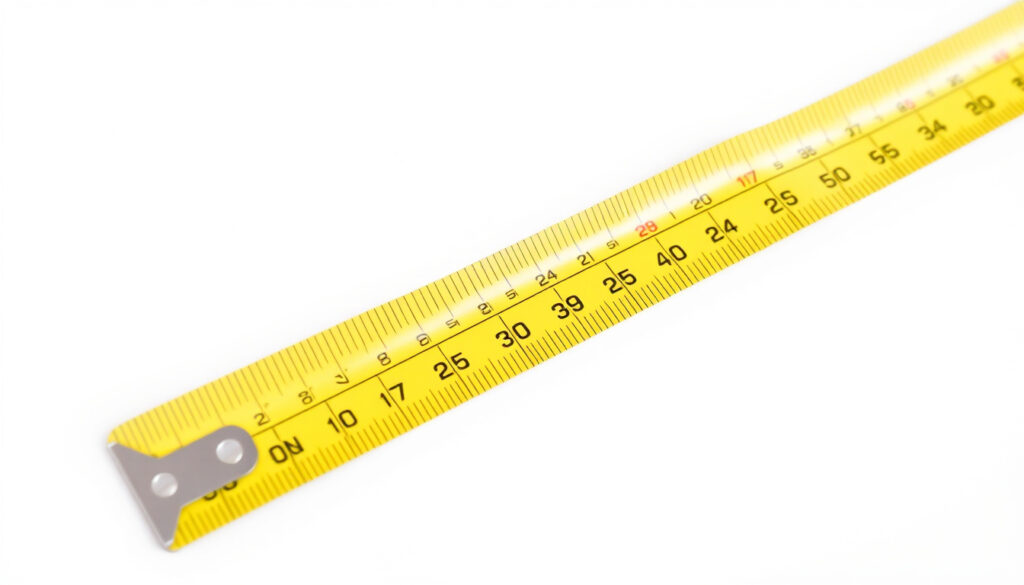
How Many Centimeters Are in a Meter? Exact Answer
Ever wondered why a meter stick is exactly 100 tiny marks long? That’s because the metric system makes it simple: 1 meter equals 100 centimeters. This guide breaks down the exact conversion, clears up common mix-ups with feet and inches, and shows you how to convert any measurement in seconds.
1 meter in centimeters: 100 cm ·
1 meter in feet: ≈ 3.28 ft ·
1 meter in inches: ≈ 39.37 in ·
1 centimeter in millimeters: 10 mm ·
1 meter in millimeters: 1000 mm
Quick snapshot
- 1 meter = 100 centimeters exactly (math.net (educational math reference))
- 1 meter = 1000 millimeters (RapidTables (conversion tool))
- Is 1 meter exactly 3 feet? No, it’s approximately 3.28 feet (UnitConverters.net (length conversion tool))
- Is 4 feet equal to 1 meter? No, 4 feet is about 1.2192 m (BYJU’S (education platform))
- The meter definition has been fixed since 1983 (LibreTexts (open educational resource))
- Use the conversion factor: multiply meters by 100 to get centimeters (CK-12 (flexible learning platform))
Six key values, one pattern: the metric system scales by powers of 10.
| Label | Value |
|---|---|
| 1 meter | 100 centimeters |
| 1 meter in feet | 3.28084 |
| 1 meter in inches | 39.3701 |
| 1 centimeter | 0.01 meter |
| 1 centimeter in millimeters | 10 |
| 1 millimeter | 0.001 meter |
The pattern: each step down the metric prefix ladder multiplies by 10, making conversions straightforward.
How many centimeters are in a meter?
How many centimeters make up one meter?
- 1 meter = 100 centimeters exactly (FAO (United Nations food and agriculture organization))
- 1 meter = 1000 millimeters (Math Tools (conversion table))
- 1 centimeter = 0.01 meter (LibreTexts (open educational resource))
The metric system defines the meter as the base unit of length. A centimeter is one hundredth of that base unit, so multiplying the number of meters by 100 gives you the number of centimeters. This relationship is exact and never changes.
What is the relationship between meter and centimeter?
- 1 cm = 0.01 m (reciprocal conversion) (UnitConverters.net (length conversion tool))
- The conversion factor is 100: multiply meters by 100 to get cm (RapidTables (conversion calculator))
The meter and centimeter are directly linked through the decimal system. Moving from meters to centimeters means shifting the decimal point two places to the right. For example, 1.5 meters becomes 150 centimeters.
The takeaway: the meter-to-centimeter conversion is one of the simplest in the metric system — no fractions, no decimals, just a clean factor of 100.
The meter-to-centimeter conversion is one of the easiest in all of measurement: just multiply by 100. No fractions, no decimals, no rounding. That’s the beauty of the metric system.
The pattern: the conversion is exact and effortless.
Is 200 cm equal to 1 meter?
How many meters are 200 centimeters?
- 200 cm = 2 meters (Math Tools (cm to m table))
- To convert cm to m, divide by 100 (UnitConverters.net (length conversion))
Since 1 meter is 100 centimeters, 200 centimeters is twice that — exactly 2 meters. A common mistake is thinking 200 cm equals 1 meter, but that would only be true if a meter were 200 cm.
What about 30 cm?
- 30 cm = 0.3 meters (RapidTables (cm to m converter))
- 10 cm = 0.1 meters (LibreTexts (metric conversion guide))
Thirty centimeters is not a third of a meter — it’s 0.3 meters. To find out how many 30 cm segments fit into 1 meter, divide 100 by 30, which gives approximately 3.33 segments.
The pattern: dividing centimeters by 100 gives meters. Always remember that 100 cm is the breakpoint, not 200 or 30.
How does the meter compare to feet and inches?
Is 1 meter exactly 3 feet?
- 1 meter ≈ 3.28084 feet (FAO (conversion table from UN agency))
- 1 foot = 0.3048 meters (UnitConverters.net (length conversion))
No, 1 meter is slightly longer than 3 feet. At 3.28 feet, it’s about 3 feet and 3⅜ inches. The common approximation “1 meter = 3 feet” is off by almost 3 inches.
How many inches in a meter?
- 1 meter = 39.3701 inches (RapidTables (meter to inch conversion))
- 1 inch = 0.0254 meters (Math Tools (conversion table))
A meter is just over 39 inches, which is about 3 feet 3 inches. So a yard (36 inches) is shorter than a meter by about 3.37 inches.
Is 1 foot longer than 1 meter?
- 1 foot is 0.3048 meters, so 1 meter is longer (CK-12 (educational platform))
- 4 feet = 1.2192 meters (BYJU’S (metric conversion chart))
No, a foot is much shorter. Four feet is only about 1.22 meters — so a person who is 4 feet tall is about 1.22 meters. For reference, the average adult height of 5’11” is approximately 1.80 meters.
The trade-off: imperial units are not evenly divisible by the metric system. If you often work with both, keep a conversion factor handy: multiply feet by 0.3048 to get meters, or multiply meters by 3.281 to get feet.
When converting to imperial units, remember that 1 meter is not exactly 3 feet — it’s about 3.28 feet. Using the rounded 3-foot figure will throw off your calculations by nearly 3 inches per meter.
The pattern: imperial conversions require decimal approximations.
How many millimeters are in a centimeter?
What is the metric system hierarchy?
- Metric prefixes: kilometer (km), hectometer (hm), dekameter (dam), meter (m), decimeter (dm), centimeter (cm), millimeter (mm) (LibreTexts (metric system overview))
- Each step is a factor of 10 (CK-12 (flexible learning))
The metric system is decimal-based: moving from one unit to the next involves multiplying or dividing by 10. From meter to centimeter is two steps down (m → dm → cm), so the factor is 10 × 10 = 100.
How many millimeters in a meter?
- 1 meter = 1000 millimeters (Math Tools (m to cm table, gives mm))
- 1 centimeter = 10 millimeters (UnitConverters.net (cm to m))
- Scientific notation: 1 m = 1×10² cm = 1×10³ mm (FAO (conversion reference))
So a millimeter is one-thousandth of a meter. That means a meter stick is also a 1000-millimeter stick. The hierarchy is consistent: 1 cm = 10 mm, 1 m = 100 cm = 1000 mm.
Why this matters: once you understand the power-of-10 pattern, you can convert any metric length without a calculator — just shift the decimal point.
How big is 1 meter?
What objects are about 1 meter long?
- 1 meter is roughly the height of a doorknob from the floor (CK-12 (visual comparison))
- 1 meter is a little over 3 feet (RapidTables (conversion))
- Standard guitar neck is about 1 meter (Math Tools (reference))
Visualizing a meter helps: it’s about the width of a standard doorway, or the length of a baseball bat. If you stretch your arms to the sides, the distance from fingertip to fingertip is roughly 1 meter for many adults.
How tall is a person of 5’11\” in meters?
- 5’11” = 71 inches = 1.8034 meters (UnitConverters.net (length conversion))
- 1 inch = 0.0254 meters (FAO (conversion table))
A person who is 5 feet 11 inches tall is about 1.80 meters. That’s roughly 180 centimeters. So if you’re 5’11”, you can say you’re 1.80 m tall.
The implication: knowing the approximate size of a meter in familiar objects makes it easier to estimate lengths without a ruler. A meter is about one long stride, or the height of a typical kitchen counter.
How to Convert Meters to Centimeters in 3 Steps
- Take the number of meters you want to convert. For example, 2.5 meters.
- Multiply that number by 100: 2.5 × 100 = 250.
- Add the unit “centimeters” — 2.5 meters = 250 centimeters.
That’s it. The formula is: centimeters = meters × 100. To go the other way, divide by 100.
Source: RapidTables (conversion formula)
The catch: don’t forget that the conversion is exact only for meters to centimeters. For imperial conversions, you’ll need decimal approximations.
What’s Confirmed and What’s Still Unclear
Confirmed facts
- 1 meter = 100 centimeters exactly (math.net (educational math reference))
- 1 meter = 1000 millimeters (Math Tools (conversion table))
- 1 centimeter = 10 millimeters (UnitConverters.net (length conversion))
- 1 centimeter = 0.01 meter (LibreTexts (open educational resource))
What’s unclear
- Is 1 meter exactly 3 feet? No, it’s approximately 3.28 ft (FAO (conversion table))
- Is 4 feet equal to 1 meter? No, 4 feet is about 1.22 m (BYJU’S (metric conversion chart))
- Is 10 inches equal to 1 meter? No, 10 inches is 0.254 m (RapidTables (cm to m))
- Is 200 cm equal to 1 meter? No, 200 cm is 2 meters (Math Tools (cm to m table))
The pattern: the key conversions are exact; common misconceptions arise from imperial approximations.
Quotes from Experts
The meter is the length of the path travelled by light in vacuum during a time interval of 1/299,792,458 of a second.
— International System of Units (SI), official definition
The metric system uses decimal-based steps, so 1 meter to 1 centimeter is a factor of 100.
— LibreTexts (open educational resource on metric measurement)
For anyone who regularly works with measurements — whether in science, construction, or everyday life — the meter-to-centimeter conversion is a foundational skill. The decision is simple: remember that 1 meter equals 100 centimeters exactly, and you’ll never be off by a factor of 10. Anyone converting between metric and imperial should keep a conversion table handy to avoid errors from approximations.
Related reading
- How Long Does It Take to Walk a Mile? — a related measurement guide
- What Is a Fortnight? — another unit-of-measure explainer
The pattern: these guides extend measurement knowledge beyond length conversions.
Frequently asked questions
Is 10 inches equal to 1 meter?
No, 10 inches is 0.254 meters. A meter is about 39.37 inches. (UnitConverters.net (length conversion))
Which is longer, 1 centimeter or 1 meter?
1 meter is longer. 1 meter equals 100 centimeters, so a meter is 100 times longer than a centimeter. (math.net (educational reference))
Is 1 foot exactly 12 inches?
Yes, 1 foot is exactly 12 inches. That is a standard definition in the imperial system. (FAO (conversion table))
How many centimeters are in a meter stick?
A meter stick is exactly 100 centimeters long. That’s the same as 1 meter. (CK-12 (educational platform))
How many centimeters are in 1000 meters?
1000 meters equals 100,000 centimeters. Multiply by 100: 1000 × 100 = 100,000. (Math Tools (conversion table))
How do you convert meters to centimeters?
Multiply the number of meters by 100. The formula: d(cm) = d(m) × 100. (RapidTables (conversion formula))
More related posts
 What Is in the Big Beautiful Bill? Provisions & Impact
 Alabama Football Schedule 2025: Dates, Odds, Playoff Path
 Hearing Aids Near Me: Cost, Coverage & Local Pros
 Who Is Bad Bunny? Real Name, LGBTQ, Kendall Jenner
 Dmitry Bivol Next Fight: Michael Eifert on May 30, 2026
 Advion Cockroach Gel Bait: How It Works and How to Use
 Broward County School Calendar: Key Dates & Updates
 Better Than the Movies: Age Rating, Spice & Parent Guide