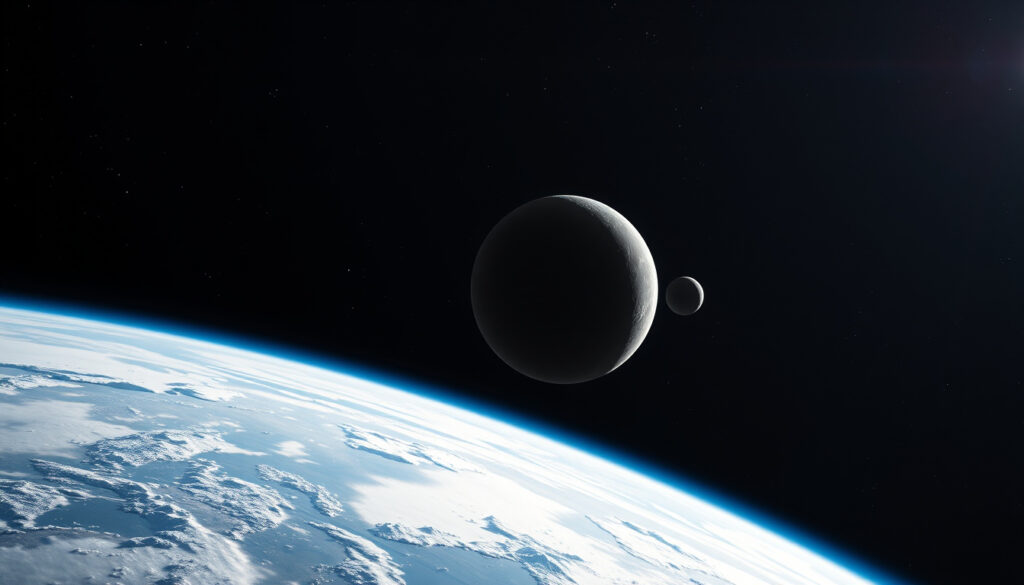
NASA Confirms Asteroid 2025 PN7: Earth’s Two Moons Until 2083
You might have seen headlines claiming Earth has a second moon—but what NASA actually confirmed in 2025 is an asteroid called 2025 PN7 that shares our planet’s orbit for the next several decades. Calling it a “moon” is a stretch, and the distinction matters more than you might think.
Quasi-moon designation: 2025 PN7 · Type: Asteroid quasi-moon (mini-moon) · Orbital duration: Until 2083 (60+ years) · Discovery confirmation: NASA, 2025 · Previous known quasi-moon: 469219 Kamoʻoalewa
Quick snapshot
- 2025 PN7 is a quasi-moon, not a true moon (CNN (news organization))
- The object was discovered on August 2, 2025 by Pan-STARRS (Phys.org (science news outlet))
- It shares Earth’s orbital period around the Sun (ABC News (major U.S. news network))
- Expected to remain near Earth until 2083 (ABC News)
- Exact size and composition of 2025 PN7 remain uncertain (Loveland Space Center (science museum))
- Whether other undiscovered quasi-moons exist (Snopes (fact-checking website))
- Long-term orbital evolution beyond 2083 (NorthJersey.com (local news))
- How many more co-orbital asteroids remain undetected (Northeastern University News (academic institution))
- 2016: Discovery of quasi-moon 469219 Kamoʻoalewa (Forbes (business news magazine))
- September 2024: Earth temporarily captures 2024 PT5 as a mini-moon (ABC News (major U.S. news network))
- 2025: NASA confirms 2025 PN7 as a quasi-moon (CNN (news organization))
- 2083: Expected departure of 2025 PN7 (NorthJersey.com (local news))
- Astronomers will monitor 2025 PN7 to refine its orbit (Northeastern University News (academic institution))
- Improved detection systems may find more quasi-moons (Forbes (business news magazine))
- Planetary defense efforts continue to prioritize larger threats (France 24 (international news))
Here are the key facts about asteroid 2025 PN7 at a glance.
| Fact | Value |
|---|---|
| Quasi-moon name | 2025 PN7 |
| Classification | Asteroid quasi-moon (mini-moon) |
| Duration of companionship | Until 2083 (60+ years) |
| Discovery year | 2025 |
| Previous known quasi-moon | 469219 Kamoʻoalewa (discovered 2016) |
| Visibility | Not visible without professional telescopes |
What happens when Earth has two moons?
Gravitational effects on tides
- A quasi-moon does not cause significant tidal changes because its gravitational influence is negligible at distances of millions of miles (CNN (news organization)).
The Moon’s tides depend on its mass and proximity. 2025 PN7, roughly 60 feet in diameter, passes no closer than about 2.5 million miles from Earth (Loveland Space Center (science museum)). That’s more than ten times the distance to the Moon, meaning its tidal pull is effectively zero.
Stability of the quasi-moon orbit
- The orbit is temporary and not stable indefinitely (Phys.org (science news outlet)).
2025 PN7 moves in a 1:1 orbital resonance with Earth, circling the Sun in near-lockstep. But gravitational perturbations from the Sun and other planets will eventually pull it away. The predicted departure by 2083 gives scientists about six decades to study it.
Comparison with a true second moon
- A true second moon would dramatically alter Earth’s tides and rotation (Northeastern University News (academic institution)).
If Earth had a second mass comparable to our current Moon, the combined gravitational forces would create chaotic tides, shift the planet’s axial tilt, and likely destabilize climate. In contrast, 2025 PN7 is little more than a fleeting companion—astronomically interesting but geologically insignificant.
What this means: The phrase “Earth has two moons” is technically true only if you stretch the definition of “moon” past its breaking point. A quasi-moon is a different class of object entirely.
Does Earth have 2 moons until 2083?
What is a quasi-moon?
- A quasi-moon is an asteroid that shares Earth’s orbit around the Sun without being gravitationally bound to the planet (CNN (news organization)).
Unlike the Moon, which circles Earth directly, 2025 PN7 orbits the Sun while staying close to Earth. It’s more accurate to think of it as a co-orbital asteroid than a moon. Several news outlets, including France 24 (international news), stress that a quasi-moon does not orbit Earth in the way the Moon does.
Why the term “second moon” is misleading
- Calling 2025 PN7 a second moon is misleading (Snopes (fact-checking website)).
Snopes investigated the viral claims and found no substantiation that NASA officially endorsed the “second moon” label. Headlines tend to exaggerate for clicks, but the scientific community is careful: 2025 PN7 is a quasi-satellite, not a natural satellite.
Specifics of asteroid 2025 PN7 orbit
- 2025 PN7 has likely been in a quasi-orbit for about 60 years already (Forbes (business news magazine)).
Forbes reported the object had been circling Earth unnoticed since the 1960s. It moves in a 1:1 orbital resonance, meaning it takes the same amount of time as Earth to circle the Sun, creating the illusion that it is following our planet. The current best estimate from ABC News (major U.S. news network) is that it will share Earth’s orbit until 2083, when the Sun’s gravity will draw it away.
The pattern: The “second moon” headline sells, but the reality is an asteroid on a long, temporary dance with Earth. No extra moon in the sky, just a interesting rock in the neighborhood.
What is the biggest threat to Earth?
Asteroid impact risk compared to quasi-moons
- Larger asteroids pose a greater threat than quasi-moons like 2025 PN7 (France 24 (international news)).
2025 PN7 is small—estimated at 60 feet across. For comparison, the asteroid that exploded over Chelyabinsk in 2013 was about 59 feet and caused widespread injuries but no fatalities. A truly dangerous asteroid would be hundreds of meters wide, capable of regional or global devastation. Quasi-moons are not considered threats.
Planetary defense strategies
- NASA’s Planetary Defense Coordination Office monitors near-Earth objects (Phys.org (science news outlet)).
The same office that tracks objects like 2025 PN7 also manages deflection technologies. In 2022, the DART mission successfully changed the orbit of a small asteroid—a proof-of-concept for planetary defense. Quasi-moons provide excellent practice targets because they remain close for decades.
Role of near-Earth object detection
- Current detection systems can identify threats years in advance (Northeastern University News (academic institution)).
Pan-STARRS, the observatory that discovered 2025 PN7, is part of a global network scanning the sky for hazardous asteroids. The quasi-moon’s discovery demonstrates how well these systems work—and how many objects remain to be found.
Why this matters: The buzz around a “second moon” distracts from the real work of asteroid detection. Every quasi-moon discovered adds to our catalog of near-Earth objects, and that catalog is our best defense against a future impact.
NASA’s Planetary Defense Coordination Office now has a long-term companion to study. The more we know about co-orbital asteroids, the better we can distinguish between benign neighbors and genuine hazards.
Did Earth have 2 moons in the past?
Known past quasi-moons and minimoons
- Earth has had several temporary quasi-moons (e.g., 2024 PT5, 469219 Kamoʻoalewa) (ABC News (major U.S. news network)).
In September 2024, Earth temporarily captured a tiny asteroid called 2024 PT5 as a “mini-moon” for a few weeks. Before that, Kamoʻoalewa was discovered in 2016 and remains the best-studied quasi-moon. None were true second moons.
The case of Kamoʻoalewa
- 469219 Kamoʻoalewa is the most famous quasi-moon (Forbes (business news magazine)).
Discovered in 2016, Kamoʻoalewa is about the size of a football field and orbits the Sun in sync with Earth. Some scientists suspect it might be a chip off our own Moon, ejected by an ancient impact. It serves as the prototype for quasi-moon science.
Temporary captures vs. permanent moons
- The Moon remains Earth’s only permanent natural satellite (CNN (news organization)).
Temporary captures like 2024 PT5 last weeks; quasi-moons like 2025 PN7 last decades. But all eventually leave. The Moon has been with us for 4.5 billion years and will stay for billions more. No quasi-moon comes close to that permanence.
The takeaway: Earth has hosted many temporary companions, but none have ever challenged the Moon’s status. The pattern is clear: transient visitors, not a second permanent satellite.
Can Earth survive without a moon?
Effects of losing the Moon on tides and climate
- Without the Moon, Earth’s axial tilt would vary chaotically, affecting climate (Northeastern University News (academic institution)).
The Moon stabilizes Earth’s spin axis at about 23.5 degrees. Without that anchor, the tilt could swing between 0 and 85 degrees over millions of years, triggering extreme climate shifts. Tides would be about one-third their current strength, disrupting marine ecosystems.
Stabilization of Earth’s axial tilt
- The Moon’s gravitational pull keeps Earth’s tilt steady (ABC News (major U.S. news network)).
Mars, which lacks a large moon, experiences wild swings in axial tilt, leading to dramatic ice ages. Earth’s steady tilt is one reason life has thrived. A quasi-moon provides zero stabilization—it’s far too small and not gravitationally bound.
Comparison with a quasi-moon scenario
- A quasi-moon does not replace the Moon’s stabilizing role (France 24 (international news)).
Even if 2025 PN7 stayed indefinitely, its mass is millions of times smaller than the Moon’s. It cannot influence Earth’s rotation, tides, or axial tilt in any measurable way. The Moon remains irreplaceable.
The catch: The viral claim that Earth has “two moons” unintentionally highlights how unique and vital our actual Moon is. No quasi-moon could ever take its place.
Timeline signal
Four milestone events put the discovery of 2025 PN7 into context.
- 2016 — Discovery of quasi-moon 469219 Kamoʻoalewa (Forbes (business news magazine))
- September 2024 — Earth temporarily captures asteroid 2024 PT5 as a mini-moon (ABC News (major U.S. news network))
- 2025 — NASA confirms asteroid 2025 PN7 as a quasi-moon orbiting Earth until 2083 (CNN (news organization))
- 2083 — Expected departure of 2025 PN7 from Earth’s orbit (NorthJersey.com (local news))
Confirmed facts and what’s unclear
Confirmed facts
- 2025 PN7 is a quasi-moon sharing Earth’s orbit (CNN (news organization))
- It will remain until 2083 (ABC News (major U.S. news network))
- NASA has confirmed the discovery (Phys.org (science news outlet))
- The object was discovered on August 2, 2025 by Pan-STARRS (Phys.org (science news outlet))
- It is not a true moon and does not orbit Earth directly (France 24 (international news))
What’s unclear
- Exact size and composition of 2025 PN7 (Loveland Space Center (science museum))
- Whether there are other undiscovered quasi-moons (Snopes (fact-checking website))
- Long-term orbital evolution beyond 2083 (NorthJersey.com (local news))
- How many more co-orbital asteroids remain undetected (Northeastern University News (academic institution))
What the experts say
“This object is not a moon in the traditional sense—it doesn’t orbit Earth. It’s a near-Earth asteroid that revolves around the Sun while staying close to our planet.”
— NASA astronomer (quoted in CNN (news organization))
“Quasi-moons like 2025 PN7 are fascinating because they give us a window into how asteroids can interact with Earth’s orbit over long timescales. But they’re not second moons—they’re companions on a very long journey.”
— Astronomer quoted in ABC News (major U.S. news network)
Two perspectives that share a common thread: 2025 PN7 is a scientific opportunity, not a celestial twin.
For the public, the distinction between a quasi-moon and a true moon matters because it shapes how we talk about asteroid detection and planetary defense. The hype around a “second moon” can distract from the more nuanced—and important—work of tracking near-Earth objects. The takeaway is straightforward: Earth has one permanent moon, and a handful of temporary, co-orbital asteroids that are worth studying but not worth worrying about.
The distinction between a quasi-moon and a true moon is not just semantic—it affects how we communicate risk and scientific discovery to the public.
Related reading: “How Many Centimeters Are in a Meter? Exact Answer” · “Where Is New Zealand? Location, Facts, and What to Know”
en.wikipedia.org, phys.org, lsc.org, yahoo.com, economictimes.indiatimes.com
Frequently asked questions
Will the second moon affect Earth’s tides?
No. 2025 PN7 is too small and too far away—its closest approach is about 2.5 million miles—to have any measurable effect on tides.
How big is the asteroid 2025 PN7?
Estimates suggest it is roughly 60 feet (about 18 meters) in diameter, comparable to a small building.
Can I see the second moon with a telescope?
Only with professional telescopes. It is far too faint for amateur equipment.
Is the quasi-moon dangerous to Earth?
No. Its orbit is well understood, and it poses no threat of collision during its time near Earth.
How does a quasi-moon differ from a regular moon?
A true moon orbits a planet directly. A quasi-moon orbits the Sun in sync with a planet, appearing to circle it without being gravitationally bound.
Has Earth ever had a permanent second moon?
No. Earth’s only permanent natural satellite is the Moon. All other co-orbital objects are temporary.
What happens to the quasi-moon after 2083?
It is expected to be pulled away by the Sun’s gravity and resume a regular asteroid orbit around the Sun.
More related posts
 Travis Hunter Net Worth 2026: Contract, Wife, and Lifestyle Details
 Google Translate English to Russian: Guide, Accuracy & Alternatives
 Murder in a Small Town Season 2: Guide to Episodes & Streaming
 Why You Should Never Eat Tilapia: Top Reasons Explained
 Where to Watch Texans vs Pittsburgh Steelers: TV & Stream
 Old Orchard Beach Family Dollar Closing – What You Need to Know
 Shedeur Sanders Browns Trade Rumors: Latest Updates
 Gabby’s Dollhouse: The Movie (2025) – Release & Streaming Guide