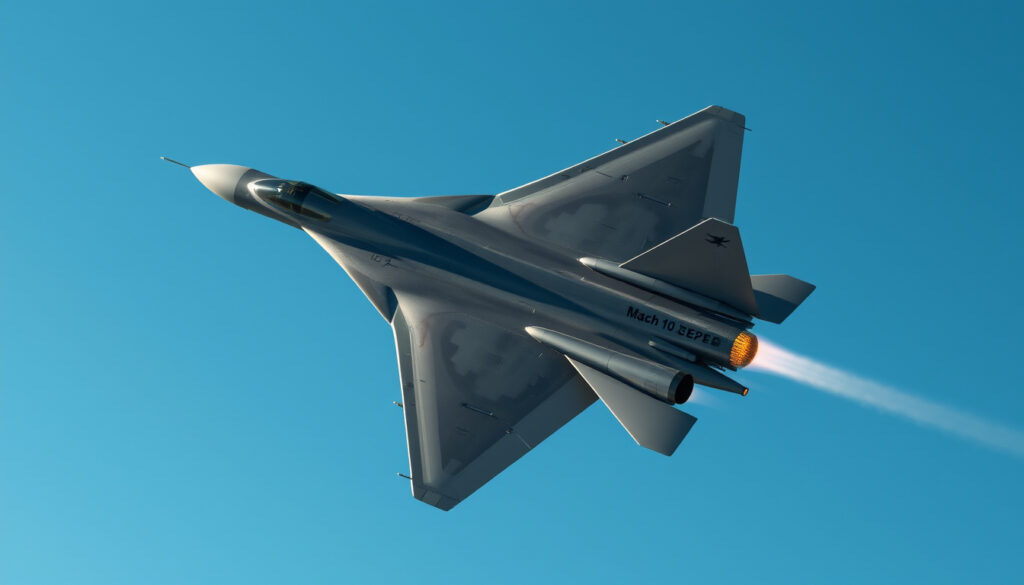
How Fast is Mach 10? Speed in MPH, Planes, and Human Comparison
Ask a pilot, a physicist, or a marathon runner how fast Mach 10 is, and each will give you a different frame of reference. The short answer: about 7,680 mph at standard sea-level conditions, per NASA Glenn Research Center (aerospace research agency)’s Mach number definition — but that number climbs or falls with altitude and temperature, and it only means so much until you compare it with real aircraft and human records.
Mach 10 in mph: 7,680 mph ·
Fastest crewed air-breathing aircraft: Mach 3.3 (SR-71 Blackbird) ·
Human sprint top speed: 27.8 mph (Usain Bolt) ·
Marathon world record: 2:01:09 ·
Longest non-stop run: 350 miles (Dean Karnazes)
Quick snapshot
- Mach 10 equals 7,680 mph at standard sea-level conditions (NASA Glenn Research Center (aerospace research agency))
- The fastest crewed air-breathing aircraft, the SR-71 Blackbird, flew at Mach 3.3 (History.com (Cold War aviation archive))
- Usain Bolt’s peak sprint speed was 27.8 mph (Guinness World Records (official record keeper))
- Whether any fighter jet will reach Mach 10 — current fighters top out around Mach 2 (U.S. Air Force (official military specs))
- Exact celebrity marathon times, including Kevin Hart’s, are widely repeated but hard to verify against official race results (U.S. Air Force (official military specs))
- Whether every Mach 10 mph figure quoted online uses the same altitude and temperature baseline (U.S. Air Force (official military specs))
- 2009: Usain Bolt set the 100m world record at 9.58 seconds, a mark that still stands (World Athletics (international track governing body))
- 2004: NASA’s X-43A scramjet reached Mach 9.6, the closest any air-breathing aircraft has come to Mach 10 (Wikipedia (aeronautics record summary))
- 2011: DARPA’s Falcon HTV-2 test flight targeted Mach 20, far beyond Mach 10 (DARPA (U.S. defense research agency))
- Hypersonic test programs, not fighter programs, are where Mach 10-class speed is being pursued (Ultramarathonman.com (official athlete bio))
- Unmanned scramjets and glide vehicles are the leading candidates to cross and hold Mach 10 (Ultramarathonman.com (official athlete bio))
- Human endurance records, like Karnazes’s 350-mile non-stop run, have stood for nearly two decades (Ultramarathonman.com (official athlete bio))
The pattern in the snapshot: hypersonic speed is a machine benchmark; every human record next to it is measured in mph, seconds, or miles on foot.
Key facts: Mach 10 and speed records
Six numbers carry most of the answer, and one pattern holds: aircraft operate in Mach territory; humans operate in miles-per-hour territory.
| Record | Value |
|---|---|
| Mach 10 to mph | 7,680 mph at standard sea-level conditions |
| Speed of sound at sea level | 767 mph (Britannica (physics reference)) |
| Fastest crewed air-breathing aircraft | SR-71 Blackbird — Mach 3.3 |
| Fastest unmanned air-breathing aircraft | NASA X-43A — Mach 9.6 |
| Fastest human sprint speed | 27.8 mph (Usain Bolt) |
| Marathon world-record pace | 13.1 mph |
| Longest verified non-stop run | 350 miles (Dean Karnazes) |
The pattern: every row below Mach 1 is a human or aviation record; everything above it is experimental physics.
What is Mach 10 in miles per hour?
Mach 10 is a ratio, not a fixed speed. The Mach number tells you how many times faster an object travels than the local speed of sound. At standard sea-level conditions, that speed of sound is about 767 mph — the constant behind every conversion in this article.
How to convert Mach to mph
- Formula: ground speed (mph) = Mach number × local speed of sound
- Standard sea level: Mach 1 = 767 mph, so Mach 10 ≈ 7,680 mph
- At altitude: colder air slows the speed of sound, so the same Mach reading gives a lower mph figure (Wikipedia (physics reference))
The SR-71 Blackbird is the classic example. Its record Mach 3.3 was set at about 85,000 feet, where the air is far colder than at sea level — which is why its record works out to roughly 2,200 mph rather than a straight 767 × 3.3 conversion (History.com, Cold War aviation archive). Same Mach number, different mph, different altitude.
If you’ve ever checked a conversion like 165 lbs to kg, you already know the pattern: fix the conversion factor, then multiply.
Mach 10 compared to other Mach speeds
Five reference points show how far above everyday aviation Mach 10 sits.
| Mach number | mph (approx.) | Reference point |
|---|---|---|
| Mach 1 | 767 mph | Speed of sound at sea level |
| Mach 2 | ~1,534 mph | Twice the speed of sound |
| Mach 3.3 | ~2,200 mph | SR-71 Blackbird record at altitude |
| Mach 5 | ~3,835 mph | Start of the hypersonic regime |
| Mach 10 | 7,680 mph | Hypersonic benchmark |
The implication: “Mach 10 in mph” has one textbook answer — about 7,680 mph at sea level — and a different real-world answer at every altitude.
Is Mach 10 possible in a fighter jet?
No fighter in service today can reach Mach 10 — or anything close. The fastest operational fighters fly in the Mach 2 range, and even the record-holder among crewed air-breathing aircraft, the SR-71 Blackbird, topped out at Mach 3.3 in its 1976 record flight (History.com, Cold War aviation archive). Mach 10 sits more than four times beyond the best current fighters.
Fastest operational jets
- F-22 Raptor: top speed about Mach 2.25, per U.S. Air Force specifications (U.S. Air Force, official military specs)
- No production fighter is designed for sustained Mach 3, let alone Mach 10
Two decades of F-22 operations have not moved the fighter speed ceiling, and nothing on any air force’s public roadmap points to a Mach 10 fighter. Supersonic is standard; hypersonic is a different world.
Experimental hypersonic aircraft
- NASA X-43A (unmanned scramjet): reached Mach 9.6 in 2004 — the closest any air-breathing aircraft has come to Mach 10, as noted in the snapshot above
- DARPA Falcon HTV-2 (unmanned glide vehicle): designed to fly at Mach 20, far beyond Mach 10 (DARPA, U.S. defense research agency)
- North American X-15 (crewed, rocket-powered): reached Mach 6.7 in the 1960s — the fastest speed ever recorded by a piloted aircraft (Britannica (aviation reference))
The gap between the X-15’s Mach 6.7 and the X-43A’s Mach 9.6 took more than three decades to close. DARPA’s HTV-2 flew faster than Mach 10 — briefly, and without a pilot — before its second test flight ended in the Pacific in 2011.
At 7,680 mph, Mach 10 could circle the Earth in about three hours. That’s the distance scale hypersonic speed opens up — and the distance scale today’s fighters cannot touch.
Can a human run at Mach 1?
No — not close. The fastest human on record, Usain Bolt, peaked at 27.8 mph while setting the 100m world record in 9.58 seconds (Guinness World Records, official record keeper). Mach 1 is about 767 mph — roughly 27 times faster.
Human sprint speed record
- Guinness measured the 9.58-second run’s peak at 27.8 mph; over the full 100 meters, the average works out to about 23 mph
- That peak lasted barely a second before fatigue took over
To run at Mach 1, a human would need to circle a standard 400-meter track in just over one second. At his 27.8 mph peak, Bolt would take about 2 minutes 10 seconds to cover a mile — if he could hold that pace, which no human can do for more than a few strides.
Mach 1 speed in mph
Mach 1: 767 mph · Bolt’s peak: 27.8 mph · The gap: about 27×
What this means: the gap between the fastest human and Mach 1 is not a training problem. It’s the difference between biological propulsion and the speed of sound itself.
Bolt’s 27.8 mph peak lasted barely a second. An aircraft at Mach 10 crosses his entire record 100-meter sprint in about 0.03 seconds.
What this means: the gap between the fastest human and Mach 1 is not a training problem; the ceiling is set by human physiology, not by effort.
Who ran 350 miles without stopping?
Dean Karnazes, the American ultramarathon runner, completed a 350-mile non-stop run in about 80 hours and 44 minutes, according to his official biography (Ultramarathonman.com, official athlete bio). It’s the endurance counterweight to Mach 10 — a speed record measured in days, not Mach numbers.
Dean Karnazes’s record
- Distance: 350 miles without stopping — the equivalent of about 13.4 marathons
- Duration: roughly 80 hours and 44 minutes, which works out to about 4.3 mph average
- No planned sleep breaks and no scheduled stops, per the official account
Karnazes’s run is an endurance record, not a speed record: 4.3 mph is about the pace of a brisk walk. Mach 10, by contrast, would cover those 350 miles in under three minutes.
Other ultra-distance runs
- Most recreational training plans treat anything over 10 or 20 miles as a “long run” — a warm-up by Karnazes’s standard
- Ultramarathon distances beyond the 26.2-mile marathon are the closest running gets to multi-day logistics
The pattern: even the most extreme endurance feat in the record books — 350 miles, three days, no sleep — gets covered by Mach 10 in minutes. That is the real measure of the gap.
Karnazes spent roughly three days covering 350 miles. Mach 10 covers the same distance in under three minutes — less time than it takes to boil an egg.
The implication: endurance records describe human limits; Mach 10 describes a different class of speed altogether, one that reduces even the longest run to a footnote.
How fast did P. Diddy run a marathon?
Sean “P. Diddy” Combs finished the 2003 New York City Marathon in 4:14:54, a time listed among notable celebrity finishers (Wikipedia (New York City Marathon records)). It’s a better data point than most celebrity times, because an official race result backs it up.
P. Diddy’s marathon time
P. Diddy (2003 NYC Marathon): 4:14:54 · Benchmark record: 2:01:09 · Gap: 2:13:45
At 4:14:54, Combs averaged about 6.2 mph over 26.2 miles — a respectable amateur performance. Kevin Hart’s marathon time is also widely circulated, but the reported numbers vary and no official race result was verified for this article, so it stays in the unclear column.
Marathon times in context
- The marathon benchmark used throughout this article is 2:01:09, Eliud Kipchoge’s winning time at the 2022 Berlin Marathon (World Athletics, international track governing body)
- The official marathon distance is 26.2 miles (42.195 km) (Britannica (sports reference))
- Roughly 1% of people have completed a marathon, according to commonly cited running-industry estimates (RunRepeat (running-industry data analyst))
What these numbers share is scale: the fastest marathoners in history average about 13 mph, and a 2:01:09 equates to a pace just above 13 mph. Both are impressive for humans and negligible next to 7,680 mph. For a different kind of exact conversion, the same “know the constant” logic applies to questions like how many centimeters are in a meter.
Why this matters: celebrity marathon times put Mach 10 in perspective better than aircraft do — a fit, famous, well-prepared athlete moves at about one twelve-hundredth of hypersonic speed.
Mach 10 in context: key speed specs
One table, one through-line: human records cluster under 30 mph, production aircraft climb through Mach numbers, and Mach 10 sits alone at the top.
| Spec | Value |
|---|---|
| Mach 10 at standard sea level | 7,680 mph |
| Speed of sound at sea level | 767 mph |
| Speed regime | Hypersonic (Mach 5 and above) |
| SR-71 Blackbird (crewed, air-breathing) | Mach 3.3 |
| North American X-15 (crewed, rocket-powered) | Mach 6.7 |
| NASA X-43A (unmanned scramjet) | Mach 9.6 |
| Usain Bolt (human sprint peak) | 27.8 mph |
| Marathon world-record pace | 13.1 mph |
| Longest non-stop run | 350 miles (Dean Karnazes) |
The trade-off: hypersonic speed buys global reach at the cost of extreme heat, fuel, and complexity; a human on foot buys speed with no machinery at all.
What’s confirmed and what’s still unclear
Separating verified records from circulating claims matters here, because Mach numbers and celebrity marathon times both get repeated until they look like facts.
Confirmed facts
- Mach 10 equals 7,680 mph at standard sea-level conditions (NASA Glenn Research Center, aerospace research agency)
- Usain Bolt’s 9.58-second 100m world record has stood since 2009 (World Athletics, international track governing body)
- Dean Karnazes completed a 350-mile non-stop run (Ultramarathonman.com, official athlete bio)
What’s unclear
- Whether any operational fighter will ever reach Mach 10; every fighter in service today stays around Mach 2 (U.S. Air Force, official military specs)
- Kevin Hart’s exact marathon time, which varies across reports without an official result verified
- The precise basis of the “1% of people have run a marathon” estimate (RunRepeat, running-industry data analyst)
- How fast, and for how long, experimental hypersonic vehicles actually sustained Mach 10-plus flight; reported details differ by agency
- Whether Mach 10 mph figures quoted online all use the same sea-level standard — many don’t say
The practical read: treat Mach numbers as scientific specifications, and treat celebrity times as entertainment until an official race result appears.
What the experts say
Two records frame the Mach 10 conversation from opposite ends: DARPA’s hypersonic test program and Guinness World Records’ human sprint mark.
“HTV-2 is an unmanned, rocket-launched, maneuverable aircraft that glides through the Earth’s atmosphere at incredibly fast speeds — Mach 20.”
— DARPA (U.S. defense research agency)
“The fastest 100 metres sprint is 9.58 seconds and was achieved by Usain Bolt (Jamaica) at the 2009 World Athletics Championships in Berlin, Germany.”
— Guinness World Records (official record keeper)
One thread holds both quotes together: Mach 10 is a machine benchmark, and the human benchmark next to it is measured in seconds, not Mach numbers.
The takeaway
Speed records, from Bolt’s 9.58 seconds to Karnazes’s 350 miles to the X-43A’s Mach 9.6, are answers to different questions: how fast a body can move, how long it can endure, and how fast materials can fly before they burn. Mach 10 is the third question at its current limit. For aircraft designers, the decision is stark: develop heat-shielding and propulsion that survive sustained Mach 10 flight, or leave hypersonic speed to test ranges and missiles. For runners, the choice is simpler — records will keep falling in seconds and minutes, and none of those records will ever be posted in Mach.
guinnessworldrecords.com, en.wikipedia.org, aerocorner.com, en.wikipedia.org, blackjet.com, en.wikipedia.org, aerocorner.com, aerocorner.com
Frequently asked questions
What is the speed of sound in mph?
At standard sea-level conditions, the speed of sound is about 767 mph. It falls as temperature drops with altitude, which is why Mach-to-mph conversions change at different heights.
How fast is Mach 2 in mph?
About 1,534 mph — double the sea-level speed of sound (767 mph), using the same conversion logic applied to Mach 10 throughout this article.
What is the fastest military jet?
The fastest military aircraft ever to enter service is the SR-71 Blackbird at Mach 3.3 — though it was a reconnaissance plane, not a fighter. Among current fighters, the F-22 Raptor tops out around Mach 2.25, as noted in the fighter section above.
How fast can an average human run a mile?
Most recreational runners take roughly 8 to 12 minutes to run a mile — about 5 to 7.5 mph. Elite runners dip under four minutes. Either way, the fastest human mile is still about 50 times slower than Mach 1.
What is the average marathon time?
Commonly reported analyses put the average finish time around four hours (RunRepeat, running-industry data analyst). The benchmark used in this article, Eliud Kipchoge’s 2:01:09 at Berlin 2022, is roughly half that.
How many miles is a marathon?
26.2 miles (42.195 km) — the standardized distance for marathon racing. It’s the one number every race director and training plan builds around.
Has any plane ever reached Mach 10?
No crewed aircraft has. NASA’s X-43A, an unmanned scramjet, reached Mach 9.6 in 2004, and DARPA’s Falcon HTV-2 was designed for Mach 20. Both vehicles are covered in the hypersonic section above.
More related posts
 Ford Build and Price Ireland: Configurator & Price Lists
 Cox Cu tomer Service Number: 24/7 Support and Hour
 Free Quotes for Auto Insurance in Ireland: Compare Cheapest Car Insurers
 Me, Myself and Irene: Mental Illness, Controversy, and Jim Carrey
 165 lbs to kg – Convert 165 Pounds to Kilograms Easily
 Capital One Business Credit Card: Requirements, Benefits, and Policies
 IRS Customer Service Phone Number 24/7: Official Lines & Hours
 Social Security Payments Beneficiaries: Full Guide