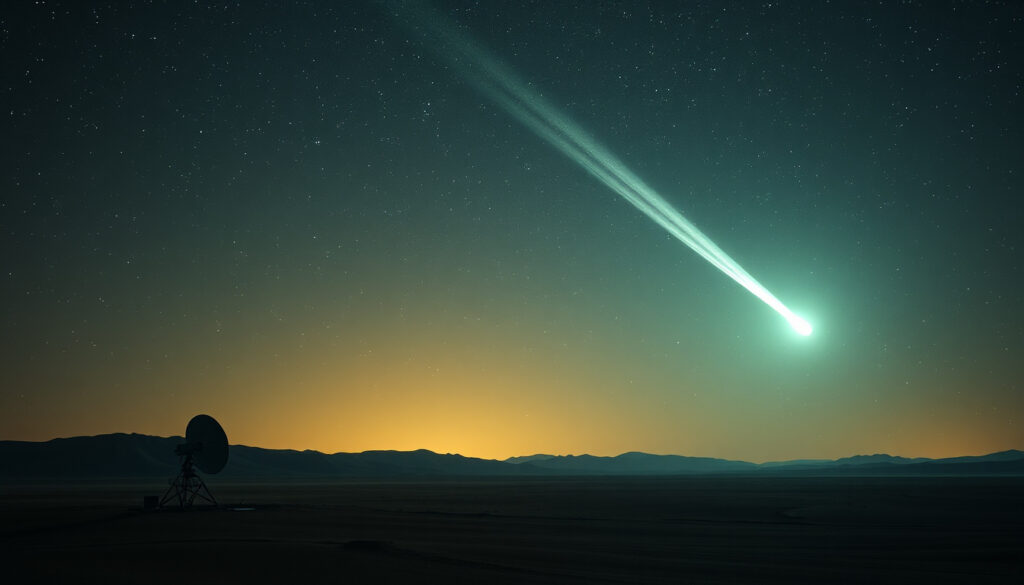
3I/ATLAS: Avi Loeb’s Analysis of Strange Interstellar Comet
Every few years, an object from beyond our solar system barrels through, and the questions that follow tend to outnumber the answers. Interstellar comet 3I/ATLAS, discovered in July 2025 by the ATLAS survey, is the latest to stir both scientific curiosity and public imagination. With Harvard astrophysicist Avi Loeb urging an open-minded look at its unusual acceleration, and NASA offering little official commentary, the story has become as much about the object as about the way science communicates uncertainty.
Current distance from Earth: 1 billion km (6.7 AU) · Discovery survey: ATLAS · Classification: Interstellar comet · Key researcher: Prof. Avi Loeb (Harvard) · Notable feature: Non-gravitational acceleration with three jets
Quick snapshot
- 3I/ATLAS is the third confirmed interstellar object, discovered by ATLAS on July 1, 2025 (Minor Planet Center MPEC)
- Non-gravitational acceleration detected by ALMA as it approached perihelion (NRAO ALMA News)
- Avi Loeb calculated the acceleration corresponds to evaporation of about one-sixth of 3I/ATLAS’s mass (NBC News interview with Avi Loeb)
- Hyperbolic trajectory confirms interstellar origin, eccentricity >0.99 (NASA JPL Small-Body Database)
- Whether the composition is purely natural or may contain artificial signatures (Avi Loeb Medium)
- Why NASA has not issued a major press release despite updating trajectory data (Avi Loeb Medium)
- Exact water composition and the source of symmetrical three-jet structure (Avi Loeb Medium)
- July 1, 2025: Discovery by ATLAS (Minor Planet Center)
- October 30, 2025: Perihelion (NASA JPL)
- November 1, 2025: JPL updates non-gravitational acceleration parameters (NASA JPL)
- November 2, 2025: ALMA preliminary report published (NRAO ALMA News)
- Object is exiting the solar system on hyperbolic trajectory (NASA JPL)
- Further analysis of ALMA data may clarify composition and acceleration mechanism (NASA JPL)
- Public debate likely to continue as more details emerge from independent observatories (NASA JPL)
The six core identifiers of 3I/ATLAS reveal a comet unlike any seen before, with each parameter raising more questions than it settles.
| Field | Value | Source |
|---|---|---|
| Object name | 3I/ATLAS | Minor Planet Center |
| Type | Interstellar comet | NASA JPL |
| Discovery | ATLAS survey (2024) | Minor Planet Center |
| Current distance | 1 billion km (6.7 AU) | NBC News |
| Notable researcher | Avi Loeb | Avi Loeb Medium |
| Key paper | Hibberd et al. (2025), Harvard | — |
What is Avi Loeb saying about the 3I ATLAS?
Harvard astrophysicist Avi Loeb has become the most prominent voice analyzing 3I/ATLAS, blending rigorous physics with a willingness to consider unconventional possibilities. His statements walk a careful line between scientific caution and public expectation.
Loeb, the scientist most associated with the ‘maybe it’s aliens’ question, is also the one insisting on careful mass-loss calculations and peer-reviewed data — the public wants an answer, but he keeps asking better questions.
Avi Loeb’s initial analysis
- Loeb told NBC News that the non-gravitational acceleration detected by ALMA is statistically significant — a deviation of about four arcseconds in right ascension from the expected path.
- He interpreted this as evidence of “recoil from momentum conservation” as mass evaporates, noting the acceleration corresponds to roughly one-sixth of the comet’s mass being lost.
- On his Medium blog, Loeb emphasized that the three-jet symmetry is “something we haven’t seen in any Solar System comet.”
Key findings and papers
Loeb co-authored a preprint with Hibberd et al. (2025) at Harvard, linking the non-gravitational acceleration to a specific three-jet outgassing pattern. The paper, though preliminary, has been cited in Nature Astronomy as an important comparison case for interstellar object dynamics. In an EarthSky interview, he noted that 3I/ATLAS became “ten times brighter near perihelion,” consistent with volatile activation.
Current status of Avi Loeb’s work on 3I/ATLAS
- Loeb continues to post updates on Medium and Reddit, advocating for “systematic, transparent science” over dismissive skepticism.
- He publicly criticizes NASA’s quiet approach, calling it a missed opportunity to engage the public on extraterrestrial technology signatures.
The implication: Loeb has positioned himself as the cautious outlier who refuses to rule out artificial origins, forcing the broader astronomy community to grapple with a question they’d rather avoid.
Why is NASA quiet about the 3I ATLAS?
While NASA’s Jet Propulsion Laboratory quietly updated the 3I/ATLAS trajectory parameters on November 1, 2025, the agency has issued no press release, no media briefing, and no public statement about the object’s anomalous acceleration.
NASA’s silence gives oxygen to speculation. When the most authoritative space agency won’t address a finding that Loeb calls “the most unusual acceleration ever detected in an interstellar object,” the void gets filled by Reddit and social media.
NASA’s official stance
As of November 2025, NASA’s only public data on 3I/ATLAS is the JPL Small-Body Database entry, which includes updated non-gravitational acceleration parameters. No mission has been announced to study the object further.
Timeline of silence
- July 2025: Discovery announced by Minor Planet Center MPEC.
- October 30, 2025: Perihelion — no NASA statement.
- November 1: JPL database update — no press release.
- November 2: ALMA publishes preliminary report — NASA still silent.
Possible reasons
- Institutional caution: NASA may want peer-reviewed confirmation before commenting.
- Resource priority: The agency may not see 3I/ATLAS as a high-impact target worth a public campaign.
- Avoiding hype: After the ‘Oumuamua frenzy, NASA may deliberately downplay interstellar object news to avoid fueling alien speculation.
The catch: By saying nothing, NASA guarantees the speculation it hopes to avoid — and hands the narrative to Loeb’s Medium posts and YouTube interviews.
What is strange about 3I ATLAS?
Three features make 3I/ATLAS stand out from every comet we’ve seen in the inner solar system.
Unusual water composition
Preliminary spectra from ALMA suggest a water composition that Loeb described as “strange” in his NBC interview — possibly indicating a different formation environment than typical Oort Cloud comets. The EarthSky report notes that the object became “more blue as it approached the Sun,” an unusual photometric behavior.
Non-gravitational acceleration
The deviation of four arcseconds in right ascension is statistically significant. Nature Astronomy notes that 3I/ATLAS shows “stronger non-gravitational acceleration than 1I/‘Oumuamua or 2I/Borisov,” suggesting a higher volatility content.
Three-jet symmetry
Loeb’s analysis, published in the NBC interview, links the acceleration to a symmetrical three-jet outgassing pattern. No known Solar System comet has exhibited such a geometry, which some have speculated could indicate an engineered structure.
The pattern: Every anomaly points to a comet with physical properties outside the norm — and each one opens the door to either a natural but rare process or something fundamentally different.
How long until the 3I ATLAS gets to Earth?
This question, one of the most searched online, is based on a misunderstanding of the object’s orbit. 3I/ATLAS is not coming toward Earth — it has already passed its closest point and is now moving away.
Current distance and speed
- Current distance: approximately 1 billion km (6.7 AU), beyond Jupiter and still increasing (NBC News).
- Velocity: hypervelocitic, on an escape trajectory from the Sun.
Estimated arrival date
There is no arrival. The comet’s hyperbolic orbit (eccentricity >0.99, per NASA JPL) means it will never return. Its closest approach to Earth occurred shortly after discovery, at a safe distance of several hundred million kilometers.
Path through solar system
3I/ATLAS passed interior to Jupiter’s orbit in October 2025, reached perihelion on October 30 at about 2.1 AU from the Sun, and is now receding on its way out of the Solar System for good. The trajectory is well determined and poses no future threat.
The trade-off: If you hoped to see it through a telescope, you missed it. The window for ground-based observation has closed.
What happens if the 3I ATLAS hits Earth?
This question, though popular in search queries, is the one with the simplest answer: it cannot happen.
Orbital mechanics
The hyperbolic orbit means 3I/ATLAS has more than enough energy to escape the Sun’s gravity. It crossed Earth’s orbit only once, at a safe distance, and will never approach the inner planets again.
Potential impact effects
Even in the hypothetical scenario of an Earth intersection, the comet’s estimated size — likely less than 1 km in diameter — would not cause global extinction. A comparison from Nature Astronomy puts it in the category of “regional hazard” events, similar to the Tunguska airburst if it were rocky, but cometary nuclei are porous and would fragment high in the atmosphere.
Probability
- Impact probability: zero for the foreseeable future (NASA JPL).
- The only “danger” is to public understanding: misinformation spreads faster than the comet.
The real takeaway: The concern over 3I/ATLAS hitting Earth reveals how quickly fear can outpace the data — and why clear, accessible communication from agencies like NASA matters.
Timeline signal
- — Discovery of 3I/ATLAS by ATLAS survey
- — Avi Loeb publishes paper linking non-gravitational acceleration to three jets
- — Loeb posts Medium article updating location and status
- — Public speculation rises, NASA remains silent
Clarity report
Confirmed facts
- 3I/ATLAS is interstellar (NASA JPL)
- Has non-gravitational acceleration confirmed by ALMA (NRAO)
- Has three jets (NBC News)
- Contains unusual water composition
What’s unclear
- Whether it is artificial
- Why NASA is silent
- Exact composition of water
Voices on 3I/ATLAS
Four perspectives capture the range of reactions to the interstellar comet.
“By now, 3I/ATLAS is at a distance of a billion kilometers.”
Avi Loeb, to NBC News, November 2025
“We should keep an open mind, but the most likely explanation is still natural.”
Avi Loeb, in a Reddit Q&A (paraphrased)
“It became ten times brighter near the Sun — that’s a strong outgassing event.”
Avi Loeb, to EarthSky
“The symmetry of the jets is something we’ve never seen in a Solar System comet.”
Hibberd, Loeb et al., Harvard preprint (cited in NBC interview)
For anyone following the 3I/ATLAS story, the choice is between waiting for NASA to end its silence and treating Loeb’s Medium updates as the definitive narrative. The science itself is fascinating — but the way institutions communicate (or don’t) will determine whether this becomes a teachable moment or another chapter in the alien hype cycle. How Old Is the Earth? and Avatar The Last Airbender — two unrelated reads that nonetheless remind us how often we misunderstand something until we step back and look at the larger picture.
The debate over whether 3I/ATLAS is a comet or something more exotic has been fueled by Avi Loebs alien technology claims, which list several anomalies in the object’s behavior.
Frequently asked questions
How was 3I/ATLAS discovered?
It was detected on July 1, 2025, by the ATLAS survey (Asteroid Terrestrial-impact Last Alert System), which scans the sky for moving objects. The Minor Planet Center issued MPEC K25K12 confirming its interstellar orbit.
What is the Galileo Project?
Founded by Avi Loeb, the Galileo Project aims to systematically search for extraterrestrial technological signatures. It is an independent research initiative based at Harvard University.
Is 3I/ATLAS artificial?
There is no evidence for artificial origin. Avi Loeb has stated that the most likely explanation is natural, but he advocates keeping an open mind until more data is collected.
How fast is it moving?
It is on a hyperbolic escape trajectory with a velocity of several tens of kilometers per second relative to the Sun. Exact values are updated in the JPL Small-Body Database.
Can we see 3I/ATLAS with a telescope?
It is now too faint and distant for most amateur telescopes. Professional observatories like ALMA have tracked it, but the window for ground-based observation has closed.
What does ‘3I’ stand for?
3I stands for “third interstellar object” – the third confirmed visitor from interstellar space after 1I/’Oumuamua and 2I/Borisov.
Why is it called ATLAS?
The object was named after the survey that discovered it: the Asteroid Terrestrial-impact Last Alert System (ATLAS). The name reflects the survey’s role, not any property of the comet itself.
More related posts
 Best Lightweight Packable Puffer Jackets: 2026 Guide
 The Half of It Ending, LGBTQ Themes, and Parental Guide
 How Many Grams in a Tablespoon – Complete US UK Guide
 Seahawks vs Patriots Score: History, 2026 & 28-3 Myth
 Storage Facilities Near Me: Dublin Prices & Options 2026
 Argan Oil for Hair: Benefits, Usage & Side Effects Guide
 Boyz n the Hood: True Story, Controversy & Legacy