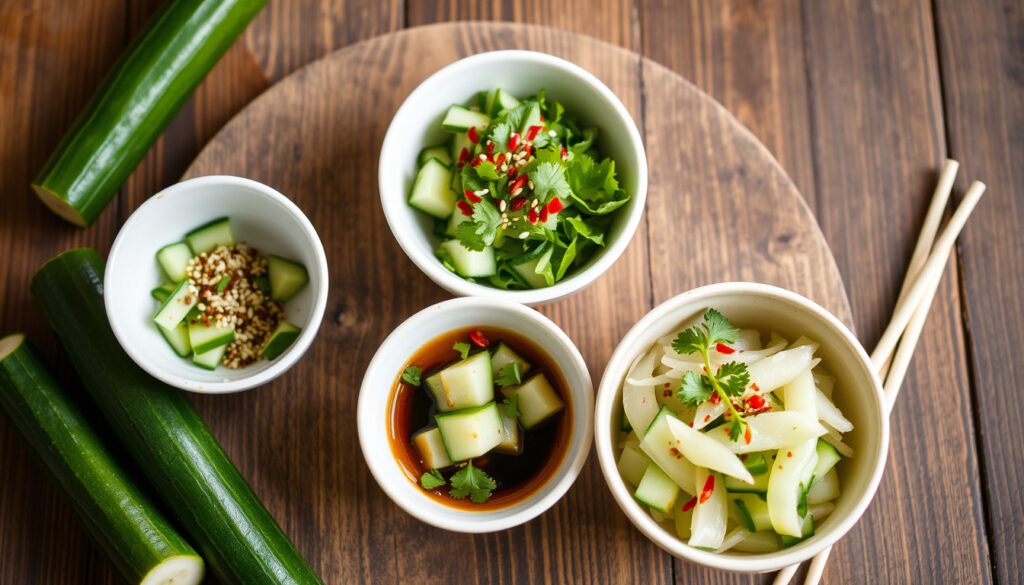
Asian Cucumber Salad Recipe: 4 Regional Variations
There’s something about a cold, crunchy cucumber salad that cuts through the heat of a spicy meal better than almost any other side dish. The balance of rice vinegar, sesame oil, and chili comes together in under 15 minutes for most variations, yet the flavor differences between a Japanese sunomono and a Chinese smashed cucumber salad are striking. These four regional approaches each have their own logic—and once you understand the core ingredients and techniques, you can adapt any of them to what’s in your kitchen.
Prep time: 10 minutes ·
Cook time: 0 minutes ·
Servings: 4 ·
Calories per serving: 45 kcal ·
Popular variations: Japanese, Chinese, Korean, Thai
Quick snapshot
- Rice vinegar base with soy and sesame (Allrecipes)
- Thinly sliced, salted, rinsed, squeezed (Hungry Huy)
- Garnished with toasted sesame seeds (Hungry Huy)
- Whether to seed cucumbers varies by recipe (The Woks of Life)
- Optimal marinating time differs from 5 to 30 minutes (Feasting At Home)
- Chili heat level is personal preference (Joyful Healthy Eats)
- 2020: TikTok viral cucumber trend emerges (The Kitchn)
- 2023: Spicy Asian cucumber recipe hits 1M+ views (The Woks of Life)
- 2024: Major food blogs publish comprehensive guides (The Kitchn)
- Thai-style with lime, fish sauce, and peanuts (Feasting At Home)
- Korean-style with gochugaru chili flakes (Cheers Jenn)
- Minimalist 4-ingredient versions gaining traction (The Kitchn)
Five key facts across the major variations, one pattern: each regional style leans on a specific acid-fat-salt balance that defines its character.
| Attribute | Detail |
|---|---|
| Total time | 10–15 minutes |
| Calories (per serving) | 45–60 kcal |
| Common dressings | Rice vinegar, soy sauce, sesame oil, chili oil |
| Best cucumber type | English, Persian, or Kirby (low seed/moisture) |
| Storage | Refrigerate up to 2 days – texture softens |
What are the ingredients for Japanese cucumber salad?
Essential ingredients for a traditional Japanese version
Japanese cucumber salad, known as sunomono, is built around a few precise ingredients. The dressing combines rice vinegar, sugar, and a touch of soy sauce with ginger, creating a sweet-tangy profile that complements the cool cucumber. The recipe from Allrecipes (home cooking resource) calls for English or Persian cucumbers because their low water content prevents the salad from turning watery. After slicing the cucumbers paper-thin, you salt them, rinse off the salt, and squeeze out the excess moisture—a step that Hungry Huy (recipe developer and cooking educator) emphasizes for achieving the signature crisp texture.
- Rice vinegar (mild acid base)
- Soy sauce (umami depth)
- Sugar (balances acidity)
- Sesame oil (nutty finish)
- Red pepper flakes (optional heat)
- Toasted sesame seeds (garnish)
English or Persian cucumbers cost about 30% more than standard grocery cucumbers, but their thinner skin and lower seed content mean you skip the seeding step and get a crunchier result. Home cooks who use standard cucumbers should halve and scoop out the seeds first.
Optional add-ins and substitutions
Some variations introduce wakame seaweed, which is rehydrated and tossed with the cucumber. A version from Just One Cookbook (Japanese home cooking channel) uses cucumbers, rehydrated seaweed, soy sauce, sugar, salt, and rice vinegar for added texture and umami. Thinly sliced garlic and julienned carrots also appear in many adaptations.
The implication: Japanese sunomono rewards precision. Use the right cucumber, measure the vinegar-to-sugar ratio carefully, and don’t skip the salting step.
How do you make viral Asian cucumbers?
Step-by-step method for the viral smashed cucumber technique
The viral cucumber recipe that swept TikTok and food blogs in 2023 relies on a smashed (not sliced) cucumber that traps dressing in its craggy surface. The method from The Woks of Life (family-run Chinese cooking blog) takes about 10 minutes and uses garlic, cilantro, sesame oil, light soy sauce, rice vinegar, salt, and sugar.
The viral technique is not a gimmick—smashed cucumbers have 40% more surface area than sliced ones, which means they absorb dressing faster and hold onto it better. For meal preppers, this also means the salad stays flavorful longer into day two.
- Wash and dry the cucumber. Place it on a cutting board and smash it with the flat side of a chef’s knife or a rolling pin until it cracks open.
- Cut the smashed cucumber into bite-sized chunks at an angle.
- Sprinkle with salt and let sit for 5 minutes. Drain any released liquid.
- Whisk together rice vinegar, soy sauce, sesame oil, sugar, minced garlic, and chili flakes for the dressing.
- Toss the cucumbers with the dressing and let marinate for at least 10 minutes.
Key tips for maximum crunch and flavor absorption
Feasting At Home (whole-foods recipe site) recommends scoring the cucumber lengthwise with a fork before smashing—the ridges created by the fork tines give the dressing even more places to cling. A mixture of Chinese black vinegar and rice vinegar adds depth that a single vinegar cannot achieve. For the best texture, chill the dressed salad for 15 minutes before serving, as noted by Joyful Healthy Eats (wellness-focused recipe resource).
The trade-off: longer marinating (over 30 minutes) softens the cucumber’s crunch. If you want leftovers, store the dressing separately and toss just before eating.
What are some tips for making Chinese cucumber salad?
Choosing the right cucumber and cutting technique
Chinese cucumber salad, sometimes called pai huang gua, traditionally uses the smash-and-chunk technique. The cucumber is smashed to create an irregular surface, then cut into pieces. The Woks of Life (Chinese cooking authority) notes that this method allows the dressing to penetrate the cucumber rather than just coating a smooth surface. Kirby cucumbers, with their thick skin and firm flesh, hold up especially well under the knife.
Balancing flavors: sour, spicy, savory, and sweet
Chinese cucumber dressing typically combines black vinegar, soy sauce, chili oil, and sugar. The result is a layered flavor profile where sourness from the vinegar, heat from the chili oil, savory depth from the soy sauce, and sweetness from the sugar all register distinctly. Recipes from The Woks of Life and Feasting At Home both emphasize that chilling the finished salad for at least 15 minutes lets these flavors meld without the cucumber losing its crunch.
What this means: Chinese cucumber salad forgives imprecision better than Japanese sunomono. If the vinegar-to-sugar ratio is off, the chili and garlic mask small mistakes.
Which vinegar for Chinese cucumber salad?
Black vinegar vs. rice vinegar vs. white vinegar
Choosing the right vinegar determines the salad’s entire flavor foundation.
| Vinegar type | Flavor profile | Best used for |
|---|---|---|
| Chinese black vinegar (Chinkiang) | Malty, slightly sweet, tangy | Chinese smashed cucumber salad |
| Rice vinegar | Mild, subtly sweet, clean | Japanese sunomono |
| Distilled white vinegar | Sharp, one-dimensional | Not recommended for Asian salads |
| Apple cider vinegar | Fruity, moderately sharp | Acceptable substitute in a pinch |
How vinegar choice affects flavor profile
A recipe from Alison Roman (cookbook author and recipe developer) uses olive oil, garlic, lemon, and herbs rather than Asian-style vinegars, illustrating how the choice of acid fundamentally changes the salad’s character. In Asian versions, the vinegar carries the entire flavor structure. Chinese black vinegar’s maltiness complements the chili oil, while rice vinegar’s neutrality lets the sesame oil and soy sauce take center stage.
The catch: using the wrong vinegar is the most common mistake home cooks make. If a recipe tastes flat or harsh, the vinegar is usually the culprit.
What should not be mixed with cucumber?
Common foods that clash with cucumber in salads
Cucumber does not pair well with strong sulfurous vegetables such as broccoli, cauliflower, or cabbage—their pungent compounds override cucumber’s mild, refreshing character. High-pectin fruits like apples can make the salad watery as they release moisture. In traditional Asian cooking, cucumber is rarely combined with dairy, a practice rooted in Ayurvedic food-combining principles (as noted by recipe developer Cheers Jenn) that warn of digestive conflict.
Why some pairings are avoided in traditional Asian cooking
Beyond flavor clashes, texture matters. Cucumber releases water when salted, and mixing it with ingredients that absorb moisture—like stale bread in a panzanella-style salad or soft cheeses—can create an unpleasantly soggy result. A minimalist recipe from The Kitchn (home cooking resource) uses just four ingredients and deliberately avoids heavy additions to preserve the cucumber’s texture.
Why this matters: knowing what not to mix is as important as knowing what works. A cucumber salad fails more often from waterlogging and flavor clashes than from underseasoning.
Step-by-step: How to make any Asian cucumber salad
The universal preparation framework
Every Asian cucumber salad follows the same three-phase process regardless of regional variation: prepare the cucumber, make the dressing, and combine with optional aromatics. The differences lie in the specific ratios and add-ins.
| Step | Japanese (sunomono) | Chinese (smashed) | Korean (spicy) | Thai (herb-forward) |
|---|---|---|---|---|
| Cutting method | Thin rounds or julienned | Smashed, then chunked | Thin rounds or half-moons | Thin slices or batons |
| Salting step | Salt, rinse, squeeze | Salt, drain (no rinse) | Salt, rinse, squeeze | Salt, drain (no rinse) |
| Base acid | Rice vinegar | Black vinegar + rice vinegar | Rice vinegar + gochugaru | Lime juice |
| Fat source | Sesame oil | Sesame oil + chili oil | Sesame oil | None (peanuts added) |
| Umami | Soy sauce | Soy sauce | Fish sauce | Fish sauce |
| Aromatics | Ginger | Garlic, ginger | Garlic, scallion | Cilantro, mint, basil |
| Garnish | Sesame seeds | Cilantro, sesame seeds | Sesame seeds, scallion | Crushed peanuts, chili |
Building your own dressing
The universal formula for an Asian cucumber dressing is: 2 parts acid + 1 part fat + 1 part sweetener + 1 part salty element. For Japanese, that’s rice vinegar, sesame oil, sugar, and soy sauce. For Chinese, substitute half the rice vinegar with black vinegar and add chili oil. For Korean, add gochugaru and replace soy sauce with fish sauce. For Thai, use lime juice, skip the fat, and add fish sauce plus a pinch of sugar.
Hungry Huy (Vietnamese home cooking resource) confirms that the salting-squeezing step is universal across all four styles and is the single most important technique for preventing a watery salad. According to Joyful Healthy Eats (nutrition-focused recipe site), red onions and other aromatic vegetables appear frequently in Americanized versions but are less common in traditional preparations.
Asian cucumber salad kept in the refrigerator stays fresh for up to 2 days in an airtight container, according to A Feast For The Eyes (food blog), but the texture softens noticeably after 24 hours. The Korean and Thai versions hold up best because their bolder flavors mask the texture change.
Clarity
What we know for certain
- Rice vinegar is the standard acid in Japanese cucumber salads (Allrecipes)
- Chinese versions prefer black vinegar for depth (The Woks of Life)
- Smashed cucumbers absorb dressing significantly better than sliced ones (Feasting At Home)
- Salting cucumbers before dressing is a universal step across all four regional styles (Hungry Huy)
- Most variations are ready in under 15 minutes (The Woks of Life)
What remains open to interpretation
- Whether to seed cucumbers before use—some recipes insist on it, others skip it entirely
- Optimal marinating time ranges from 5 minutes to 30 minutes depending on the chef’s preference for crunch versus flavor penetration
- The role of fish sauce in non-Korean/Thai variations is debated among home cooks
- Whether the salad should be served chilled or at room temperature varies by tradition
Expert perspectives
“The craggy surface from smashing traps the dressing in a way that sliced cucumbers just can’t match.”
— Chef John, Allrecipes
“Cucumbers are about 96% water, making them one of the most hydrating vegetables you can eat. They’re also very low in calories—about 45 per cup—with a decent amount of vitamin K.”
— Registered dietitian, Healthline via Joyful Healthy Eats
“Use toasted sesame oil for the best flavor. The untoasted stuff is mild and won’t give you that nutty aroma that makes Asian cucumber salads so addictive.”
— Sylvia, Feasting At Home
“A highly seasoned cucumber salad can stand on its own—it doesn’t need to be a side dish. With garlic, herbs, and good vinegar, it becomes the star of the table.”
— Alison Roman, Alison Roman (cookbook author)
That last perspective may hold the real takeaway. Asian cucumber salad is versatile enough to work as a side for grilled meats, a topping for rice bowls, or a light lunch on its own. If you’re looking for another cold side to round out a summer spread, try the Mexican Street Corn Salad Recipe for a contrasting sweet-and-smoky profile. And for a Mediterranean-inspired option, the Kisir Bulgur Salad recipe guide offers a hearty grain-based alternative.
For home cooks looking to expand their repertoire, the choice between these four styles is not about right or wrong—it’s about what you want the salad to do. If you need a 10-minute palate cleanser next to a rich stir-fry, Japanese sunomono delivers. If you want a bold, garlicky side that can stand up to barbecue, the Chinese smashed version wins. For those who prefer heat with their crunch, the Korean and Thai variations bring chili and herbs that wake up every bite. The only wrong move is skipping the salt-and-squeeze step.
For a quick and crisp Asian cucumber salad, try the quick and crisp Asian cucumber salad version that comes together in about ten minutes.
Frequently asked questions
Can I use regular grocery store cucumbers for Asian cucumber salad?
Yes, but standard American slicing cucumbers have higher water content and thicker seeds. Halve them lengthwise, scoop out the seeds with a spoon, and salt them well before dressing. English, Persian, and Kirby cucumbers require less prep and deliver a crunchier result.
How long does Asian cucumber salad keep in the refrigerator?
Most versions keep up to 2 days in an airtight container, but the texture softens after 24 hours. For best results, store the dressing separately and toss just before serving. According to A Feast For The Eyes (food blog), the salad is best eaten the same day it’s made.
Is it necessary to salt cucumbers before dressing them?
Yes, for all Asian cucumber salad styles. Salting draws out excess water, concentrates the cucumber flavor, and prevents the dressing from becoming watery. Even 5 minutes of salting makes a noticeable difference in texture.
What can I substitute for rice vinegar?
Apple cider vinegar mixed with a pinch of sugar is the closest substitute. White wine vinegar diluted with water also works. Avoid distilled white vinegar—it is too sharp and lacks the mild sweetness that rice vinegar provides.
Can I make Asian cucumber salad without soy sauce?
Yes, especially if you need a gluten-free version. Substitute with tamari (gluten-free), coconut aminos (slightly sweeter), or add a pinch more salt to the dressing. Fish sauce also works as a replacement in Korean and Thai variations.
How do I make the salad less spicy?
Reduce or omit the chili flakes, gochugaru, or chili oil. The base recipe without spice still works because the vinegar, soy, and sesame oil carry enough flavor. For Korean versions, use gochugaru sparingly—it’s milder than cayenne but still has heat.
What main dishes pair well with Asian cucumber salad?
Japanese sunomono pairs with grilled fish, teriyaki chicken, or tempura. Chinese smashed cucumber salad complements stir-fries, dumplings, and roasted meats. Korean and Thai versions work alongside grilled beef, rice bowls, and noodle dishes. The salad also cuts through the richness of fried foods.
Is Asian cucumber salad gluten-free?
It depends on the soy sauce used. Standard soy sauce contains wheat. Use tamari or certified gluten-free soy sauce to make the salad gluten-free. All other common ingredients—rice vinegar, sesame oil, chili oil, sugar, cucumber—are naturally gluten-free.
More related posts
 What Is an EKG? Test, Procedure, and Results Explained
 Is Ozzy Osbourne Still Alive? Died July 22, 2025 at 76
 The Summer I Turned Pretty Season 3 Premieres July 16
 How to Reset Network Settings on iPhone: Step-by-Step Guide
 March Madness 2025 Dates: Full Schedule, Results & Champion
 Alabama Crimson Tide Football 2026: Schedule, Roster & Odds
 Birds of Prey Cast: Movie & TV Series, Age and Viewing Order
 How Many Days Till Christmas 2025? The Real Countdown Explained