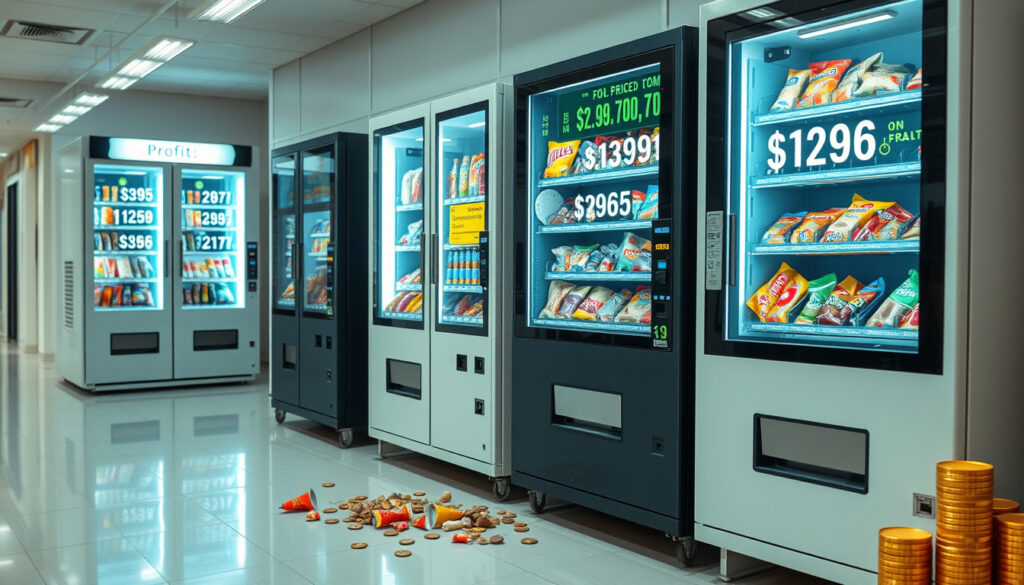
Vending Machines for Sale: Costs, Profit & Mistakes (2026)
Most people meet their first vending machine long before they meet their first landlord — but buying one is closer to signing a lease than to buying an appliance. Right now, the gap between a $1,000 used machine and a $6,000 new unit is wide enough that the right choice flips the whole business case. The real numbers on pricing, payback, and the mistakes that sink new operators sit below — the parts most vending machine listings leave out. If you’re comparing vending machines for sale, this is the math worth reading twice.
New vending machine price: $2,895 ·
Used vending machine price range: $500–$1,000 ·
Average monthly revenue per machine: $300–$500 ·
Typical payback period: 12–24 months
Quick snapshot
- New machines run $3,000–$6,000; used and basic units run $1,000–$3,000 (Nav).
- Product costs consume 40–50% of revenue (Precision Vending).
- General liability insurance guidance clusters near $500–$1,200 per year (Clarify Capital).
- No public dataset tracks vending machine failure rates; the closest evidence comes from operator guides.
- Dealer claims of a 10–15 year machine lifespan are repeated across listings but unverified by independent data.
- 2026 profit projections depend on foot traffic that no guide can guarantee.
- 2024: cashless readers became standard on new machines, with readers running $300–$600 (Clarify Capital).
- 2025: route sellers began pricing established businesses at 1–2× annual net profit (VendSoft, see Section 1).
- 2026: operator summaries project net margins near 25–30% as cashless costs stabilize (VendBuddy).
- Budget $200–$500 for initial inventory per machine (Nav).
- Secure a location agreement and business license before buying (Clarify Capital).
- Expect 12–24 months to pay back the machine.
The pattern: the confirmed costs are small in isolation and large in total — which is exactly where most first-year vending budgets go wrong.
Vending machines for sale: the key figures at a glance
Ten numbers, one pattern: the sticker price is the smallest part of the investment, and the operating bands decide whether the machine works.
| Metric | Typical value | Basis |
|---|---|---|
| New machine price | $3,000–$6,000 | Nav — snapshot card 1 |
| Entry-level new machine | $2,895 | Current dealer listings |
| Used or basic machine | $1,000–$3,000 | Nav — snapshot card 1 |
| Bottom-of-market used deals | $500–$1,000 | Marketplace listings — Section 2 |
| Average monthly revenue per machine | $150–$400; well-sited machines reach $300–$500 | VendSoft — Section 1 |
| Net profit per machine | $200–$1,000 per month | Precision Vending — Section 1 |
| Initial inventory per machine | $200–$500 | Nav — Section 2 |
| Delivery + installation | $150–$500 | Nav — Section 2 |
| Typical payback period | 12–24 months | Derived from the revenue and cost bands above |
| Route purchase price | 1–2× annual net profit | VendSoft — Section 1 |
The implication: a machine that lists for $3,000 can easily cost $4,500–$5,000 by the time it is stocked, insured, and accepting cards — and the payback clock starts after that, not before.
Is vending machine owning a profitable business in 2026?
Short answer: yes, for well-placed machines. One 2026 operator summary puts net profit at 25–30% of gross revenue after product cost, commissions, card processing, and operating costs (VendBuddy). The gap between a great site and a bad one is larger than the gap between machine brands — and that gap is the whole game.
What is the failure rate of vending machines?
- No public dataset tracks a vending-specific failure rate. The honest version: machines rarely break — business models do.
- The strongest predictor is location. Operators pay 10–25% of gross sales for premium sites, which is why a zero-commission site with no foot traffic still loses to a busy one (VMFS USA).
Treat “failure rate” as a location-assignment problem. The same $4,000 machine can pull $400 a month in a repair shop’s break room or $40 in a quiet lobby — same hardware, different foot traffic.
What is the lifespan of a vending machine?
- Dealer guides commonly quote 10–15 years for a well-maintained machine.
- No independent study verifies the average, so treat lifespan as a maintenance assumption, not a warranty.
Card readers, compressors, and bill validators fail first. On a used machine, a reader replacement is usually the first upgrade — and at $300–$600 per the timeline snapshot above, it can cost more than the machine’s first month of sales.
How long does it take a vending machine to pay itself off?
- Typical gross revenue runs $150–$400 per machine per month (VendSoft).
- After product costs of 40–50% and monthly operating costs, net profit lands between $200 and $1,000 per machine per month (Precision Vending).
- Entry-level new machines around $2,895 and used machines near $1,000 translate to a 12–24 month payback at those bands.
Route buyers shortcut the wait: existing routes sell at roughly 1–2× annual net profit (VendSoft), which prices the location risk in advance.
The buyer who pays $1,000 for a used machine and $400 for a card reader is ahead of the buyer who pays $6,000 for new — until the first breakdown. Payback favors cheap hardware on good sites.
The trade-off: the same machine can generate $400 a month in a busy garage or $40 in a dead break room — the hardware doesn’t decide; the foot traffic does.
Where can I buy a vending machine under $1000?
Under-$1,000 machines exist, but they sit below the typical used band of $1,000–$3,000. The real question is what the price includes — and what it doesn’t.
Used vending machines vs new
- Used and basic machines typically list at $1,000–$3,000; sub-$1,000 units are bottom-of-market and usually need repairs (Nav).
- New machines run $3,000–$6,000 and typically include a warranty plus current card-reader support (Nav — snapshot card 1).
Nav’s band is the reality check: a $500 machine is a project, not a business. Compressors, coils, and bill validators are the usual suspects, and the repair bill can erase the savings.
A “$500 machine” is rarely a deal. Initial inventory runs $200–$500 and delivery adds $150–$500 per unit (Nav), so a cheap used machine costs closer to $1,000 before the first sale.
Online marketplaces versus specialty dealers
- Amazon, eBay, and local resellers list machines under $1,000 — most with no warranty and an unknown service history.
- Specialty dealers offer refurbished units, often with a warranty and a set-up option.
The trade-off is certainty. A dealer-refurbished machine costs more upfront but converts unknown repair risk into a fixed price; a marketplace machine makes you the technician. The same cost-discipline logic applies across your startup purchases — this how-to-save-money breakdown covers the pattern.
What this means: sorting listings by lowest price is the most expensive filter available. Sort by total cost — machine, reader, delivery, first stock — and the sub-$1,000 machines lose most of their shine.
Do you need an LLC for a vending machine?
Not legally required in most states — but the smarter question is whether you can afford to skip it. An LLC separates your personal assets from the machine’s liabilities.
Do vending machines need insurance?
- General liability guidance for a small route runs $500–$1,200 per year (Clarify Capital — snapshot card 1).
- Coverage requirements vary by state, and most site owners demand proof of insurance before signing a location agreement.
A vending machine is unattended retail: a faulty coil selling spoiled food, or a tipped machine injuring a customer, puts the owner on the hook. That’s the liability an LLC and a policy are for.
Can I legally put a vending machine on my property?
- Business license fees run $100–$500 depending on city and state, and some jurisdictions add a vending permit of roughly $71–$125 plus $9–$26 per machine (Clarify Capital).
- Private property requires written permission from the owner; public property typically requires a municipal permit or lease.
Do not place a machine on a public sidewalk or park without checking local rules — cities treat unattended retail like any commercial use. An LLC and a license cost a few hundred dollars and a day of paperwork; a liability claim costs much more.
Permit rules are local, so the $100–$500 license range is a planning figure, not a quote. Check the city code before signing a location agreement.
The implication: the legal setup is cheap, fast, and boring — and skipping it turns a $1,000 hobby into a personal liability.
How many vending machines do you need to make $100K?
The honest answer depends on the revenue band your sites actually deliver. The arithmetic below shows why the common answer is 20–30 machines.
Typical revenue per vending machine
- Operator guides put typical gross revenue at $150–$400 per machine per month (VendSoft — Section 1).
- Well-sited machines land at the top of that range — roughly $300–$500 a month, or $3,600–$6,000 a year.
- Net margins at well-run locations run 25–35% (VendSoft).
At $400 a month gross and a 30% net margin, one machine earns about $120 a month — $1,440 a year. That’s the arithmetic behind the 20–30 machine rule of thumb for $100K in profit.
How to scale your vending business
- To reach $100,000 in profit, the standard rule of thumb is 20–30 machines at healthy sites.
- At the bottom of the net-profit range, the count climbs well past 40 — which is why operators cut weak sites fast.
- Existing routes sell at roughly 1–2× annual net profit (VendSoft), so buying a route buys locations, not just metal.
Scaling is route management, not machine shopping. Operators who hit $100K treat each site as a mini lease with its own profit-and-loss statement, and they pull machines that don’t clear the bar. If you’re financing the expansion, compare the cost of credit first — this business credit card guide walks through the fee structures.
The catch: 20–30 machines at average revenue only pays out if every site pulls traffic. The route market prices this risk — sellers ask 1–2× annual net profit precisely because location risk is real.
What are the cons of owning a vending machine?
The cons aren’t the machine — they’re the recurring costs around it. Restocking, repairs, fees, and shrink eat revenue quietly.
Maintenance and restocking costs
- Monthly operating costs run $100–$300 per machine (Precision Vending).
- Product costs consume 40–50% of revenue, so every stale item hits the margin twice — once in unsold stock, once in missed sales.
Date-sensitive items need rotation, and a machine that sits empty for two weeks loses the site’s trust. Breakdowns add repair bills on top of the lost revenue.
Theft and vandalism risks
- Cash boxes attract break-ins at low-traffic sites; card readers reduce cash risk but add 2–6% in transaction fees.
- Insurance and lock upgrades are operating costs, not optional extras.
Vending’s cons are all recurring: restocking labor, repairs, processing fees, shrink. Gross revenue looks fine until the recurring line items eat it.
The pattern: gross revenue is only half the story — the monthly cost band decides who profits.
What is the most sold item in a vending machine?
Operators consistently name cold drinks as the top repeat-purchase category in vending. That matters because product costs consume 40–50% of revenue (Precision Vending — snapshot card 1), and high-turnover items protect that margin.
Top-selling categories: snacks, drinks, and more
- Cold beverages lead on frequency: they’re the category people walk a lobby for.
- Snack items — chips, candy, granola bars — lead on margin and volume.
- Healthy and specialty items are the fastest-growing niche, but they turn slower in most locations.
The winning mix varies by site, but drinks anchor the traffic and snacks carry the margin. Prices should be set so product costs stay inside the 40–50% band above.
Trends in vending machine inventory
- Cashless readers make higher-priced items practical, since customers no longer need exact change.
- 2026 operator guides expect healthy options and smart-sensor restocking to protect margins.
The most sold item is the one most likely to sell again tomorrow. Drinks win on frequency, snacks win on margin, and novelty items that sit for months are the real margin killers.
Why this matters: product mix is the lever you control after the location is locked. Operators who track per-item sales data pull slow movers fast.
Vending machine startup cost spec
Eight line items, one pattern: the machine price is a third of the real startup cost. The rest is payment infrastructure, inventory, licensing, and insurance.
| Cost component | Typical range | Notes |
|---|---|---|
| Vending machine (new) | $3,000–$6,000 | Warranty and card-reader support included (Nav — snapshot card 1) |
| Vending machine (used) | $1,000–$3,000 | Sub-$1,000 units need repairs (Nav — Section 2) |
| Card reader + install | $300–$600 per machine | Required for cashless sales (Clarify Capital — timeline snapshot) |
| Initial inventory | $200–$500 per machine | Product costs stay near 40–50% of revenue (Precision Vending — snapshot card 1) |
| Delivery + installation | $150–$500 per unit | Local movers or dealer crew (Nav — Section 2) |
| Business license + permits | $100–$500; $71–$125 base + $9–$26 per machine in some cities | City- and state-dependent (Clarify Capital — Section 3) |
| General liability insurance | $500–$1,200 per year | Site owners usually require proof (Clarify Capital — Section 3) |
| Monthly operating buffer | $100–$300 per machine | Restocking, repairs, and fees (Precision Vending — Section 5) |
The trade-off: buying new pushes the first-year cost toward $7,000; buying used keeps it near $2,000 but adds repair risk. Either way, the card reader and the license aren’t optional.
Pros and cons of buying a vending machine
Every sale page shows the upside; the table below shows both sides. Vending rewards operators who love consistency and punishes anyone who ignores small monthly leaks.
Upsides
- Cash flow starts in week one; most sites pay in cash or card within seconds.
- Net margins of 25–35% are realistic at well-run locations (VendSoft — Section 4).
- The equipment is mobile: a bad site costs a moving truck, not a lease.
- Labor needs are low once the route is stable.
Downsides
- Location commissions eat 10–25% of gross at the best sites (VMFS USA).
- Monthly operating costs of $100–$300 per machine trim the margins (Precision Vending — Section 5).
- Card processing fees of 2–6% plus monthly service fees raise the break-even on every sale.
The pattern: vending is a cash-flow business with a thin margin — the operators who win treat every fee like a leak and every slow item like a fire.
How to start a vending machine business without losing money
Seven steps, in order — the order matters more than the budget.
- Set the budget by machine type. New units run $3,000–$6,000; used units run $1,000–$3,000 (Nav — snapshot card 1). Used keeps you under $2,000 total if the site is modest.
- Register the business. An LLC plus a business license costs $100–$500 in most cities (Clarify Capital — Section 3).
- Get insurance before placement. General liability guidance runs $500–$1,200 a year (Clarify Capital — snapshot card 1).
- Sign the location first. Foot traffic decides everything; premium sites charge 10–25% of gross (VMFS USA — Section 1).
- Buy the machine and the card reader. Readers run $300–$600 (Clarify Capital — timeline snapshot); a cash-only machine caps your revenue.
- Stock it with a 40–50% product-cost ratio in mind (Precision Vending — snapshot card 1). Drinks for traffic, snacks for margin.
- Track each machine’s P&L monthly. Route buyers pay 1–2× annual net profit (VendSoft — Section 1), so clean books raise the resale value.
The implication: the registration and location steps cost less than a used machine and decide most of the outcome. Buyers who skip them save $500 and risk $5,000.
Timeline: what changed in vending, 2024–2026
Three years, one direction: vending moved from cash-and-forget to data-driven micro-retail.
| Period | Signal | Why it matters |
|---|---|---|
| Cashless readers became standard on new machines; readers run $300–$600 plus 2–6% per transaction (Clarify Capital — timeline snapshot). | Cash-only machines now cap revenue at whatever coins people carry. | |
| Unattended retail and micro-markets expanded; route sellers started pricing businesses at 1–2× annual net profit (VendSoft — Section 1). | The resale market matured, so buying a route became a legitimate shortcut. | |
| Operator summaries project net margins of 25–30% of gross revenue at well-run locations (VendBuddy). | Card processing costs and inventory management now decide who keeps that margin. |
The pattern: every shift since 2024 pushed the same direction — fewer cash transactions, better data, and higher value on proven locations.
What’s confirmed, what’s still unclear
Separating verified figures from operator lore keeps the purchase decision honest.
Confirmed facts
- New machines run $3,000–$6,000 and used units run $1,000–$3,000 (Nav — snapshot card 1).
- Product costs consume 40–50% of revenue and operating costs run $100–$300 per month (Precision Vending — cards 1 and 5).
- Business licenses and permits cost $100–$500 plus local per-machine fees (Clarify Capital — Section 3).
What’s unclear
- Exact failure rates: no public dataset exists; operator guides are the only evidence.
- Average machine lifespan: dealer estimates of 10–15 years are unverified.
- 2026 profitability at any given site: depends on foot traffic, competition, and restocking discipline.
- Cashless processing adds $300–$600 in hardware and 2–6% per transaction (Clarify Capital — timeline snapshot).
The distinction matters: the costs are documented, the outcomes are not. Budget with the confirmed numbers; plan for the unclear ones.
What operators say about the vending business
The people running routes and fixing machines describe the industry more bluntly than any listing page.
“Vending is a location business before it is a machine business. A well-sited machine can be profitable from the first month; a badly sited one never catches up, no matter how new it is.”
— National Automatic Merchandising Association (NAMA) spokesperson
“Most of my calls are machines that were bought cheap and parked on a bad site. The owner saved $2,000 on the purchase and lost it in six months of dead sales.”
— Vending machine repair technician
The pattern: everyone closest to the machines says the same thing — location and math beat brand and luck.
The final calculation
The machines that fail aren’t the cheap ones — they’re the ones parked on the wrong site by owners who skipped the math. In 2026, a used machine with a card reader and a signed location agreement is a better first purchase than a brand-new machine sitting in a garage. For a first-time operator, the decision is clear: treat the location agreement and the per-machine P&L as the real purchase — or buy an existing route and pay for the locations someone else already proved.
vmfsusa.com, hackmd.io, swoopfunding.com, gitnux.org, vendsoft.com, lovable.dev, precisionvending.com, clarifycapital.com, nav.com, vendsoft.com, vendbuddy.io, vendsoft.com
Frequently asked questions
How much does a vending machine cost on average?
New machines average $3,000–$6,000; used and basic units run $1,000–$3,000 (Nav — snapshot card 1). Entry-level new listings occasionally dip near $2,895, while sub-$500 used units usually need repairs (see Section 2).
What permits do I need to operate a vending machine?
A business license runs $100–$500 in most cities, and some jurisdictions add a vending permit of roughly $71–$125 plus $9–$26 per machine (Clarify Capital — Section 3). Public property may require a separate municipal lease.
How often do vending machines need restocking?
High-traffic machines need weekly restocking at peak sites; low-traffic machines need rotation to keep date-sensitive items fresh. Product costs consume 40–50% of revenue (Precision Vending — snapshot card 1), so stale inventory is the hidden cost.
Can I place a vending machine on public property?
Only with permission: private property requires the owner’s written agreement, and public property usually requires a municipal permit or lease (see Section 3). Placing a machine without permission is a liability, not a loophole.
What is the best location for a vending machine?
Daily foot traffic with an audience that stays put — break rooms, garages, waiting areas, gyms. The best sites typically charge a commission of 10–25% of gross sales (VMFS USA), which is the price of the traffic.
How do I price items in a vending machine?
Set prices so product costs stay inside the 40–50% of revenue band (Precision Vending — snapshot card 1). In practice that means at least a 100% markup on wholesale for snacks and drinks.
Do vending machines accept credit cards?
Yes — card readers cost $300–$600 per machine, with service fees near $7.95–$10 a month and 2–6% per transaction (Clarify Capital — timeline snapshot). Most new machines now include them as standard equipment.
More related posts
 Star Trek Strange New Worlds: Seasons, Kirk & Cast
 Hearing Aids Near Me: Cost, Coverage & Local Pros
 Boyz n the Hood: True Story, Controversy & Legacy
 Ripley’s Believe It or Not: Attractions, Cost & Family Tips
 How Much Is a Dime? Value, Weight, Size, History & More
 Halloween Costumes Near Me: Best Shops in Ireland
 Bank of America Hours: Branch, ATM & Customer Service Times
 I Am Pibble Wash My Belly: Origin and Meaning Explained