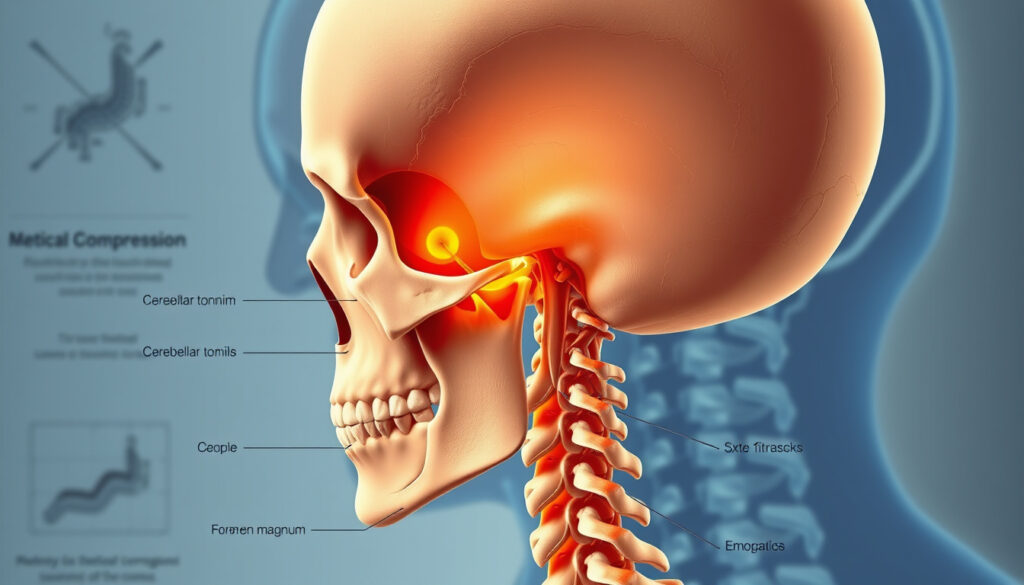
Chiari Malformation Type 1: Causes, Symptoms, and Prognosis
Finding out you have Chiari malformation type 1 can feel like a medical stop sign. The name sounds serious, and the MRI finding is permanent. Yet for many people, the more important message is that this finding often does not change anything. A Chiari type 1 malformation is a structural difference in the back of the skull, and the first question is not usually “Do I need surgery?” It is “What does this mean for me?”
Prevalence: 1 in 1,000–2,500 people · Most common type: Type I accounts for >90% of diagnosed Chiari malformations · Sex ratio: Females are affected more frequently than males (StatPearls, a peer-reviewed clinical reference).
These numbers set the clinical picture: Chiari type 1 is common, more common in females, and often found when an MRI is done for another reason.
| Feature | What the research says |
|---|---|
| What it is | Chiari malformation type I is a structural defect of the cerebellum, characterized by downward displacement of the cerebellar tonsils through the foramen magnum (StatPearls, a peer-reviewed clinical reference). |
| Prevalence | 1 in 1,000–2,500 individuals (StatPearls, a peer-reviewed clinical reference). |
| Most common type | Type I accounts for >90% of diagnosed Chiari malformations (StatPearls, a peer-reviewed clinical reference). |
| Sex predilection | Females are affected more frequently than males (StatPearls, a peer-reviewed clinical reference). |
| Age at diagnosis | Often diagnosed in childhood to early adulthood; symptoms can appear at any age (StatPearls, a peer-reviewed clinical reference). |
| Classic symptom | Suboccipital headache and neck pain worsened by coughing, sneezing, straining, or other Valsalva maneuvers (StatPearls, a peer-reviewed clinical reference). |
| Other reported symptoms | Dysphagia, hoarseness, dysarthria, sleep apnea, ocular disturbances, and finger or toe numbness (Cleveland Clinic, an academic medical center). |
| Associated conditions | Syringomyelia, hydrocephalus, and Ehlers-Danlos syndrome (Cleveland Clinic, an academic medical center). |
| Typical course | Often asymptomatic; many cases do not require treatment, and prophylactic surgery is not indicated (PMC article, Chiari Malformation: Update on Diagnosis and Treatment). |
What is Chiari malformation type 1?
Chiari malformation type I is a structural defect of the cerebellum, characterized by downward displacement of the cerebellar tonsils through the foramen magnum (StatPearls, a peer-reviewed clinical reference). This means the lowest part of the brain sits slightly lower than expected inside the skull.
- The condition is defined by anatomy, not by symptoms alone (StatPearls, a peer-reviewed clinical reference).
- It is often found when an MRI is done for an unrelated reason (StatPearls, a peer-reviewed clinical reference).
What are the symptoms of Chiari malformation type 1?
Symptoms, when they occur, often relate to pressure on the lower brainstem or upper spinal cord.
- Classic headache: suboccipital headache and neck pain worsened by coughing, sneezing, straining, or other Valsalva maneuvers (StatPearls, a peer-reviewed clinical reference).
- Throat and voice: dysphagia, hoarseness, and dysarthria are reported symptoms in symptomatic Chiari malformation type I (Cleveland Clinic, an academic medical center).
- Breathing: sleep apnea can be a feature of symptomatic Chiari type I (Cleveland Clinic, an academic medical center).
- Neurological: ocular disturbances and finger or toe numbness may occur; symptoms can worsen with coughing, sneezing, or straining (University Hospital Basel, tertiary referral center for Chiari and syringomyelia).
What causes Chiari malformation type 1?
The exact cause is often unclear, but the condition is structural and present from birth in many cases (StatPearls, a peer-reviewed clinical reference).
The role of skull size and shape
- The definition of Chiari type 1 is anatomical: the cerebellar tonsils descend through the foramen magnum (StatPearls, a peer-reviewed clinical reference).
- The clinical course depends on whether that structure compresses nearby pathways or whether it stays quiet (StatPearls, a peer-reviewed clinical reference).
How is Chiari malformation type 1 diagnosed?
Diagnosis is usually made with MRI. The finding is often incidental on scans performed for other reasons (StatPearls, a peer-reviewed clinical reference).
Other diagnostic imaging modalities
- Imaging is also used to check for syringomyelia, a fluid-filled cavity in the spinal cord that can be associated with Chiari type I (Cleveland Clinic, an academic medical center).
- Hydrocephalus, or excess cerebrospinal fluid, is another associated finding that can show up on imaging (Cleveland Clinic, an academic medical center).
What is the treatment for Chiari malformation type 1?
Treatment depends on symptoms. Many cases do not require treatment at all (PMC article, Chiari Malformation: Update on Diagnosis and Treatment).
- Asymptomatic Chiari I malformations should be left alone, and there is no indication for prophylactic surgery (PMC article, Chiari Malformation: Update on Diagnosis and Treatment).
- Surgery is generally considered when symptoms are present and clearly related to the malformation (PMC article, Chiari Malformation: Update on Diagnosis and Treatment).
- Reported surgical success rates for posterior fossa decompression in Chiari I vary widely (PMC article, Chiari Malformation: Update on Diagnosis and Treatment).
What is the prognosis for Chiari malformation type 1?
The outlook is generally favorable, especially for people without symptoms (PMC article, Chiari Malformation: Update on Diagnosis and Treatment).
- Many people with Chiari type 1 remain asymptomatic and need no treatment (PMC article, Chiari Malformation: Update on Diagnosis and Treatment).
- The need for surgery is driven by symptoms, not by the MRI alone (Cleveland Clinic, an academic medical center).
- Risk factors for progression are not fully predictable (PMC article, Chiari Malformation: Update on Diagnosis and Treatment).
Chiari type 1 vs. type 2: a side-by-side comparison
This side-by-side highlights what the reviewed sources actually say about the two main types.
| Feature | Chiari type 1 | Chiari type 2 |
|---|---|---|
| Definition | Downward displacement of the cerebellar tonsils through the foramen magnum (StatPearls). | Usually involves the brainstem and is often associated with myelomeningocele (Cleveland Clinic). |
| Share of cases | Type I accounts for >90% of diagnosed Chiari malformations (StatPearls). | Less common than type 1 (Cleveland Clinic). |
| Typical timing | Often found incidentally; symptoms can appear at any age (StatPearls). | Usually diagnosed earlier in life, often in the setting of spina bifida (Cleveland Clinic). |
| Associated conditions | Syringomyelia, hydrocephalus, and Ehlers-Danlos syndrome (Cleveland Clinic). | Spina bifida with myelomeningocele and hydrocephalus (Cleveland Clinic). |
Confirmed facts and open questions
The reviewed research is clear on several points.
- Chiari malformation type I can be asymptomatic, and many cases do not require treatment (PMC article, Chiari Malformation: Update on Diagnosis and Treatment).
- Asymptomatic Chiari I malformations should be left alone, and there is no indication for prophylactic surgery (PMC article, Chiari Malformation: Update on Diagnosis and Treatment).
- Dysphagia, hoarseness, dysarthria, and sleep apnea are reported symptoms in symptomatic Chiari malformation type I (Cleveland Clinic).
The same research leaves some questions open.
- Risk factors for progression are not fully predictable (PMC article, Chiari Malformation: Update on Diagnosis and Treatment).
- The relationship between Chiari type 1 and mental illness is not well established (PMC article, Chiari Malformation: Update on Diagnosis and Treatment).
What the experts say
Chiari malformation type I is a structural defect of the cerebellum, characterized by downward displacement of the cerebellar tonsils through the foramen magnum.
StatPearls, a peer-reviewed clinical reference
Dysphagia, hoarseness, dysarthria, and sleep apnea are reported symptoms in symptomatic Chiari malformation type I.
Cleveland Clinic, an academic medical center
In symptomatic cases, posterior head or neck pain and finger or toe numbness may worsen with coughing, sneezing, or straining.
University Hospital Basel, tertiary referral center for Chiari and syringomyelia
Asymptomatic Chiari I malformations should be left alone, and there is no indication for prophylactic surgery.
PMC article, Chiari Malformation: Update on Diagnosis and Treatment
Summary: What this means for you
A Chiari type 1 malformation is a structural finding, not a disease sentence. Many people with this condition have no symptoms and need no treatment. For people who do have symptoms, the first step is a careful clinical evaluation that connects the MRI finding to the person’s experience. The decision to operate should be based on symptoms and their impact, not on the scan alone.
Related reading: **Pain on Top of Foot: Causes, Symptoms, and Relief Options**
ncbi.nlm.nih.gov, my.clevelandclinic.org, ukbb.ch, onlinelibrary.wiley.com, pacificneuroscienceinstitute.org, hopkinsmedicine.org, pmc.ncbi.nlm.nih.gov, aans.org, pmc.ncbi.nlm.nih.gov, neurosurgery.weillcornell.org
Frequently asked questions
Is Chiari malformation type 1 serious?
Not necessarily. Many cases do not require treatment, and prophylactic surgery is not indicated for asymptomatic Chiari I (PMC article, Chiari Malformation: Update on Diagnosis and Treatment).
Can you live a normal life with Chiari type 1?
Yes, especially when asymptomatic. Many cases are found incidentally and do not require treatment (PMC article, Chiari Malformation: Update on Diagnosis and Treatment).
What triggers Chiari malformation symptoms?
Coughing, sneezing, and straining can worsen head or neck pain and finger or toe numbness in symptomatic cases (University Hospital Basel, tertiary referral center for Chiari and syringomyelia).
Is surgery always needed for Chiari type 1?
No. Asymptomatic Chiari I malformations should be left alone, and there is no indication for prophylactic surgery (PMC article, Chiari Malformation: Update on Diagnosis and Treatment).
What is the success rate of Chiari decompression surgery?
Reported surgical success rates for posterior fossa decompression in Chiari I vary widely. Your care team should give you outcomes from their own center (PMC article, Chiari Malformation: Update on Diagnosis and Treatment).
What is the difference between Chiari type 1 and type 2?
Type 1 is more common and often found incidentally. Type 2 is less common, often associated with spina bifida, and usually diagnosed earlier in life (Cleveland Clinic, an academic medical center).
More related posts
 Google Pixel 10 Release Date: Launch, Price, Comparison
 Jelly Roll Hey Dudes: Where to Buy and Podiatrist Review
 How Much Is a Dime? Value, Weight, Size, History & More
 Seahawks vs Patriots Score: History, 2026 & 28-3 Myth
 Where Is New Zealand? Location, Facts, and What to Know
 Alvin and the Chipmunks: Names, Movies, Streaming Guide
 Shaved Ice Near Me: Differences, Health, and Where to Buy
 Hail Holy Queen Prayer – Full Text, Meaning and History