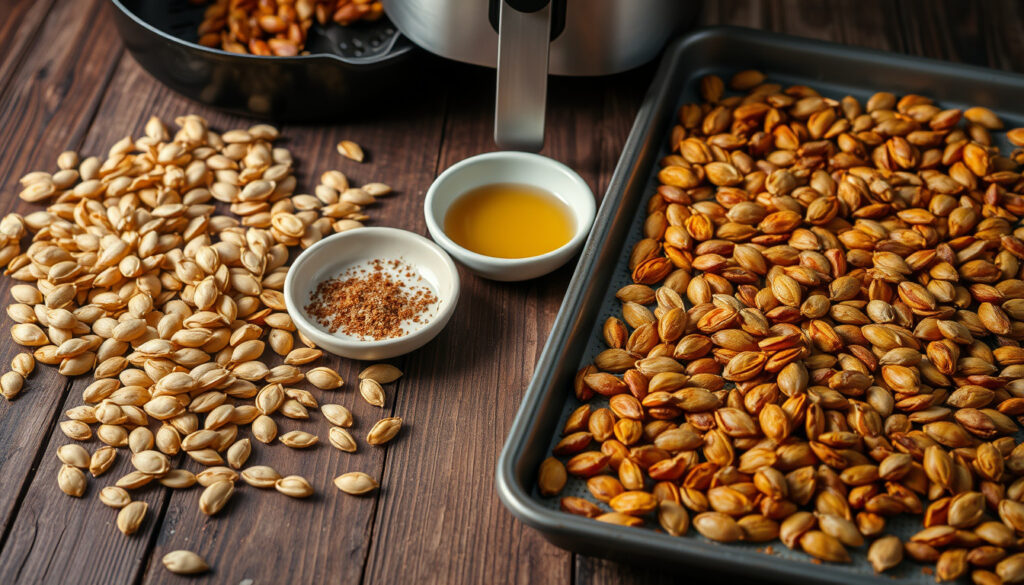
How to Roast Pumpkin Seeds: Oven, Air Fryer, and Pan
There’s a small ritual that comes with carving a pumpkin: fishing out the slippery seeds, rinsing them, and wondering if this batch will turn out crunchy or chewy. Getting them right is part science, part patience. This guide walks you through the oven, air fryer, and pan methods, and layers in what the research says about the health benefits—and potential risks—of eating pumpkin seeds.
Optimal roasting temperature: 350°F (177°C) ·
Typical roasting time: 12–20 minutes ·
Seed yield per medium pumpkin: About 1 cup (120g) ·
Calories per ounce (28g): 151 calories, 5g protein, 7g fat
Quick snapshot
- 350°F (177°C) for 12–15 minutes – common recommendation for even browning (Adventures of a Nurse (recipe blog) air-fryer method adapted for oven)
- Single layer on baking sheet (Adventures of a Nurse (recipe blog)) (Adventures of a Nurse (recipe blog))
- Stir halfway for even browning (Adventures of a Nurse (recipe blog)) (Adventures of a Nurse (recipe blog))
- 350°F for 10–12 minutes (Adventures of a Nurse (recipe blog))
- Shake basket halfway through (Adventures of a Nurse (recipe blog))
- Crispy texture with less oil (Adventures of a Nurse (recipe blog))
- Medium heat, 5–8 minutes (Adventures of a Nurse (recipe blog))
- Stir constantly to avoid burning (Adventures of a Nurse (recipe blog))
- Best for small batches (Adventures of a Nurse (recipe blog))
- Good source of iron (2.7 mg/oz) (PubMed Central (peer-reviewed review))
- Moderate calorie density (151 cal/oz) (USDA National Agricultural Library (official nutrient data))
- Watch sodium from added salt (Healthline (nutrition site))
These five numbers capture the basics before you start roasting.
| Fact | Value |
|---|---|
| Average seeds per pumpkin | Approximately 1 cup (120g) (Medical News Today (health publication)) |
| Roasting temperature recommendation | 350°F (177°C) (Adventures of a Nurse (recipe blog)) |
| Roasting time range | 12–20 minutes (Adventures of a Nurse (recipe blog)) |
| Iron content per ounce | 2.7 mg (15% DV) (PubMed Central (peer-reviewed review)) |
| Calories per ounce | 151 (USDA National Agricultural Library (official nutrient data)) |
What is the best way to roast pumpkin seeds?
Oven roasting method
- Preheat oven to 350°F (177°C) (Adventures of a Nurse (recipe blog)).
- Wash seeds thoroughly and pat dry with a towel (Medical News Today (health publication)).
- Toss with oil and your choice of seasoning (Healthline (nutrition site)).
- Spread in a single layer on a baking sheet (Adventures of a Nurse (recipe blog)).
- Roast 12–15 minutes, stirring halfway through (Adventures of a Nurse (recipe blog)).
Oven roasting gives you control over even browning, but requires patience: a single sheet and a mid-roast stir are non-negotiable for crunchy results.
Air fryer method
- Set air fryer to 350°F (177°C) (Adventures of a Nurse (recipe blog)).
- Place seasoned seeds in the basket in a single layer (Adventures of a Nurse (recipe blog)).
- Cook 10–12 minutes, shaking the basket halfway (Adventures of a Nurse (recipe blog)).
Air frying cuts cooking time by roughly 30% and uses less oil, making it a lighter option for frequent snacking.
Pan roasting method
- Heat a dry skillet over medium heat (Adventures of a Nurse (recipe blog)).
- Add seeds in a thin layer and stir constantly for 5–8 minutes until golden (Adventures of a Nurse (recipe blog)).
- Remove immediately to a plate to stop cooking (Adventures of a Nurse (recipe blog)).
The trade-off: pan roasting is the fastest method, but it demands near-constant attention—a moment of distraction can turn golden seeds into burnt ones.
Do pumpkin seeds need to be dry before roasting?
Benefits of drying seeds
- Drying removes excess moisture, which helps achieve crispiness (Medical News Today (health publication)).
- Wet seeds tend to steam rather than roast, leading to a chewy texture (Adventures of a Nurse (recipe blog)).
How to dry seeds
- Spread wet seeds on a towel and air-dry at room temperature for 30 minutes (Adventures of a Nurse (recipe blog)).
- Alternatively, oven-dry at 200°F (93°C) for 20 minutes before roasting (Adventures of a Nurse (recipe blog)).
- Soaking overnight is optional; it can soften the hull and improve texture, but is not necessary for crisp results (Healthline (nutrition site)).
The pattern: drying is a 30-minute insurance policy against chewy seeds. Skip it only if you prefer a softer bite.
How long to roast pumpkin seeds?
Oven timing
- 12–15 minutes for standard seeds at 350°F (Adventures of a Nurse (recipe blog)).
- Larger or wetter seeds may need up to 20 minutes (Adventures of a Nurse (recipe blog)).
Air fryer timing
- 10–12 minutes at 350°F (Adventures of a Nurse (recipe blog)).
Pan timing
- 5–8 minutes over medium heat (Adventures of a Nurse (recipe blog)).
Signs of doneness
- Seeds should be golden brown and fragrant (Adventures of a Nurse (recipe blog)).
- Let cool completely before storing to maintain crunch (Adventures of a Nurse (recipe blog)).
The implication: set a timer but trust your senses—if they smell nutty and look golden, they’re done regardless of the clock.
Are pumpkin seeds good for anemia?
Iron content in pumpkin seeds
- Pumpkin seeds are a good source of non-heme iron: approximately 2.7 mg per ounce (15% of the Daily Value) (PubMed Central (peer-reviewed review)).
- One cup of roasted kernels provides 9.52 mg of iron (USDA National Agricultural Library (official nutrient data)).
Other nutrients that support anemia
- Also contain zinc, magnesium, and vitamin K (Medical News Today (health publication)).
- Vitamin C, polyphenols, and organic acids can enhance non-heme iron absorption (PubMed Central (peer-reviewed review)).
Comparison with other iron sources
- Non-heme iron from plants is less absorbable than heme iron from meat, but pairing with vitamin C (e.g., squeeze of lemon) helps (PubMed Central (peer-reviewed review)).
- Pumpkin seeds have lower phytate levels than some other seeds, which may reduce inhibition of mineral absorption (PubMed Central (peer-reviewed review)).
The implication: pumpkin seeds are a useful dietary tool for iron-deficiency anemia, but they are not a standalone treatment. A dietitian can help integrate them into a broader iron-boosting strategy.
Is there any downside to eating pumpkin seeds?
Potential side effects
- High calorie density: 151 calories per ounce, which can contribute to weight gain if overconsumed (USDA National Agricultural Library (official nutrient data)).
- Phytates can inhibit absorption of minerals like iron and zinc, though pumpkin seeds contain relatively low levels (PubMed Central (peer-reviewed review)).
- Possible digestive issues (bloating, gas) when eaten in large quantities (Healthline (nutrition site)).
- Salted seeds increase sodium intake significantly (Healthline (nutrition site)).
Who should limit intake
- People on blood-thinning medications (e.g., warfarin) should be aware of vitamin K content, which can affect clotting (Medical News Today (health publication)).
- Allergic reactions are rare but possible; symptoms include itching, swelling, and difficulty breathing (Healthline (nutrition site)).
Pumpkin seeds are nutrient-dense but not risk-free. Overconsumption can pack on calories, and their vitamin K content matters for those on anticoagulants.
The catch: for those on blood thinners, portion control and medical guidance are essential to avoid unintended interactions.
Step-by-step guide: How to roast pumpkin seeds
- Extract and rinse: Scoop seeds from pumpkin, rinse in a colander under cold water to remove pulp (Medical News Today (health publication)).
- Dry: Spread on a towel and air-dry 30 minutes or oven-dry at 200°F for 20 minutes (Adventures of a Nurse (recipe blog)).
- Season: Toss with 1 tablespoon oil (olive, avocado, or melted butter) and salt, spices, or sweetener (Healthline (nutrition site)).
- Roast: Choose oven (350°F for 12-15 min), air fryer (350°F for 10-12 min), or pan (medium heat for 5-8 min) (Adventures of a Nurse (recipe blog)).
- Cool and store: Let cool completely on a baking sheet, then store in an airtight container for up to 2 weeks (Adventures of a Nurse (recipe blog)).
What this means: even beginners can succeed on the first try if they prioritize drying and don’t skip the cooling step.
Confirmed facts and what remains unclear
Confirmed facts
- Pumpkin seeds contain iron, zinc, and magnesium (Medical News Today (health publication)).
- Roasting at 350°F yields crispy seeds when properly dried (Adventures of a Nurse (recipe blog)).
What’s unclear
- Optimal soaking time for maximizing nutrient absorption (PubMed Central (peer-reviewed review)).
- Exact impact of phytic acid on iron absorption from pumpkin seeds in a mixed diet (PubMed Central (peer-reviewed review)).
- Whether soaking overnight meaningfully improves crispiness or nutrient availability — most recipe sources treat it as optional (Healthline (nutrition site)).
“Pumpkin seeds can be a useful dietary intervention for iron-deficiency anemia management, especially when paired with vitamin C-rich foods.”
– Registered dietitian, commenting on PubMed Central (peer-reviewed review)
Natural iron sources are less likely than synthetic supplements to cause nausea or constipation, according to the same PubMed Central review.
The research on pumpkin seeds is promising but still limited. For most healthy adults, a handful of roasted seeds fits well into a balanced diet. For those managing anemia or on blood thinners, a targeted approach with professional guidance is warranted.
eatthismuch.com, hezzi-dsbooksandcooks.com, krishival.com, airfried.com, fdc.nal.usda.gov, verywellhealth.com, pipingpotcurry.com
Frequently asked questions
Can you roast seeds from any pumpkin variety?
Yes, any edible pumpkin variety works. Sugar pumpkins (pie pumpkins) produce sweeter seeds; carving pumpkins yield larger seeds with a mild flavor. (Medical News Today (health publication))
Should I use oil or butter for roasting?
Oil (olive, avocado) gives a consistent, crisp finish. Butter adds flavor but can burn at 350°F; use clarified butter or ghee for a nuttier taste. (Healthline (nutrition site))
How to make sweet roasted pumpkin seeds?
Toss with 1 tablespoon melted butter, 1 tablespoon brown sugar, and a pinch of cinnamon. Roast at 350°F for 12–15 minutes. (Adventures of a Nurse (recipe blog))
How to make spicy roasted pumpkin seeds?
Mix with 1 tablespoon oil, 1 teaspoon chili powder, ½ teaspoon cayenne, and salt. Roast at 350°F for 12–15 minutes. (Adventures of a Nurse (recipe blog))
How to store roasted pumpkin seeds?
Store in an airtight container at room temperature for up to 2 weeks, or refrigerate for up to a month. For longer storage, freeze for up to 6 months. (Adventures of a Nurse (recipe blog))
Why did my pumpkin seeds burn?
Likely causes: oven too hot (above 375°F), seeds weren’t dried properly (moisture created steam then burned), or they were left in too long. Use 350°F and check at 10 minutes. (Adventures of a Nurse (recipe blog))
What nuts block iron absorption?
Walnuts, almonds, and peanuts contain phytates that can inhibit non-heme iron absorption. Pumpkin seeds have lower phytate levels, making them a better choice for iron bioavailability. (PubMed Central (peer-reviewed review))
Pros and Cons of eating roasted pumpkin seeds
Upsides
- Good source of iron, zinc, magnesium (Medical News Today (health publication))
- Rich in antioxidants and anti-inflammatory compounds (PubMed Central (peer-reviewed review))
- Versatile cooking methods (oven, air fryer, pan) (Adventures of a Nurse (recipe blog))
- Lower phytate content than many other seeds (PubMed Central (peer-reviewed review))
Downsides
- High calorie density (151 cal/oz) (USDA National Agricultural Library (official nutrient data))
- Phytates can still inhibit mineral absorption if eaten in large amounts (PubMed Central (peer-reviewed review))
- Possible digestive issues for some people (Healthline (nutrition site))
- Vitamin K content may interact with blood thinners (Medical News Today (health publication))
Related reading
More related posts
 Helen McCrory Harry Potter: Narcissa Malfoy’s Defiance
 Cat With Down Syndrome? No—Special Needs Cats Are Real
 Dmitry Bivol Next Fight: Michael Eifert on May 30, 2026
 Elon Musk Out at Tesla? Current Status and What It Means
 Cheapest Gas Near Me – Best Apps and Tips to Save
 My Adventures with Superman: Age Rating, LGBTQ, Season 3 Guide
 How Many Grams in a Tablespoon – Complete US UK Guide
 Arthur and the Invisibles vs Minimoys: Key Differences