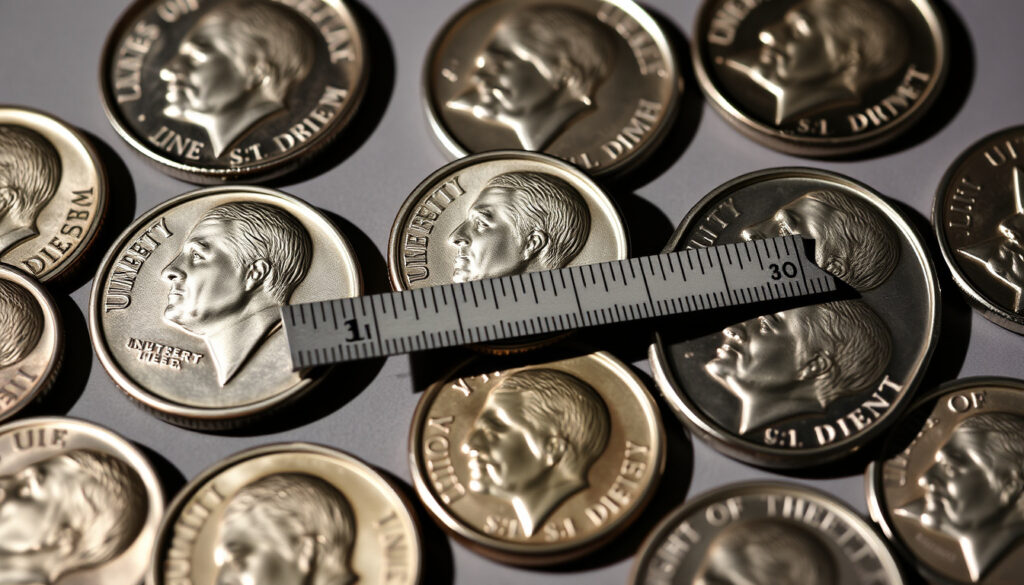
How Much Is a Dime? Value, Weight, Size, History & More
You know a dime is worth 10 cents, but did you know it weighs just 2.268 grams? That lightness is by design. The U.S. dime has been a staple of pocket change since 1796, and its size and weight have shifted over time to reflect changing silver prices and minting technology.
Value of a dime: 10 cents ($0.10) ·
Weight: 2.268 grams ·
Diameter: 17.91 mm (0.705 inches) ·
Thickness: 1.35 mm ·
Composition (modern): 91.67% copper, 8.33% nickel ·
First minted: 1796
Quick snapshot
- A dime is worth 10 cents ($0.10) (United States Mint (official U.S. coin authority))
- Ten dimes equal one dollar (United States Mint)
- Roosevelt dime weighs 2.268 grams and has a diameter of 17.91 mm (United States Mint)
- Exact value of rare error coins (e.g., 1982 penny) varies by condition and market demand (United States Mint (does not appraise coins))
- Long-term purchasing power of a dime is subject to inflation — no fixed future value (SD Bullion (precious metals analyst))
- The dime’s weight dropped from 2.70 g to 2.268 g after the 1850s and the 1965 Coinage Act ended silver content (SD Bullion (precious metals analyst))
- No new U.S. dime design is announced; the Roosevelt dime remains in production (United States Mint)
Seven key facts give you the full picture of the dime’s physical and monetary identity.
| Attribute | Value | Source |
|---|---|---|
| Value | 10 cents ($0.10) | United States Mint |
| Weight | 2.268 grams | United States Mint |
| Diameter | 17.91 mm (0.705 in) | United States Mint |
| Thickness | 1.35 mm | United States Mint |
| Composition (modern) | 91.67% copper, 8.33% nickel | Pot of Gold Estate Sales (coin auction reference) |
| First Minted | 1796 | United States Mint |
| Current Design | Roosevelt dime (since 1946) | United States Mint |
The pattern: the dime’s specs have been stable for decades, but its composition shift in 1965 was a major break from silver.
Is a dime 10 or 5 cents?
A dime is 10 cents, not 5. The confusion often comes from the word “dime” sounding like “dime” — but it’s a tenth of a dollar. The U.S. Mint defines the dime as a coin worth one-tenth of a dollar (United States Mint). A nickel is 5 cents, and a quarter is 25 cents.
How much is a dime worth?
Exactly 10 cents, or $0.10. Ten dimes make a dollar (United States Mint).
Is 25 cents a dime?
No, 25 cents is a quarter. A dime is 10 cents, so two dimes and a nickel make 25 cents.
Is 10 dimes a $1?
Yes, 10 dimes equal one dollar. That’s the simplest conversion: 10 × $0.10 = $1.00.
If you’re counting change, remember: 10 dimes to a dollar. The dime’s decimal value makes it the smallest base-10 coin.
How much is a dime and quarter?
Adding a dime (10¢) and a quarter (25¢) gives you 35 cents. That’s three quarters of a dime short of two quarters — or 35¢ total.
How much is a dime and nickel?
A dime (10¢) plus a nickel (5¢) equals 15 cents. That’s a common combination for vending machines.
How much is a dime and penny?
11 cents. A dime plus a penny (1¢) gives you 11¢.
These simple sums assume face value only. If your dime is a rare error coin, its collector value could be far higher — but the U.S. Mint does not appraise coins (United States Mint).
The implication: everyday dime math works for pocket change, but collectors need certified appraisals for rare specimens.
How much is a nickel?
A nickel is worth 5 cents. It was introduced in 1866 and is made of a copper-nickel alloy. The nickel is larger than the dime: 21.21 mm in diameter and 5.000 grams.
How much money is a buffalo nickel?
Buffalo nickels (1913–1938) have face value of 5 cents, but collectors may pay more depending on condition and date. A common buffalo nickel in worn condition might be worth $1–$3, while key dates can fetch hundreds (Wikipedia (coin encyclopedia)).
What this means: nickel values split between face value for clad coins and collector premiums for vintage designs.
What is a penny?
A penny is worth 1 cent. It’s the smallest unit of U.S. currency. The current Lincoln cent has been in production since 1909, with changes in composition over the years.
What is a roll of pennies worth today?
A standard roll of pennies contains 50 coins, worth 50 cents face value. Banks may sell a box of 50 rolls (2,500 pennies) for $25 (United States Mint (penny specs)).
Can you still buy a box of pennies at the bank?
Yes, most banks still sell boxes of pennies at face value, though availability varies. The U.S. Mint continues to produce pennies for circulation.
How many pennies do you need to make $1,000,000?
You’d need 100,000,000 pennies. That’s 100 million cents, or one million dollars. At 2.5 grams per penny, that’s 250 metric tons of copper.
Why is a 1982 penny worth $10,000 today?
Some 1982 pennies are valuable because of a transitional error: the U.S. Mint switched from 95% copper to a zinc core in 1982, and a few copper planchets were struck with the new zinc design. Those errors are rare and can fetch thousands at auction (United States Mint). However, not all 1982 pennies are valuable — most are common zinc cents worth face value.
The catch: penny collectors face the same challenge as dime collectors — rare errors command premiums, but common coins stay at face value.
Which coin is the largest?
Among common U.S. coins, the quarter is the largest by diameter (24.26 mm), followed by the nickel (21.21 mm), then the penny (19.05 mm), and the dime (17.91 mm). The dime is the smallest coin in current circulation (United States Mint).
What is on the back of a dime?
The Roosevelt dime (since 1946) features a torch, an oak branch, and an olive branch on the reverse — symbolizing liberty, peace, and strength. The obverse has a portrait of President Franklin D. Roosevelt (United States Mint).
How much is a dime in grams?
2.268 grams. That’s the official weight for a modern Roosevelt dime (United States Mint).
Size of dime in cm
1.791 cm in diameter (17.91 mm). Its thickness is 0.135 cm.
The pattern: the dime has always been the smallest U.S. coin by diameter, even as its weight and composition adapted to economic pressures.
The dime is the smallest U.S. coin in current circulation by diameter.
United States Mint (official specifications)
Modern circulating dimes have a clad composition rather than silver, a shift driven by the Coinage Act of 1965.
SD Bullion (precious metals analyst)
The dime’s story is one of material necessity: from silver to clad, from 2.70 g to 2.268 g, from Draped Bust to Roosevelt. For anyone collecting or using pocket change, the dime remains a small but consequential piece of American currency. The implication for coin collectors: the clad dime is common, but silver dimes (pre-1965) and early issues carry premium value. For everyday users, the dime’s small size means it’s easy to lose, but its value is constant: 10 cents, always.
en.wikipedia.org, cointrackers.com, currencies.fandom.com, en.wikipedia.org, en.wikisource.org, en.wikipedia.org, en.wikipedia.org, oldcoinonline.com, cgaa.org, potofgoldestate.com
Frequently asked questions
How many dimes are in a dollar?
10 dimes make a dollar.
What is the dime made of?
Modern dimes are 91.67% copper and 8.33% nickel (clad). Pre-1965 dimes were 90% silver.
Is a dime silver?
Only pre-1965 dimes are 90% silver. Modern dimes are copper-nickel clad.
How much is a dime from 1964 worth?
A 1964 dime is 90% silver and has melt value around $1.50–$2 (depending on silver price). Its numismatic value is low for circulated condition.
What is the most valuable dime?
The 1894-S Barber dime is one of the rarest, with only 24 minted; one sold for over $1.9 million at auction.
How can I tell if a dime is rare?
Check the date, mint mark, and condition. Error coins and low-mintage years are key. Consult a reputable coin dealer or use the Red Book guide.
What is the difference between a dime and a cent?
A dime is worth 10 cents; a cent (penny) is worth 1 cent. The dime is smaller in diameter but larger in value.
More related posts
 Spend Elon Musk Money: Game, Net Worth, and What His Wealth Could Do
 Kisir Bulgur Salad Near Me: Authentic Recipe Guide
 Spider-Man Movies in Order: Full Guide
 Good Culture Cottage Cheese Review: Is It Healthier
 Men’s Mental Health Month – History, Stats and Support
 Pain on Top of Foot: Causes, Symptoms, and Relief Options
 The Summer I Turned Pretty Season 3 Premieres July 16
 Telugu Movies Near Me: Showtimes, Top Picks & Where to Watch