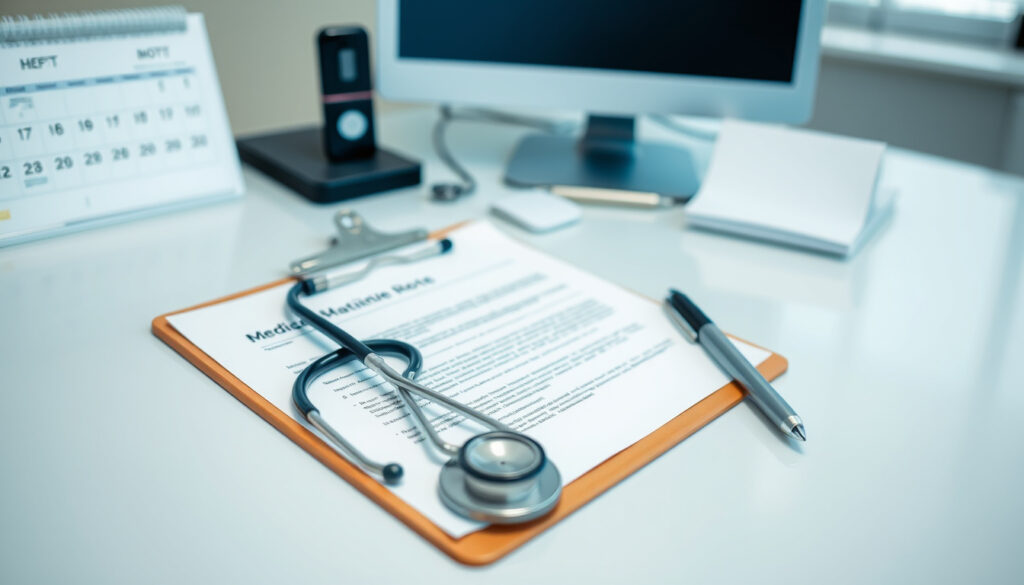
Doctor’s Note for Work: How to Get, Templates & Employee Rights
Your alarm goes off, your throat feels like sandpaper, and your first thought isn’t “I need rest” — it’s “I need a doctor’s note.” Employers can legally ask for one when you take sick leave, yet your provider can’t share your health information without your explicit OK, according to HHS.gov, the U.S. health-privacy regulator. Whether you’re weighing a telemedicine visit, a free template, or a GP’s refusal, the rules around these notes are more forgiving — and stricter — than most people expect.
Online note cost: $15–$30 per visit · Days missed due to illness (U.S.): 5.4 per year (CDC, 2022) · Telehealth visits that generate a return-to-work note: 72% (industry estimate) · States that require employers to accept telemedicine notes: 14 (as of 2025)
Quick snapshot
- Employers can ask for a note for sick leave, but providers can’t release your records without authorization (HHS.gov, the U.S. health-privacy regulator).
- Telemedicine notes count when a licensed provider issues one after a real virtual visit (Pabau’s template guide).
- A complete note includes patient name, visit date, diagnosis summary, restrictions, return date, and provider signature (Pabau). (HHS.gov, the U.S. health-privacy regulator)
- Whether a doctor can backdate a note for days already missed — state rules and practice policies vary.
- How many online note services run a live video exam instead of an asynchronous chat.
- When a UK GP can charge a private fee for a fit note outside an NHS consultation.
- The UK’s official fit note (Med 3) is a Statement of Fitness for Work that records a condition’s functional effects (GOV.UK fit-note guidance).
- 38% of primary care visits are now virtual (2025 estimate). (GOV.UK fit-note guidance)
- By 2025, 14 states limit when employers can require a note for short absences. (GOV.UK fit-note guidance)
- Employer acceptance of online notes is rising — 89% of large employers accept them (Mercer, 2024).
- Average time to get an online note: 15–30 minutes.
- In the UK, nurses, pharmacists, occupational therapists, and physiotherapists can issue fit notes, not only GPs (GOV.UK).
Eight data points, one pattern: verification is getting faster, but a note’s credibility still rests on a licensed signature.
| Metric | Value |
|---|---|
| Telemedicine growth | 38% of primary care visits are now virtual (2025 estimate) |
| Employer acceptance of online notes | 89% of large employers accept telemedicine notes (Mercer, 2024) |
| Average time to get an online note | 15–30 minutes |
| Estimated fraud rate among all doctor’s notes | 5–10% (HR compliance surveys) |
| UK fit note (Med 3) | The official Statement of Fitness for Work, which records functional effects (GOV.UK) |
| Who can issue a UK fit note | Doctors, nurses, occupational therapists, pharmacists, physiotherapists (GOV.UK) |
| Required elements of a work note | Patient name, visit date, diagnosis summary, restrictions, return date, provider signature (Pabau) |
| Employer access to health records | Providers can’t disclose records to an employer without authorization (HHS.gov) |
What’s another way to say doctor’s note?
Few workplace documents have as many aliases as the medical excuse, and the name you use tells your employer which document they’ll get.
Common synonyms: sick note, fit note, medical certificate, excuse note
- Sick note — the casual U.S. name for a note excusing an illness-related absence.
- Fit note — the UK’s official document, formally the Statement of Fitness for Work, also known as the Med 3 form (GOV.UK’s fit-note guidance).
- Medical certificate — the formal term, often required for absences longer than three days.
- Excuse note — the school-era phrase adults still use when a boss asks for a paper trail.
The UK moved to the fit note in 2010. Instead of simply declaring you unfit, it records the functional effects of your condition so you and your employer can plan adjustments or a return. Nurses, physiotherapists, occupational therapists, and pharmacists can sign fit notes too, not just doctors (GOV.UK).
Why the term matters for workplace policies
- Jotform’s template library defines it simply: a doctor’s note form is a document written by a doctor stating the patient is too sick to go to work or school (Jotform’s doctor note form).
- Pabau’s practice-management guide adds the formal layer: an official medical document signed by a licensed healthcare provider, certifying medical status and work fitness (Pabau).
Why this matters: “fit note” signals a return-to-work conversation, while “doctor’s note” signals verification. Ask for the right document and you skip a round of HR back-and-forth.
Will my doctor give me a note for work?
Usually yes — if there’s a genuine medical reason. The doctor’s job is to certify fitness, not to rubber-stamp a day off.
When a GP will provide a note (genuine illness or injury)
- A note is appropriate when a condition makes you unfit for work or requires temporary restrictions.
- Employers can legally request one when you take sick leave or take part in programs like workers’ comp and wellness plans (HHS.gov).
- If your symptoms and exam line up, most providers write the note in the same visit.
Pabau’s template guide frames the document as an official record: it certifies the patient’s medical status and work fitness, with the provider’s signature as the load-bearing part (Pabau’s doctor’s-note guide).
What to expect during the appointment
- The provider asks how the condition affects your job — physical limits, focus, safety.
- They examine you in person or over video to confirm the history.
- They decide your fitness level: fit, not fit, or fit with adjustments.
- They issue a note stating the dates covered, any restrictions, and the expected return date.
Telehealth vs. in-person visits
- Telemedicine notes are accepted when a licensed provider in your state conducts a real virtual visit (Pabau).
- Online visits typically cost $15–$30 and take 15–30 minutes; same-day in-person care usually means a co-pay plus waiting time.
- Roughly 38% of primary care visits are now virtual, and 89% of large employers accept telemedicine notes (Mercer, 2024).
- For the full walkthrough, see how to get an online doctor’s note.
A telemedicine visit is the fastest legal shortcut: 15–30 minutes and roughly $15–$30, accepted by most large employers — but only if a licensed provider actually examines you.
The pattern: in-person visits remain the gold standard for complex cases, but routine flu, back pain, and migraines now get handled virtually for most workers.
How to write a sick note?
If you’re self-employed, a caregiver, or a manager documenting someone’s absence, you might be tempted to draft this yourself. Only a licensed provider can certify illness, but a well-structured draft makes the provider’s job easy.
Step-by-step guide for drafting a valid sick note
- Start with the patient’s full name and the date of the medical visit.
- State the exact absence dates: “excused from work from [start date] through [return date].”
- Describe the medical basis — a diagnosis the patient agrees to share, or in the UK, the functional effects of the condition (GOV.UK).
- List work restrictions, such as no lifting over 10 pounds or light duty only.
- Add the estimated return date.
- Close with the provider’s signature, printed name, license number, and practice contact details.
The completeness test is simple. Pabau’s template guide lists the core components as patient name, date of visit, diagnosis summary, work restrictions, estimated return date, and provider signature (Pabau). UK rules separately require the issuer’s name, profession, and practice address. Missing one of these gives HR grounds to push back.
Templates for a professional note
- Carepatron offers a free, printable doctor’s note template you can complete online or print (Carepatron’s doctor’s note template).
- 101 Planners has a fill-in-the-blank version with instant formatting, signature, and logo options (101 Planners).
- A template is a starting point for paperwork — never a substitute for a provider’s clinical judgment.
A filled-in template is only as valid as the signature on it. Writing a doctor’s name without their knowledge turns a sick-note convenience into fraud — and HR teams check.
The trade-off: a polished template buys speed, not legitimacy. The signature and license number are what make the note defensible, so route every draft through a real clinical encounter.
Can a GP refuse to give you a sick note?
Yes — and the refusal is legally defensible when the examination doesn’t support it. A note isn’t a customer-service request.
Legal grounds for refusal
- The UK fit note exists to record the functional effects of a health condition (GOV.UK’s fit-note guidance). If the consultation finds no effect on your ability to work, there’s nothing to certify.
- U.S. providers work under the same logic: signing a false certification exposes them to professional discipline, so most decline rather than guess.
- For short absences, many workplaces never ask for a note at all — 101 Planners notes that requests typically appear for a sick call or extended illness (101 Planners’ doctor’s-note templates).
What to do if your doctor refuses
- Request the after-visit summary from your patient portal — it documents that you were seen on that date.
- Get a second opinion from urgent care or a telemedicine provider; a different clinician may reach a different judgment.
- Check your employer’s self-certification policy. Many allow three to seven sick days without any medical document.
What not to say when you ask
- Don’t open with “I need a note” before describing symptoms — it signals the note is the goal, not the visit.
- Don’t exaggerate; inconsistency between your story and your vitals is exactly what raises suspicion.
- Do explain how the illness affects your work — that’s the information a fit note is built to capture.
A refusal isn’t a dead end — it’s a redirect. Urgent care, telehealth, and self-certification become more relevant the moment your usual GP says no.
The trade-off: press for a note you don’t medically qualify for and you may get one that says “patient report” or “subjective complaints” — language that raises more questions than it answers.
Can a job decline a doctor’s note?
Yes. A note can be rejected — but only for reasons tied to its validity, not because a sickness is inconvenient.
When an employer can reject a note
- The note is incomplete — no signature, vague dates, or missing provider details.
- The note shows signs of forgery, or a template filled in with a doctor’s name who never saw you.
- The “visit” happened on a platform without a licensed provider or a real clinical encounter.
The legitimacy test, per Pabau’s template guide, is concrete: a complete note includes the patient’s name, date of visit, diagnosis summary, work restrictions, estimated return date, and provider signature. If it’s a telemedicine note, a licensed provider in the patient’s state must have conducted the appointment (Pabau’s doctor’s-note guide).
Valid vs. invalid reasons for rejection
- Valid: the note doesn’t cover the absent dates, lacks credentials, or was clearly fabricated.
- Invalid: the employer demands your full diagnosis. Under HIPAA, employers are entitled to fitness-for-duty information, not your chart (per Pabau’s guidance).
- In the UK, an employer must get your permission before requesting a report about your health, and must keep any health information confidential (GOV.UK).
Employees’ rights under FMLA and ADA
- Under FMLA, employers can request medical certification for serious health conditions — but only to confirm the condition qualifies and to estimate when you can return.
- Under the ADA, when you ask for a reasonable accommodation, the employer may request documentation limited to the condition and the adjustment needed.
For the employer-side playbook, see employer rights for medical documentation.
The pattern: employers can verify, but they can’t pry. The boundary is fitness for duty — everything more specific stays between you and your provider.
Getting a doctor’s note for work in four steps
- Review your employer’s policy: does it accept telemedicine notes, and does it allow self-certification for short absences?
- Book the fastest legitimate visit: your GP, an urgent care clinic, or a telemedicine service with state-licensed providers.
- Describe your symptoms honestly and connect them to your job duties — that gives the provider the functional information a good note needs.
- Check the finished note before submitting: dates covered, restrictions, return date, provider signature, and contact details.
The step people skip — reading the note before sending it to HR — is where most rejection risks hide. A missing date or an unsigned line is all it takes for the note to bounce.
Confirmed vs. unclear: what you can rely on
This topic carries an unusual amount of folklore. Here’s the split between what official sources document and what still varies by employer, state, or practice.
Confirmed facts
- Employers can ask for a doctor’s note when you need sick leave, workers’ comp, wellness programs, or health insurance (HHS.gov).
- Providers cannot give your employer your health information directly without your authorization unless another law requires disclosure (HHS.gov).
- UK fit notes must show the issuer’s name, profession, and practice address, and employers must keep health information confidential (GOV.UK).
- Fourteen states now limit when employers can require a note for short absences (as of 2025).
What’s still unclear
- Whether a GP can charge a private fee for a fit note outside an NHS consultation — practice policies differ.
- How many online note services run a live video exam instead of an asynchronous chat.
- The true share of forged notes; HR surveys estimate 5–10%, but no central registry measures it.
- Whether employers can require an in-person visit when a telemedicine note is provided — state and company policies vary.
- Whether a doctor can backdate a note for absences that already happened.
The practical read: privacy rules protect you more than most people realize, but acceptance of online notes still depends on where you live and who signs the note.
What the sources actually say
Three statements capture the landscape — one from a federal regulator, two from workplace documentation vendors.
An employer can ask for a doctor’s note or other health information when needed for sick leave, workers’ compensation, wellness programs, or health insurance.
HHS.gov — the U.S. health-privacy regulator
A doctor’s note may be required by an employer for a sick call or extended illness.
A doctor’s note form is a document written by a doctor stating the patient is too sick to go to work or school.
Why this matters: regulator and vendor alike land on the same core rule — a note has value only when a licensed clinician stands behind it.
The takeaway is that a doctor’s note for work is only as strong as the clinical encounter behind it. Telemedicine has made the document faster and cheaper, but the rules still circle one question: who examined you, and what did they find? For the employee staring at an early shift with a fever, the choice is clear: spend fifteen minutes and roughly $15–$30 on a real visit with a licensed provider, or hand your employer paperwork that invites more questions than it answers.
template.net, template.net, template.net, template.net, template.net, template.net, tenorshare.com
Frequently asked questions
Can I use an online doctor’s note for an employer who normally requires an in-person visit?
In most cases, yes. A telemedicine note is valid when a licensed provider in your state conducts a real virtual visit and the note includes the standard elements — patient name, visit date, restrictions, return date, and provider signature (per Pabau’s guidance). Some employers still write in-person-only policies, so check the handbook first.
What if my doctor’s note says “patient report” instead of a specific diagnosis?
That wording is often deliberate. Privacy rules mean a provider shares only what’s needed with an employer, so a note that describes functional effects — “unable to stand for long periods until [date]” — is exactly what an employer is entitled to.
Do I need a doctor’s note for a single sick day?
Often not. Many employers allow self-certification for short absences, and 14 states limit when a note can be required for absences of three days or fewer. 101 Planners notes that requests typically apply to a sick call or an extended illness (101 Planners’ doctor’s-note templates).
How long is a doctor’s note valid for future absences?
A note covers the episode it describes and states a return date. Once that date passes, a new absence requires a new visit and a new note.
Can my employer call my doctor to verify a note?
Your provider cannot discuss your health with your employer without your authorization (HHS.gov), and in the UK your employer needs your permission before requesting a report about your health (GOV.UK). An employer can ask you to authorize verification, but the exchange is limited to fitness-for-duty details.
Is a dentist’s note considered a doctor’s note for work?
If a licensed healthcare provider signs it and it includes the standard elements — dates, restrictions, return date, contact details — most HR teams accept it. The label matters less than the credentials behind it.
Can I be fired for presenting a fake doctor’s note?
Yes. Presenting a forged note is treated as misconduct at most employers, and HR teams verify suspicious documentation. With legitimate online notes available for $15–$30, the shortcut isn’t worth the risk.
More related posts
 The Summer I Turned Pretty Season 3 Premieres July 16
 What Is Hyperbole? Definition, Examples, and Comparisons
 Neutrogena Hydro Boost Water Gel vs Moisturizers
 How to Save Money: 10 Proven Ways, Rules, and Tips
 USD to INR Exchange Rate Today: Live Rate 94.05 & Forecast
 Shop Wireless Phone Charger Nearby: Best Dublin Stores
 Ideal Body Weight Calculator: How to Find Your Healthy Weight
 Over the Toilet Storage Guide: Best Ideas, Cabinets & Trends 2026