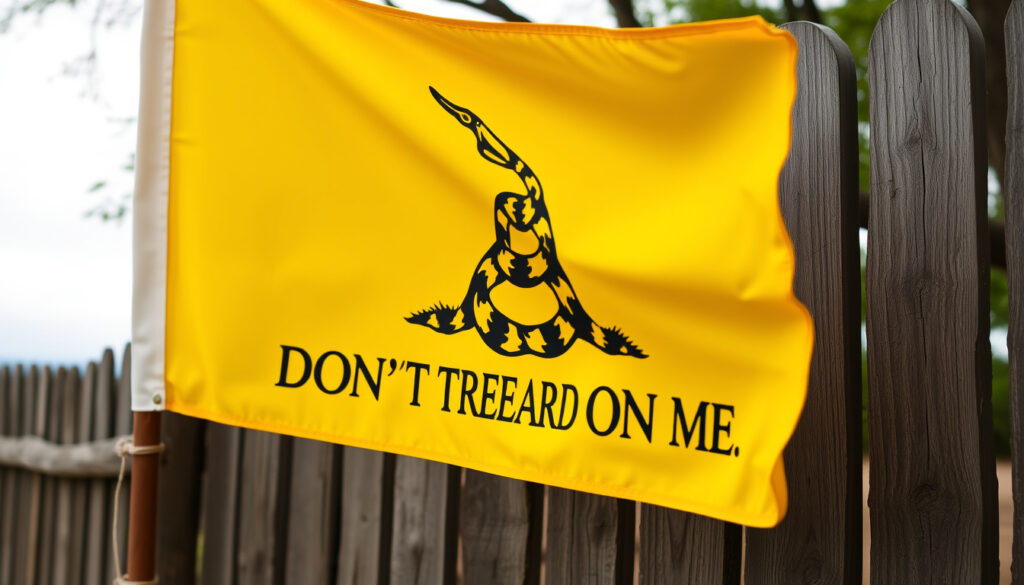
Don’t Tread on Me Flag Meaning, History & Controversy
The coiled rattlesnake on a yellow field is one of the most recognizable American symbols — yet it’s also one of the most divisive. A flag born in the 1770s as defiant warning to the British has become, 250 years later, a flashpoint for arguments about patriotism and protest. Here’s what the Gadsden flag actually means, where it came from, and why it keeps sparking debate.
Year of creation: 1775 ·
Designer: Christopher Gadsden ·
First military use: Continental Marines (1775) ·
Current status: Public domain, widely used ·
Controversy level: High (frequently debated)
| Flag colors | Yellow field, black rattlesnake |
| Rattlesnake species | Timber rattlesnake |
| Number of rattles | 13 (representing original colonies) |
| Text | DONT TREAD ON ME (no apostrophe) |
| Designer | Christopher Gadsden |
| Year of creation | 1775 |
“The motto appears as ‘Dont Tread on Me’ — deliberately missing the apostrophe, which was common in 18th-century printing.” — U.S. Fish and Wildlife Service (source)
“The Tea Party movement adopted the flag as a symbol of limited government and fiscal conservatism.” — NPR, 2010 (source)
Quick snapshot
- Yellow field with a coiled timber rattlesnake (U.S. Fish and Wildlife Service)
- Text reads “DONT TREAD ON ME” (no apostrophe) (U.S. Fish and Wildlife Service)
- Designed in 1775 (Wikipedia)
- Rattlesnake represents vigilance and the American colonies (U.S. Fish and Wildlife Service)
- 13 rattles for the original colonies (U.S. Fish and Wildlife Service)
- Slogan warns against oppression (U.S. Fish and Wildlife Service)
- Adopted by far-right and anti-government groups (OregonLive)
- Banned in some government buildings (OregonLive)
- Debated as hate symbol vs. historical icon (OregonLive)
What does the don’t tread on me flag mean?
The literal meaning of the slogan
The phrase “Don’t Tread on Me” is a direct warning: back off, do not step on me, do not oppress me. On the Gadsden flag, the coiled rattlesnake reinforces that message. The U.S. Fish and Wildlife Service notes the motto appears as “Dont Tread on Me” — deliberately missing the apostrophe, which was common in 18th-century printing.
The snake is not attacking — it’s coiled and warned. The flag signals deterrence, not aggression, which is why its tone shifts depending on who flies it.
Historical context of the Gadsden flag
The flag emerged in 1775, as the American colonies were moving from protest to armed resistance against British rule. EBSCO Research Starters (a scholarly database) frames the original meaning as straightforward: resistance to British rule and defense of colonial rights. The rattlesnake was not a new idea — Benjamin Franklin’s 1754 “Join, or Die” cartoon had already used a segmented snake to rally the colonies, as noted by Emerging Revolutionary War (a history publication).
Symbolism of the rattlesnake
The U.S. Fish and Wildlife Service explains that the timber rattlesnake had become a powerful emblem of American defiance by the Revolutionary War. The snake’s 13 rattles represent the original 13 colonies. American revolutionaries admired the rattlesnake’s traits: it gives warning before striking, it does not attack without provocation, and once provoked, it fights to the end.
Flag colors: Yellow field, black rattlesnake ·
Rattlesnake species: Timber rattlesnake ·
Number of rattles: 13 ·
Text: DONT TREAD ON ME ·
Designer: Christopher Gadsden ·
Year: 1775
The implication: The Gadsden flag was never a neutral symbol. It was designed to warn a specific adversary — the British Crown. That original target is long gone, but the warning language remains, which is why the flag so easily transfers to new political conflicts.
Is ‘don’t tread on me’ good or bad?
Positive interpretations (patriotism, individualism)
For many Americans, the Gadsden flag represents a foundational national value: resistance to overreach by authority. The NPR reported in 2010 that the Tea Party movement adopted the flag as a symbol of limited government and fiscal conservatism. The U.S. Marine Corps continues to reference the “Don’t Tread on Me” motto on its uniforms and recruitment materials, rooted in the flag’s use by the Continental Marines.
Negative interpretations (racism, political extremism)
The same flag has been carried by groups far outside the Tea Party. OregonLive reported that the flag was widely flown during the January 6, 2021, U.S. Capitol riot. A Washington Post (a national newspaper) investigation found Confederate-era variations of the rattlesnake banner with 15 stars representing slave states, flown at a Southern Rights Club event in Savannah in November 1860, as noted by Bunk History (a historical commentary site).
The flag’s meaning is not fixed. Dictionary.com describes it as a symbol “adopted by a variety of political groups” whose context determines what it signals. The same coiled rattlesnake that means “leave me alone” to one person can mean “resist the state by any means” to another.
The trade-off: Individuals who fly the flag generally intend a personal-liberty message, but in a polarized era, the audience’s interpretation matters as much as the flag-bearer’s intent. The flag’s history of re-use by Confederate sympathizers and anti-government militants means it carries baggage its original designer never envisioned.
What is the most controversial flag in the world?
Modern political associations
The Gadsden flag has become a staple at protests across the political spectrum — from gun-rights rallies to anti-lockdown demonstrations. Newsweek (a news magazine) traced the flag’s modern revival through the Tea Party, the libertarian movement, and more recently, groups protesting COVID-19 restrictions. Its presence at the U.S. Capitol riot cemented its status as a contested symbol.
Debates over free speech and offense
Some government bodies have responded by restricting the flag. In 2014, the flag was banned from certain state buildings due to controversy over its association with extremism. The debate mirrors deeper arguments in the U.S. about whether historical symbols can be applied to new political contexts without losing their original meaning.
The pattern: The Gadsden flag is not controversial because of what it originally said — it’s controversial because it has been reused so many times by so many different groups that no single meaning sticks. The flag is effectively a blank warning sign that each movement fills with its own grievance.
Is ‘Don’t Tread on Me’ flag offensive?
Arguments that it is offensive
Critics argue that the flag’s adoption by white supremacist and anti-government groups has tainted it. OregonLive detailed how the flag was present at the January 6 attack on the Capitol, which for many observers redefined the flag’s public meaning. The Confederate-era use of the rattlesnake banner further complicates its safety as a neutral historical symbol.
Arguments that it is not offensive
Defenders point to the flag’s Revolutionary War heritage and its use by the U.S. military. The Marine Corps has not disavowed the flag. For many Americans, the flag remains a symbol of the American Revolution and the principle that citizens should resist tyranny — a concept enshrined in the Declaration of Independence.
Legal and social implications
Legally, the flag is in the public domain and can be displayed on private property under First Amendment protections. Socially, however, its meaning depends entirely on context. A Gadsden flag on a front porch in a rural town is read differently than a Gadsden flag at a political rally a hundred miles away.
Why this matters: The offense question is not resolved by looking at the flag’s design — it’s resolved by knowing who is flying it, alongside what other symbols, and in what setting. The flag has no single inherent moral weight; its weight changes with its company.
Whose flag is the Don’t Tread on Me flag?
Originator: Christopher Gadsden
The flag is named for Christopher Gadsden, a South Carolina delegate to the Continental Congress and a brigadier general in the Continental Army. Wikipedia identifies Gadsden as the designer. Newsweek reports that Gadsden presented a version of the flag to Esek Hopkins, the first commander of the American Navy, as a personal standard.
Historical use by the Continental Marines
The flag gained its military association through the Continental Marines, who reportedly carried the flag during the Revolutionary War. U.S. Fish and Wildlife Service notes the flag was used on drums, military buttons, and battle flags — though exact documentation of its first use at sea remains incomplete.
Current ownership and public domain
The Gadsden flag design is in the public domain. Anyone can manufacture, sell, or fly it without permission. The U.S. Marine Corps still uses the motto “Don’t Tread on Me” as part of its institutional heritage. No single organization owns the flag, which is why it appears on everything from license plates to protest signs.
The implication: Because the flag is public domain and no group controls it, the meaning of the Gadsden flag is determined by whoever uses it most loudly. In the 20th century, that was the Marine Corps. In the 21st, it is increasingly protest movements — which is why the flag feels newly divisive even though it is old enough to pre-date the United States itself.
Timeline: Key moments in the Gadsden flag’s history
The following timeline traces the flag’s journey from Revolutionary War to present-day controversy.
| Date | Event |
|---|---|
| 1754 | Benjamin Franklin publishes “Join, or Die” snake cartoon, a symbolic predecessor (Emerging Revolutionary War) |
| 1775 | Christopher Gadsden presents the flag to the Continental Marines (Wikipedia) |
| 1775–1783 | Flag used by the Continental Marines during the American Revolution (U.S. Fish and Wildlife Service) |
| 1860 | Confederate variant flown at Southern Rights Club event in Savannah (Bunk History) |
| 2000s | Tea Party movement adopts the flag as a symbol of limited government (NPR) |
| 2014 | Flag banned from some state buildings due to extremist associations |
| 2021 | Flag widely flown by the U.S. Capitol mob on January 6 (OregonLive) |
The pattern: The flag has been claimed by at least three distinct ideological movements — Revolutionary patriots, Confederate secessionists, and modern anti-government activists — each reading its own meaning into the coiled rattlesnake. That flexibility is both its strength and its liability.
Confirmed facts vs. what remains unclear
Confirmed facts
- Gadsden designed the flag in 1775 (Wikipedia)
- The flag was used by the Continental Marines (U.S. Fish and Wildlife Service)
- The rattlesnake has 13 rattles representing the colonies (U.S. Fish and Wildlife Service)
- The motto appears without an apostrophe (U.S. Fish and Wildlife Service)
- The flag is in the public domain
- The Tea Party adopted the flag in the 2000s (NPR)
What’s unclear
- Exact first date the flag was flown
- Original flag dimensions
- Gadsden’s personal motivation for the design
- Whether the flag was carried in any specific battle
- How widely it was used outside the Continental Marines
The Gadsden flag’s history is well-documented in its broad strokes but thin in its specific early use. Researchers know the who and the when, but the how (exactly where it flew, on what ships, in which battles) remains partly lost. That gap makes the flag ripe for competing origin stories.
Frequently asked questions about the Gadsden flag
What year was the Gadsden flag created?
The flag was created in 1775, designed by Christopher Gadsden during the American Revolution.
What does the rattlesnake symbolize?
The timber rattlesnake on the Gadsden flag represents vigilance, defiance, and the American colonies. Its 13 rattles symbolize the original 13 colonies (U.S. Fish and Wildlife Service).
Why is the flag sometimes banned?
Some government buildings and schools have banned the Gadsden flag due to its adoption by extremist and anti-government groups, particularly after the January 6, 2021, Capitol riot.
Is the flag only used by conservatives?
No. While the flag has been heavily adopted by the Tea Party and libertarian movements, it has also appeared at protests across the political spectrum. Its original meaning as an anti-oppression symbol makes it appealing to various groups.
Can I fly the Gadsden flag on my property?
Yes. The Gadsden flag is in the public domain and is protected under First Amendment free speech rights in the United States.
What is the difference between the Gadsden flag and the American flag?
The American flag (Stars and Stripes) is the official national flag of the United States with 50 stars and 13 stripes. The Gadsden flag is a historical banner with a yellow field, a coiled timber rattlesnake, and the motto “Dont Tread on Me.” It has no official government status.
How many rattles are on the snake?
The timber rattlesnake on the Gadsden flag has 13 rattles, representing the original 13 American colonies.
What is the official name of the flag?
The flag is officially called the Gadsden flag, named after its designer Christopher Gadsden. It is also commonly referred to as the “Don’t Tread on Me” flag.
For anyone encountering the Gadsden flag today — on a license plate, a protest sign, or a Marine uniform — the question is not what the flag originally meant, but what the person flying it means right now. The flag’s power is that it says “don’t tread on me” to anyone. Its problem is that anyone can say it back. Related reading: Try That in a Small Town Controversy and What Was the Cold War? A Simple Explanation and Timeline.
washingtonpost.com, americanflags.com, en.wikipedia.org, de.wikipedia.org
More related posts
 How to Save Money: 10 Proven Ways, Rules, and Tips
 Ripley’s Believe It or Not: Attractions, Cost & Family Tips
 Urgent Care Kit USA: Cost, Contents & Where to Buy
 Mexican Street Corn Salad Recipe (Easy & Authentic)
 Telugu Movies Near Me: Showtimes, Top Picks & Where to Watch
 Reba McEntire Net Worth in 2025: $95 Million Fortune Explained
 Over the Toilet Storage Guide: Best Ideas, Cabinets & Trends 2026
 Galaxy M21 to Buy – Prices Availability and Value in 2024