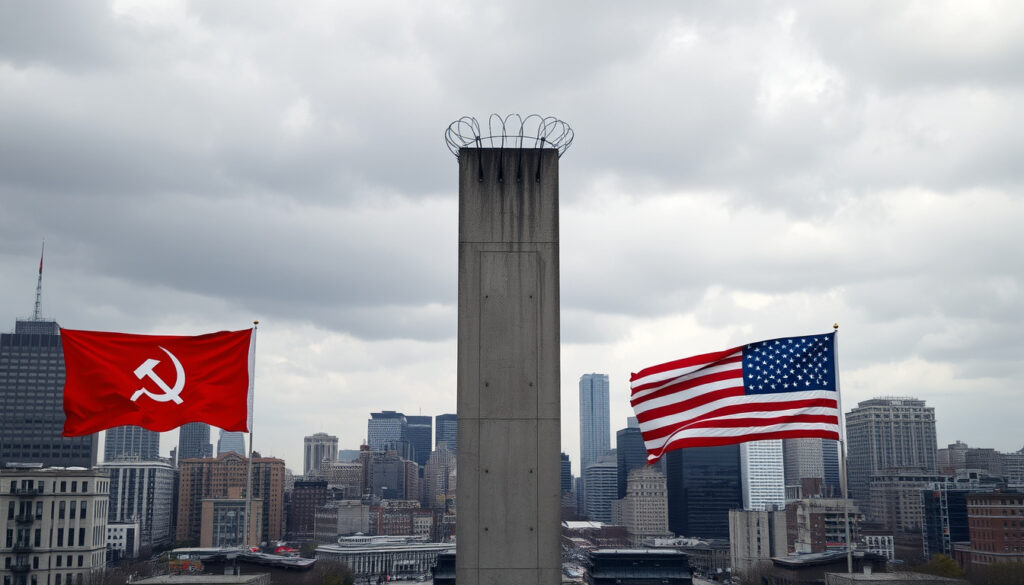
What Was the Cold War? A Simple Explanation and Timeline
The Cold War shaped the world for nearly half a century, yet it never escalated into a direct battle between the two superpowers. Instead, the United States and the Soviet Union waged a struggle through proxy wars, ideological competition, and a nuclear arms race that brought the world to the brink of disaster. This article explains what the Cold War was, why it was called “cold,” who was involved, and how it ended.
Duration: 1947–1991 · Main adversaries: United States and Soviet Union · Proxy wars: Korea, Vietnam, Afghanistan, and others · Nuclear warhead peak: approx. 70,000 (1980s) · Outcome: Dissolution of the Soviet Union in 1991
Quick snapshot
- Lasted from 1947 to 1991 (Britannica)
- US and USSR were the main adversaries (Library of Congress)
- No direct large-scale combat between superpowers (Britannica)
- Exact start date debated (some cite 1945, others 1947) (Britannica)
- Who “won” remains contested (Britannica)
- Role of specific leaders in ending the Cold War interpreted differently (Britannica)
- 1947: Truman Doctrine announced (Harry S. Truman Presidential Library)
- 1962: Cuban Missile Crisis (Britannica)
- 1989: Fall of the Berlin Wall (Britannica Kids)
- Post-Cold War shift to US-led unipolar world (Britannica)
- Legacy of proxy conflicts continues in regions like the Middle East (Britannica)
- Nuclear disarmament remains an ongoing challenge (Britannica)
The Cold War was defined by a small number of core dates and alliances that set the stage for decades of tension.
| Fact | Value | Source |
|---|---|---|
| Start date | 1947 (Truman Doctrine) | Harry S. Truman Presidential Library |
| End date | 1991 (Dissolution of USSR) | Britannica Kids |
| Main participants | United States, Soviet Union, and their respective allies | Britannica |
| Key alliances | NATO (1949), Warsaw Pact (1955) | JFK Library |
| Notable crises | Cuban Missile Crisis (1962), Berlin Blockade (1948–49) | Britannica |
What was the Cold War in simple terms?
Definition of the Cold War
The Cold War was an open but limited rivalry between the United States and the Soviet Union after World War II (Britannica). It developed as tensions grew between the two powers and their allies (Library of Congress). The implication: rivalry without direct battlefield combat defined the entire era.
Key characteristics
- Competing political and economic ideologies (capitalism vs. communism) (Library of Congress)
- Soviet control of Eastern Europe after WWII (Britannica)
- US and Britain feared Soviet domination and communist expansion (Britannica)
- Fought mainly through politics, economics, and propaganda (Britannica)
Basic timeline
- 1947–1953: Peak of early Cold War tensions (Britannica)
- 1948–1949: Berlin Blockade and Airlift (Britannica)
- 1962: Cuban Missile Crisis (Britannica)
- 1989–1991: Fall of Berlin Wall, dissolution of USSR (Britannica Kids)
The Cold War was not a single event but a forty-year state of tension that reshaped global alliances, military spending, and everyday life on both sides of the Iron Curtain.
Why was it called a Cold War?
Origin of the term
The term “Cold War” was first used by Bernard Baruch during a congressional debate in 1947 (Britannica). It was popularized by writer George Orwell in 1945.
The absence of direct combat
It was “cold” because the US and USSR never fought each other directly in large-scale battles (Britannica). Instead, they used proxy wars, espionage, diplomacy, and economic pressure. The catch: the term itself masked the millions who died in proxy wars.
Contrast with “hot” wars
Unlike a hot war, the Cold War was fought through ideology, technology, and influence rather than open battlefield engagement (Britannica).
The deadliest weapons ever built—nuclear warheads—were never used in combat between the superpowers, yet the threat of annihilation defined the entire era.
Who were the big 3 in the Cold War?
The United States
The United States led the Western alliance, promoting democracy and capitalism. Key leaders included Harry Truman, Dwight Eisenhower, and John F. Kennedy (JFK Library).
The Soviet Union
The Soviet Union, under Joseph Stalin and later leaders, controlled Eastern Europe and spread communism. It formed the Warsaw Pact in 1955 as a counter to NATO (JFK Library).
The United Kingdom (role in early Cold War)
The UK, led by Winston Churchill, played a key role in the early Cold War, notably through Churchill’s “Iron Curtain” speech in 1946 (Britannica). The implication: the “Big Three” of WWII (US, UK, USSR) became the two superpowers and a secondary player once the Cold War fully set in.
How did the Cold War end?
Fall of the Berlin Wall (1989)
The Berlin Wall, built in 1961 as a symbol of division, fell in 1989, signaling the collapse of communist control in Eastern Europe (Britannica Kids).
Reforms of Mikhail Gorbachev (perestroika and glasnost)
Mikhail Gorbachev, who became Soviet leader in 1985, introduced reforms that weakened Soviet control and led to its breakup (Britannica Kids).
Dissolution of the Soviet Union (1991)
The Cold War ended with the collapse of the Soviet Union in December 1991 (Britannica). The Warsaw Pact was dissolved in July 1991 (Britannica Kids). The pattern: internal economic strain, not external invasion, brought the Soviet system down.
The end of the Cold War did not mean the end of global tensions—many proxy conflicts and nuclear arsenals outlasted the superpower rivalry.
Who actually won the Cold War?
The US perspective
Many historians argue the US and its allies won because the USSR dissolved (Britannica). No official surrender occurred.
The Soviet collapse
The Soviet system collapsed internally due to economic strain and political reforms (Britannica).
Debate on winners and losers
Some note that both sides suffered economic strain and the outcome was a complex global shift (Britannica). The trade-off: the US emerged as the sole superpower, but the cost of the arms race left deep economic and social scars.
Cold War Timeline
- 1945: End of World War II; tensions emerge between US and USSR (Harry S. Truman Presidential Library)
- 1947: Truman Doctrine and Marshall Plan announced (Harry S. Truman Presidential Library)
- 1948–1949: Berlin Blockade and Airlift (Britannica)
- 1949: NATO formed; Soviet Union tests first atomic bomb (JFK Library)
- 1955: Warsaw Pact established (JFK Library)
- 1962: Cuban Missile Crisis brings world close to nuclear war (Britannica)
- 1979: Soviet invasion of Afghanistan (Britannica)
- 1985: Mikhail Gorbachev becomes Soviet leader, introduces reforms (Britannica Kids)
- 1989: Fall of the Berlin Wall (Britannica Kids)
- 1991: Dissolution of the Soviet Union; Cold War ends (Britannica)
What’s confirmed and what’s unclear
Confirmed facts
- The Cold War lasted from roughly 1947 to 1991 (Britannica)
- The United States and the Soviet Union were the main superpowers (Library of Congress)
- The Soviet Union collapsed in 1991, ending the Cold War (Britannica Kids)
- No direct large-scale combat occurred between US and USSR forces (Britannica)
What’s unclear
- Who “won” the Cold War is debated (Britannica)
- The exact start date is disputed (some cite 1945, others 1947) (Britannica)
- The role of specific leaders and events in ending the Cold War is interpreted differently by historians (Britannica)
Voices from the Cold War
“From Stettin in the Baltic to Trieste in the Adriatic, an iron curtain has descended across the Continent.”
— Winston Churchill, “Iron Curtain” speech, 1946 (Britannica)
“Ich bin ein Berliner.”
— John F. Kennedy, 1963 address on the Berlin Crisis (JFK Library)
“Perestroika opened the way for a new thinking in international relations.”
— Mikhail Gorbachev, on reforms (Britannica Kids)
“The main element of any United States policy toward the Soviet Union must be that of a long-term, patient but firm and vigilant containment of Russian expansive tendencies.”
— George F. Kennan, “Long Telegram,” 1946 (Britannica)
The Cold War’s end brought a new world order, but the legacy of its ideological battles, arms races, and proxy wars continues to shape international relations. For the United States, the Cold War’s end meant a new era of global leadership, but the economic and military costs left lasting scars. For the nations that emerged from Soviet control, the choice was clear: build democratic institutions, or risk falling back into authoritarian patterns.
Related reading: Big Beautiful Bill Summary · Federal Reserve News Today
studentsofhistory.com, studocu.com, youtube.com, britannica.com, youtube.com, britannica.com, kids.britannica.com
Frequently asked questions
Was the Cold War an actual war?
No, it was not a war in the traditional sense. The Cold War was a period of geopolitical tension without direct large-scale combat between the United States and the Soviet Union (Britannica).
What caused the Cold War?
Competing ideologies (capitalism vs. communism), Soviet control of Eastern Europe, and mutual suspicion after World War II (Library of Congress).
What was the Iron Curtain?
A term popularized by Winston Churchill describing the division of Europe into Soviet-controlled Eastern Europe and Western-aligned nations (Britannica).
What was the Space Race?
A competition between the US and USSR for supremacy in space exploration, including the Soviet launch of Sputnik (1957) and the US moon landing (1969) (Britannica).
What was the Truman Doctrine?
Announced in 1947, it committed the US to supporting countries resisting communist takeover, marking the official start of the containment policy (Harry S. Truman Presidential Library).
How did the Cold War affect everyday people?
It influenced culture, education, and daily life through propaganda, civil defense drills, and the threat of nuclear war (Britannica).
What is detente?
A period of relaxed tensions between the US and USSR during the 1970s, marked by arms control agreements like SALT (Britannica).
Did the Cold War ever turn into a hot war?
No, the superpowers never fought directly, but proxy wars in Korea, Vietnam, and Afghanistan caused millions of casualties (Britannica).
More related posts
 Why You Should Never Eat Tilapia: Top Reasons Explained
 Subaru Outback for Sale: Best Years & Problems to Avoid
 How to Stop Tooth Pain Fast: 5 Immediate Home Remedies
 What Is the Stock Market Doing Today? S&P 500, Dow, NASDAQ
 USCIS Case Status Online: How to Check Your Application Status
 The Time Traveler’s Wife TV Series Canceled – Why
 Is Ozzy Osbourne Still Alive? Died July 22, 2025 at 76
 Is Walmart Open Today? Hours, Holidays & More