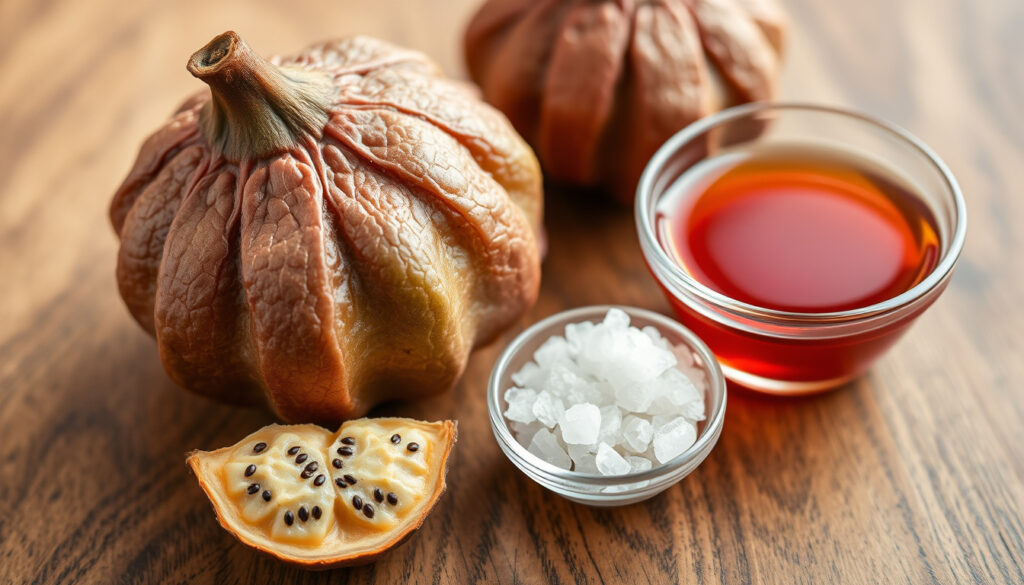
What Is Monk Fruit? Health, Safety, and Uses
If you’ve ever scanned the sweetener aisle and wondered what that little green fruit is doing in a packet of white powder, you’re not alone. Monk fruit has quietly become one of the most talked-about zero-calorie sweeteners, but most people know surprisingly little about it. This guide will help you read labels, compare options, and decide whether monk fruit belongs in your kitchen.
Calories per serving: 0 · Botanical source: Siraitia grosvenorii · Native region: Southern China · First cultivated: 13th century by Buddhist monks · Sweetness vs sugar: 100–250 times sweeter
Quick snapshot
- Small green fruit from southern China (WebMD health review)
- Also called luo han guo or lo han gao (WebMD health review)
- Extract is used as a zero-calorie sweetener (WebMD health review)
- Mogrosides are extracted from the fruit (Healthline nutrition review)
- Water extraction concentrates the sweet compounds (Healthline nutrition review)
- Sold as powder, liquid, or blended sweetener (Healthline nutrition review)
- Zero calories per serving (Food & Nutrition Journal)
- No known blood sugar spike in available studies (Food & Nutrition Journal)
- FDA considers it generally safe (PubMed Central review)
- Pure extract is much sweeter than sugar (Healthline)
- Blended versions can measure like sugar (Healthline)
- Use it in drinks, baking, and tabletop sweetening (Healthline)
The table below summarizes the key facts about monk fruit.
| Label | Value |
|---|---|
| Botanical name | Siraitia grosvenorii |
| Common English name | Monk fruit; also luo han guo / lo han gao |
| Sweet compounds | Mogrosides, mainly mogroside V |
| Calories | 0 per serving |
| Regulatory status (US) | Generally recognized as safe (GRAS) (PubMed Central review) |
| Native region | Southern China |
| Sweetness vs sugar | 100–250 times sweeter |
What is monk fruit and is it bad for you?
Monk fruit is the small green fruit of Siraitia grosvenorii, a vine native to southern China. The English name comes from the Buddhist monks who first cultivated it in the 13th century, according to WebMD medical review. The fruit is also called luo han guo or lo han gao.
What is monk fruit called in English?
- “Monk fruit” is the standard English name, derived from the monks who grew it.
- In traditional Chinese medicine it is known as luo han guo.
- The botanical name Siraitia grosvenorii honors Gilbert Grosvenor, former president of the National Geographic Society.
Current safety assessments consider monk fruit sweetener generally recognized as safe. The PubMed Central (PMC) review notes that the U.S. FDA has classified monk fruit extract as GRAS for use in food products. In the EU, however, monk fruit extract is regulated under the Novel Foods framework, which requires pre-market authorization, as reported by the same review.
Monk fruit is not the same as a “chemical sweetener” — it’s a fruit extract. The few safety questions that exist come from blended products, not the pure extract itself.
The takeaway: For consumers, the safety questions are less about the monk fruit itself and more about the complete product formula.
What is monk fruit sweetener made of?
The sweet flavor comes from mogrosides, especially mogroside V, which are natural compounds found in the fruit’s flesh. According to Healthline nutrition review, the fruit is water-extracted to concentrate those compounds into a sweetener. The result is a powder, liquid, or blended product that is 100–250 times sweeter than sugar.
What is monk fruit used for?
- Drinks: coffee, tea, smoothies, lemonade
- Baking: blended formulas are designed to replace sugar cup-for-cup
- Tabletop sweetening: single-serve packets
- Commercial use: yogurt, sauces, beverages, and confections
Pure extract is intensely sweet, so many retail blends add fillers such as erythritol to reduce sweetness and provide bulk. That’s why a “monk fruit” sweetener might contain only a small percentage of actual monk fruit extract.
If you buy a “monk fruit” sweetener that measures like sugar, check the ingredient list. The fillers — often erythritol, dextrose, or maltodextrin — determine the health impact more than the monk fruit itself.
The takeaway: Understanding the ingredient list is the most reliable way to predict the health impact of a monk fruit product.
Are stevia and monk fruit the same?
No. Stevia comes from the leaves of Stevia rebaudiana; monk fruit comes from Siraitia grosvenorii. Both are natural zero-calorie sweeteners, but they have different taste profiles and aftertastes. According to Food & Nutrition Journal, monk fruit is roughly 100–250 times sweeter than sugar, while stevia is 200–300 times sweeter. People may avoid stevia due to a bitter aftertaste or concerns about processed steviol glycosides, not inherent toxicity.
The table below compares monk fruit and stevia across several key attributes.
| Attribute | Monk fruit | Stevia |
|---|---|---|
| Source | Siraitia grosvenorii fruit | Stevia rebaudiana leaves |
| Sweetness vs sugar | 100–250× | 200–300× |
| Calories | 0 per serving | 0 per serving |
| Blood sugar impact | Negligible (Food & Nutrition Journal) | Negligible (EatingWell) |
| Aftertaste | Mild, licorice-like | Bitter or metallic for some users |
| Regulatory status (US) | GRAS (FDA) (PubMed Central) | Purified steviol glycosides GRAS; whole-leaf not approved (FDA) |
| Regulatory status (EU) | Novel Foods authorization pending (EFSA) | Steviol glycosides authorized since 2010 (EFSA) |
What is the healthiest sugar substitute?
There is no single answer. Both monk fruit and stevia are considered safe and effective for sugar reduction. A Verywell Health comparison notes that both are suitable for people managing diabetes because they do not significantly affect blood sugar. The choice often comes down to taste and how the product is blended.
Why are people avoiding stevia now?
Some consumers report a bitter aftertaste from stevia, and there is confusion about processed steviol glycosides versus whole-leaf stevia. However, regulatory bodies like the European Food Safety Authority (EFSA) have evaluated steviol glycosides as safe. The avoidance is not due to toxicity but to personal taste and labeling concerns.
Monk fruit wins on mild aftertaste; stevia wins on EU regulatory approval. For most people, the healthiest substitute is the one they will actually use — and that depends on which aftertaste they can tolerate.
The takeaway: The choice between monk fruit and stevia often comes down to personal taste and regional availability, as both are considered safe and effective.
Why are people avoiding monk fruit?
Avoidance is often related to price, aftertaste, or unknown ingredients in blends. Pure monk fruit sweetener rarely causes adverse effects, but digestive upset may come from sugar alcohols in blended products. According to Verywell Health, if a product contains erythritol or other polyols, high intakes can cause bloating or diarrhea.
What are monk fruit sugar side effects?
- Pure monk fruit extract: no significant side effects reported
- Blended with erythritol: may cause digestive upset in large amounts
- Blended with dextrose or maltodextrin: adds calories and may affect blood sugar
- Allergic reactions: extremely rare
Most safety questions focus on the complete product formula, not the monk fruit extract itself. The Verywell Health review emphasizes that long-term effects of daily human consumption are still being studied, and a specific safe daily intake has not been established.
The ingredient that causes the side effect is often not monk fruit — it’s the filler. Reading labels is the single most important step for avoiding surprises.
The takeaway: Reading the ingredient list is the single most important step for avoiding surprises with monk fruit sweeteners.
Does monk fruit spike blood sugar?
Mogrosides do not enter normal glucose metabolism, so monk fruit sweetener has a negligible effect on blood sugar. A crossover study cited by Food & Nutrition Journal found that monk fruit extract caused no blood sugar impact compared with sucrose. Both monk fruit and stevia are often cited as diabetic-friendly sweeteners because they provide sweetness without calories or carbohydrates.
What is the safest sweetener for diabetics?
Monk fruit and stevia top the list. According to EatingWell, experts and studies consider both similarly helpful for blood sugar management. However, people with diabetes should still read labels because blends may contain sugar, maltodextrin, or other carbs.
For someone with diabetes, the difference between a pure monk fruit product and a blended one can be the difference between stable blood sugar and a surprise spike.
The takeaway: For diabetics, choosing a pure monk fruit product over a blended one can be the difference between stable blood sugar and a dangerous spike.
Is 1 cup of monk fruit equal to 1 cup of sugar?
Pure monk fruit extract is not a 1:1 sugar substitute because it is hundreds of times sweeter. Most packaged monk fruit baking blends are formulated with fillers such as erythritol so that 1 cup replaces 1 cup of sugar. Healthline notes that baking may need extra moisture or bulk because monk fruit does not caramelize like sugar.
Does Tesco in the UK sell monk fruit sugar?
Availability in UK supermarkets such as Tesco can change. Look for “monk fruit sweetener” or “monk fruit sugar” in the sugar aisle or check the retailer’s online stock. UK shoppers may also find it in health food stores or online. As of 2025, the EU has not broadly authorized monk fruit extract as a food additive, so some products may be sold as “food supplements” rather than sweeteners, according to BSH Ingredients regulatory summary.
If you buy a 1:1 baking blend, you get convenience but also fillers. If you buy pure extract, you get intensity but no volume. Neither is wrong — just know which one you have.
The takeaway: When baking with monk fruit, knowing the exact type of product you have—pure extract or a blended formula—is essential for achieving the right texture and sweetness.
Confirmed facts
- Monk fruit is native to southern China. (WebMD)
- Monk fruit sweetener is calorie-free. (WebMD)
- The fruit’s botanical name is Siraitia grosvenorii. (PubMed Central)
- It contains mogrosides, which are much sweeter than sugar. (Healthline)
What’s unclear
- Long-term effects of daily human consumption are still being studied. (Verywell Health)
- A specific safe daily intake for monk fruit sweetener has not been established. (PubMed Central)
- Whether products labeled “monk fruit” are pure extract or blended with fillers depends on the brand. (WebMD)
- Antioxidant claims need more human clinical evidence. (Healthline)
“Monk fruit sweetener is a calorie-free, natural sugar alternative that comes from the extract of the monk fruit.”
— WebMD medical review
“The fruit was first cultivated by Buddhist monks in the 13th century as a Southeast Asian melon.”
“Monk fruit extract is a natural high-intensity sweetener derived from Siraitia grosvenorii.”
— Kaim et al., PMC review (2025)
“Monk fruit sweetener is a zero-calorie natural sweetener with antioxidant properties.”
— Healthline nutrition review
Monk fruit is a genuinely natural zero-calorie sweetener, but it’s not magic. The biggest risk is assuming that anything labeled “monk fruit” is pure extract — most products are blends, and the fillers are what cause side effects or blood sugar changes. For the label-conscious shopper, the choice is clear: read the ingredient list, not the front-of-package claim. Or, if you’re curious about other kitchen staples, check out our guide to Cream of Tartar Substitute and Omega-3 Fatty Acids.
weightandwellness.com, reddit.com, cris.msu.edu, pyureorganic.com
Frequently asked questions
What is monk fruit sweetener?
Monk fruit sweetener is a zero-calorie sweetener made from the extract of the monk fruit (Siraitia grosvenorii). It is 100–250 times sweeter than sugar and contains no calories or carbohydrates.
Is monk fruit safe?
Yes, the U.S. FDA considers monk fruit extract generally recognized as safe (GRAS). In the EU it is under evaluation as a Novel Food. Long-term studies are limited, but short-term safety is well supported.
Who shouldn’t eat monk fruit?
People with allergies to the fruit itself (extremely rare) should avoid it. Those sensitive to sugar alcohols like erythritol should check the product label, as many blends contain these fillers.
Is it okay to eat monk fruit every day?
Moderate daily consumption of pure monk fruit extract is considered safe. However, a specific safe daily intake has not been established. If you consume blended products, watch for fillers that may cause digestive issues.
What is monk fruit called in Hindi?
Monk fruit is commonly referred to as “मोंक फ्रूट” (monk fruit) in Hindi. It is not a traditional Indian fruit, so no native Hindi name exists. The botanical name Siraitia grosvenorii is used in scientific contexts.
More related posts
 Gorsuch Roberts Immigration Decision: Supreme Court 5-4
 Is Goofy a Dog – Disney Confirmation and Myths Busted
 Nobody Wants This Season 3: Release Date & Cast Confirmed
 Sabrina Carpenter Espresso Lyrics – Meaning, Release and Facts
 Google Pixel 10 Release Date: Launch, Price, Comparison
 Inter Miami vs Orlando City: Florida Derby Guide
 Federal Reserve News Today: Rate Decision & Next Meeting
 Broward County School Calendar: Key Dates & Updates