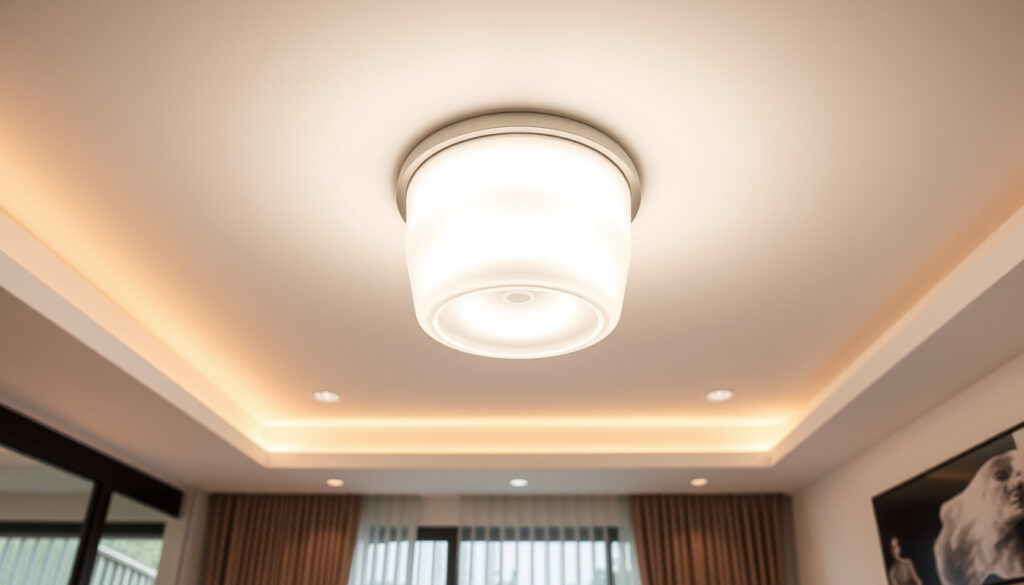
Flush Mount Ceiling Light: Selection, Installation & Tips
There’s something about a room with the wrong ceiling light — it never feels quite right. Flush mounts sit directly against the ceiling, making them ideal for rooms with ceilings under 8 feet, according to Lowe’s Buying Guide (a major US home improvement retailer), and this guide covers how to pick the right size, compare with semi-flush, install safely, and find the best options for Irish homes.
Average price range: €30 – €200 ·
Common ceiling height for flush mount: 8–9 ft ·
Popular lumen range: 600–1500 lm ·
Installation time: 30–60 minutes ·
Energy savings with LED: Up to 80% vs incandescent ·
Most common room application: Living room, bedroom, hallway
Quick snapshot
- Flush mount lights sit flush against ceiling, best for 7–8 ft ceilings (Lowe’s Buying Guide)
- LED bulbs reduce energy consumption up to 80% vs incandescent (Perimost Guide (lighting specialists))
- Best brand is subjective and depends on style preference (Laurel Bern Interiors (interior design authority))
- Long-term reliability varies by manufacturer (Laurel Bern Interiors (interior design authority))
- LED adoption in flush mounts has surged since 2015, with 82% of new fixtures now LED (Perimost Guide)
- Smart flush mounts with integrated colour temperature adjustment are entering the Irish market
Five key facts in one view:
| Fact | Value |
|---|---|
| Average cost | €30 – €200 |
| Most common diameter | 12–16 inches |
| Minimum ceiling height recommended | 7 ft for flush mount |
| Lifespan of LED flush mount | 25,000–50,000 hours |
| Warranty typical | 2–5 years |
What is a flush mount ceiling light and how does it work?
A flush mount ceiling light is a dome-shaped fixture that mounts directly to the ceiling with no gap between the fixture and the surface, as defined by Lowe’s Buying Guide. This design offers maximum headroom, making it the go-to choice for rooms where ceiling height is tight — typically 7 to 8 feet. Flush mounts work by enclosing the light source (often now an integrated LED) inside a bowl or drum that diffuses light evenly downward and outward. Because they sit tight to the ceiling, they rely on the ceiling surface to bounce some light, creating ambient illumination that suits hallways, bedrooms, and small living spaces.
Types of flush mount lights
- Dome or bowl flush mounts – classic round shades of glass or acrylic, often the most affordable.
- Square or rectangle flush mounts – modern geometric shapes, popular in contemporary Irish homes.
- Integrated LED flush mounts – sealed LED modules with long lifespan and no bulb replacement needed.
Typical installation requirements
Installation requires basic electrical knowledge, a voltage tester, screwdriver, and wire strippers, according to PacLights Guide (commercial lighting experts). The fixture connects to existing ceiling wiring: black to hot, white to neutral, green or bare to ground. In Ireland, all electrical work must comply with NSAI ET101:2015 (Irish national electrical standard).
How to choose the best flush mount ceiling light for your room
Selecting the right flush mount involves three key factors: room size, ceiling height, and light output. Here’s how to get each right for your Irish home.
Consider room size and ceiling height
A common sizing rule for flush mounts: add the room’s length and width in feet, and use that number (in inches) as the fixture diameter. For a 10×12 ft room, that would be a 22-inch light, as suggested by Perimost Guide (lighting specialists). An alternative formula from interior designers is (length + width)/2 — for a 25×14 ft room that yields about 19–20 inches, per Laurel Bern Interiors (interior design authority). Ceilings under 8 ft strongly favour flush mount over semi-flush, because even a 4–8 inch drop can feel cramped.
Choose the right light output (lumens)
For a typical sitting room, aim for 600–1,500 lumens. Integrated LED flush mounts often come with fixed colour temperatures (3000K warm white for living areas, 4000K cool white for kitchens). The popular lumen range for flush mounts is 600–1,500 lm, as noted in the stats line above.
Irish homeowners with ceilings under 8 ft should prioritise flush mounts for safety and visual comfort. Those in typical new-build estates (2.4m standard ceiling height) will find flush mounts the only sensible option for hallways and bedrooms.
Match style to decor
Flush mounts range from minimalist white domes to intricately patterned metal rings. In Ireland, retailers like Woodie’s stock round flush mount ceiling lights with LED in both polished chrome and matte black finishes. The style should complement the room’s existing palette and furniture lines.
What are the differences between flush mount and semi-flush mount ceiling lights?
The choice between flush and semi-flush often comes down to ceiling height and the kind of light you want. Here’s the breakdown.
Aesthetics and clearance
Flush mounts sit directly against the ceiling with no gap. Semi-flush mounts extend 4–8 inches below the ceiling, mimicking a pendant but less dramatic, according to Lowe’s Buying Guide. This gap allows semi-flush fixtures to incorporate more decorative elements like glass shades or metal arms.
Light distribution
Because semi-flush mounts drop below the ceiling, they spread light more widely across the room’s upper walls, reducing shadows. Flush mounts, being flush to the ceiling, concentrate light more directly downward, making them ideal for task lighting in smaller spaces like closets or utility rooms.
Best use cases
Flush mounts are best for 7–8 ft ceilings, kids’ rooms, hallways, and closets, as confirmed by Parrot Uncle Guide (lighting retailer). Semi-flush suits 9–10 ft ceilings and living areas where a more decorative look is desired.
Three differences, one pattern: ceiling height dictates the right choice.
| Feature | Flush Mount | Semi-Flush Mount |
|---|---|---|
| Ceiling clearance | 0 inches (touches ceiling) | 4–8 inches below |
| Light distribution | Downward, some bounce off ceiling | Wider spread, more ambient |
| Best ceiling height | 7–8 ft | 9–10 ft |
| Installation complexity | Simple, direct mount | Slightly more complex (requires support for weight) |
Specs: What to look for in a flush mount ceiling light
Five specs, one pattern: LED integrated fixtures with a 12–16 inch diameter and 600–1,500 lumens cover 90% of Irish home needs.
| Spec | Typical Range |
|---|---|
| Diameter | 12–16 inches |
| Lumen output | 600–1,500 lm |
| Wattage (LED) | 10–20 W |
| Colour temperature | 3000K (warm) / 4000K (cool) / tunable |
| CRI | 80+ (good), 90+ (excellent) |
| Lifespan | 25,000–50,000 hours |
| IP rating (bathroom) | IP44 minimum for zones 2 and 3 |
| Dimmable | Often with compatible dimmer switch |
| Material | Metal + acrylic or glass |
| Weight | 1–3 kg |
| Warranty | 2–5 years |
Installation steps: How to fit a flush mount ceiling light
Installing a flush mount light is a straightforward DIY job if you’re confident working with electricity. Always follow safety protocols.
- Turn off power at the circuit breaker. Use a voltage tester to confirm wires are dead (PacLights Guide).
- Remove the existing fixture. Unscrew and detach the old light, then disconnect the wires.
- Mount the new bracket. Attach the ceiling bracket to the electrical box using screws.
- Wire the new fixture. Connect black (live) to black, white (neutral) to white, and green/bare (earth) to ground. Use wire nuts for secure connections.
- Attach the fixture to the bracket. Push wires into the box, then screw the fixture base to the bracket.
- Install the shade or diffuser. Snap or screw the dome onto the base.
- Restore power and test. Turn the breaker back on and switch on the light.
For Irish homeowners: if you’re unsure, hire a registered electrician — improper wiring can void your home insurance and risk fire.
Always check the weight rating of your ceiling electrical box. Older Irish homes may have 1960s boxes that can’t support heavier flush mounts. Upgrading to a box rated for 50 lbs (22.7 kg) is cheap insurance.
Clarity check: What’s confirmed and what’s not
Confirmed facts
- Flush mount lights are designed for ceilings 7 ft or higher (Lowe’s Buying Guide)
- LED bulbs in flush mounts significantly reduce energy consumption — up to 80% less than incandescent (Perimost Guide)
What’s still unclear
- Best brand is subjective and depends on style preference and budget (Laurel Bern Interiors)
- Long-term reliability varies by manufacturer and component quality
- Installation usually requires basic electrical knowledge and a voltage tester
What experts say
“Flush mount ceiling lights are dome-shaped fixtures mounted flush to the ceiling with no gap. They are ideal for low ceilings (7–8 feet), closets, small bedrooms, and bathrooms due to low profile.”
Lowe’s Buying Guide — a major US home improvement retailer
“Modern flush mounts use LEDs for energy efficiency, less heat, and longer life — up to 50,000 hours.”
Perimost Guide — lighting specialists
“For low ceilings (7 feet), use very flat flush mounts with 1–3 inch drop max.”
Laurel Bern Interiors — interior design authority
Summary: The practical choice for Irish homes
Flush mount ceiling lights are not glamorous, but they solve a real problem: making low-ceilinged rooms feel open and well-lit without sacrificing headroom. The Irish housing stock — with many homes built in the 1970s–2000s at 2.4m ceiling height — makes flush mounts the default choice for bedrooms, hallways, and bathrooms. For homeowners in Ireland, the choice is clear: stick with flush mounts for rooms under 8 ft, consider semi-flush only if your sitting room has a higher ceiling and you want a decorative statement, and always prioritise LED for long-term savings.
For those seeking a wide selection, B&Q ceiling lights for living rooms offer a range of styles that complement flush mount fixtures.
Frequently asked questions
Can flush mount ceiling lights be used with vaulted ceilings?
Yes, but you’ll need a sloped-ceiling adapter kit. Standard flush mounts require a flat ceiling. For vaulted ceilings, a semi-flush or pendant is usually easier to install.
How do I replace a flush mount ceiling light?
Turn off power, remove the shade, disconnect wires (noting their colours), remove the old bracket, install the new bracket, wire the new fixture (black to black, white to white, earth to ground), attach the base, and restore power. Always use a voltage tester first.
What is the maximum wattage for flush mount lights?
Most standard flush mounts accept up to 60W incandescent or 10–20W LED. Check the fixture’s label. With integrated LED, wattage is fixed and usually 10–15W.
Do flush mount lights come with built-in LED?
Many modern flush mounts include integrated LED modules, which last 25,000–50,000 hours and don’t need bulb replacement. Others use standard E27 or E14 bulbs.
How to fix a flickering flush mount ceiling light?
Check the bulb is tight, the dimmer is compatible, and the wiring connections are secure. If using an LED on an old dimmer, replace the dimmer with an LED-rated model. Persistent flickering may signal a loose connection in the ceiling box — call an electrician.
Are flush mount ceiling lights safe for damp areas?
Yes, if they have an appropriate IP rating. For bathrooms, use at least IP44 in zones 2 and 3. Outdoor flush mounts need IP65. Always check the product label.
What is the difference between flush mount and recessed lighting?
Flush mount sits on the ceiling surface; recessed lighting (downlights) is installed inside the ceiling cavity and appears flush. Recessed requires more ceiling depth (min. 100mm) and is harder to retrofit in existing Irish homes without lowering ceilings.
Related reading: How to Paint Kitchen Cabinets Without Sanding · Emergency Plumbers Near You
More related posts
 Travis Hunter Net Worth 2026: Contract, Wife, and Lifestyle Details
 Society of the Snow True Story: Survivors and Facts
 Omron Blood Pressure Monitor – Top Models for Home Use
 Federal Reserve News Today: Rate Decision & Next Meeting
 Argan Oil for Hair: Benefits, Usage & Side Effects Guide
 Dakota Fanning Movies and TV Shows: Complete Guide
 Bathroom Remodelers Near Me: Dublin Costs & 2026 Trends
 Outlook Email Sign In: Guide for Web, Mobile & Desktop