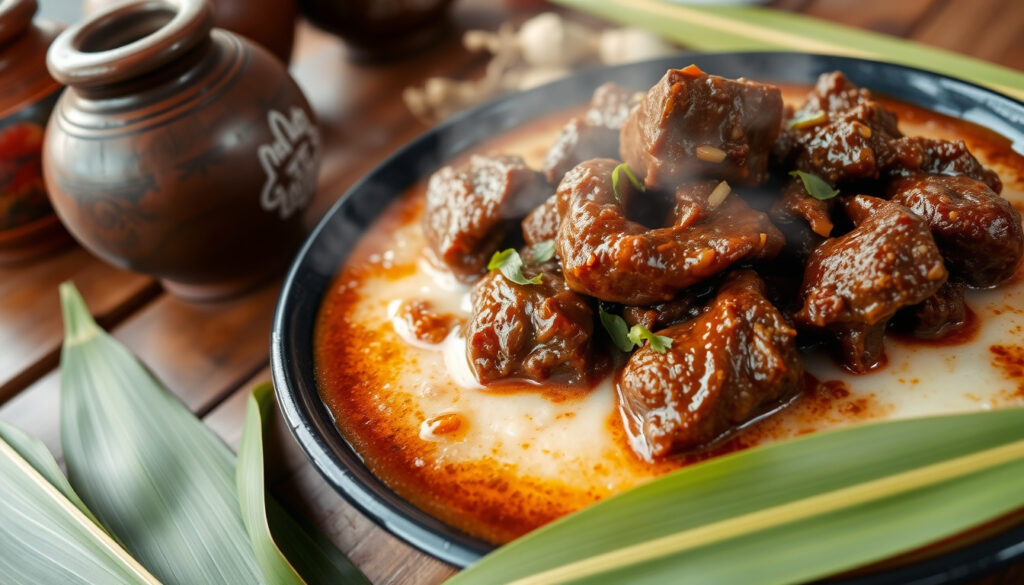
Beef Rendang Malay Near Me: Taste, Differences & Local Spots
Few dishes make a room go quiet the way a good rendang does — dark, glossy beef that has simmered for hours into a caramelized, almost jam-like coating. Before you type “beef rendang malay near me” into a search bar, it helps to know this is a dish rooted in the Minangkabau tradition of West Sumatra (Seasoned Pioneers (food history site)), claimed with pride by Malaysian kitchens too, and slow-cooked until the sauce nearly disappears into the meat.
Origin: Indonesia and Malaysia · Calories per serving: approx. 500 kcal · Cooking time: 4 to 6 hours · Alternative names: Caramelized beef curry, Beef rendang dry curry · Popularity: Ranked #1 on CNN World’s 50 Best Foods (2017)
Quick snapshot
- Rendang is most strongly associated with the Minangkabau people of West Sumatra, Indonesia (Rasa Malaysia (Malaysian food publication)).
- Authentic rendang is slow-cooked until the liquid reduces into a dense, heavily seasoned coating (Nik Sharma Cooks (chef and food scientist)).
- Minangkabau migration and trade helped spread rendang beyond West Sumatra to the Malay Peninsula (Seasoned Pioneers (food history site)). (Rasa Malaysia (Malaysian food publication))
- The exact date of the first written rendang recipe is not documented. (Tasting Table (food media))
- Whether the earliest rendang used beef, water buffalo, or another meat is unresolved; regional versions use buffalo and other proteins (Tasting Table (food media)).
- Calorie counts vary widely by recipe, so any single menu number is only an estimate. (Tasting Table (food media))
- 16th–20th century — rendang develops in the Minangkabau highlands of West Sumatra and spreads across the Strait of Melaka into the Malay Peninsula through migration and trade (Seasoned Pioneers (food history site)). (Wikipedia (overview of rendang’s international recognition))
- 2011 — CNN International names beef rendang the number one dish in its World’s 50 Best Foods list (Wikipedia (overview of rendang’s international recognition)).
- 2024 — UNESCO designates Indonesian rendang as an Intangible Cultural Heritage of Humanity (Wikipedia (overview of rendang’s international recognition)). (Wikipedia (overview of rendang’s international recognition))
- Search Yelp or Google Maps for “beef rendang,” then filter for Malaysian or Indonesian restaurants.
- Read reviews for phrases like “cooked for hours” or “dark and caramelized” — they signal a real reduction.
- If you are near Queens, NY, or Los Angeles, review roundups consistently name Lemak Kitchen and Ipoh Kopitiam as well-reviewed rendang spots.
Eight facts, one pattern: rendang is defined by slow reduction, and every core ingredient — beef, coconut milk, chilies, and aromatics — is chosen to survive that long cook (International Islamic University Malaysia repository (academic food research)).
| Attribute | Detail |
|---|---|
| Main ingredients | Beef, coconut milk, lemongrass, galangal, chilies, spices |
| Cooking method | Slow simmering for 4–6 hours until sauce caramelizes |
| Serving temperature | Hot or room temperature, typically with rice |
| Common variations | Chicken rendang, jackfruit rendang (vegan) |
| Cultural significance | Served at festive occasions and deemed one of the world’s best foods |
| Origin community | Minangkabau, West Sumatra, Indonesia |
| Regional spread | Indonesia, Malaysia, Singapore, and Brunei |
| Flavor base | Coconut, chili, shallots, galangal, lemongrass, turmeric, and ginger |
Is Beef Rendang Indonesian or Malay?
What are the historical roots of rendang?
- The strongest historical link runs to the Minangkabau of West Sumatra, where the dish took shape.
- In peninsular Malaysia, Negeri Sembilan is the region most associated with a rendang tradition shaped by West Sumatran migrants (International Islamic University Malaysia repository (academic food research)).
Both countries can claim it honestly. Indonesian rendang is Minangkabau heritage; Malaysian rendang is a local Malay food that still carries strong Minangkabau and Indonesian associations — which is why the label “Malay rendang” often signals a Malaysian interpretation rather than a strictly Minangkabau preparation (Rasa Malaysia (Malaysian food publication)).
That migration is also why the dish settled so deeply in Malaysia: Minangkabau traders and migrants carried the technique with them, and each generation adapted it to local tastes, so the same slow-cooked idea now wears two national flags.
How does the cooking process differ between the two countries?
- The Minangkabau method emphasizes prolonged reduction rather than quick frying or an ordinary curry simmer (Rasa Malaysia (Malaysian food publication)).
- “Dry” and “wet” rendang sit on one continuum: keep cooking and the sauce darkens into a glaze.
- Malaysian home versions sometimes stop earlier, leaving a softer, more sauce-like finish.
The practical signal for diners: a real rendang arrives as a coating, not a soup. If the sauce pools around the beef like a curry, the cook stopped before the dish was done.
The implication: “Indonesian or Malay?” is the wrong question. Rendang is a Minangkabau dish with two national lives, and the migration route explains both.
The implication: rendang’s dual heritage is a strength, not a confusion — both traditions honor the same slow-cooked technique.
What Does Beef Rendang Taste Like and What Is Best Served With It?
What are the key flavor notes in beef rendang?
- The flavor is a chord, not a single note: coconut, chili, shallots, galangal, lemongrass, turmeric, and ginger build together, with no single curry powder doing the work (International Islamic University Malaysia repository (academic food research)).
- The slow reduction makes the sauce softly sweet, deeply savory, and only gently spicy.
- The finished coating should be dark, glossy, and fragrant before it even reaches the rice.
Rendang tastes like warmth and depth before it tastes like heat. Coconut milk sweetens as it reduces, chilies add a slow burn, and lemongrass and galangal keep the whole pot bright.
Texture is half the experience: the beef should pull apart easily but still hold its shape, and every piece should carry a sticky, dark glaze. The best rendang balances three things at once — sweetness from the coconut, savoriness from the beef and spices, and a gentle heat that builds with each bite.
Which side dishes complement beef rendang best?
- Rendang is commonly served with rice and belongs to festive or communal meals (Wikipedia (open encyclopedia)).
- Steamed white rice is the plate’s quiet anchor; it absorbs the glossy sauce.
- Cooling vegetables, keropok (crisp crackers), and sambal belacan add crunch and heat.
Keep the sides plain. Cucumber slices, a simple salad, or steamed greens give the palate a break between rich bites.
The pattern: rendang does the heavy lifting; the rest of the plate exists for relief.
What Is the Best Cut of Beef for Beef Rendang?
Which meat cuts are traditionally used for rendang?
- Recipes consistently point to chuck, brisket, or round — well-marbled cuts that hold up through hours of simmering.
- The Minangkabau historically used tougher meat cuts and, in some accounts, water buffalo, relying on long cooking to tenderize the protein (Tasting Table (food media)).
- Beef is the most famous version, but chicken, lamb, and jackfruit rendang are common variations.
Buy for marbling, not tenderness. A lean cut like sirloin can turn dry and stringy before the sauce reaches its dark, caramelized stage.
The long cook does the tenderizing; your job is to choose a cut with enough fat and collagen to reward it.
Why does the cut affect the texture after long cooking?
Chuck and brisket reward the hours: the fat melts into the sauce and the collagen turns silky. Lean cuts save a little money and cost you texture in the pot.
Muscle that works hard — chuck, brisket, round — is rich in connective tissue, and long cooking in coconut milk breaks that tissue down. That is why the original rendang tradition favored tough, economical meat — and it creates a paradox: the “cheap” cut becomes the luxurious bite, while the “good” cut dries out.
The lesson: in rendang, the best beef is the one that needs the longest cook.
How Unhealthy Is Beef Rendang?
What is the nutritional breakdown of a typical serving?
The same slow reduction that gives rendang its character also concentrates coconut cream and beef fat — which is why a restaurant serving typically settles into the 500–600 kcal range, with 30–40 g of fat, before rice (Nik Sharma Cooks (chef and food scientist)).
Rendang also carries a serious sodium load, thanks to salt and the concentrated spice paste — which is what you expect from a celebration dish, not a daily habit.
How can rendang be made slightly healthier without sacrificing flavor?
- Cut the coconut milk by a third and stretch the sauce with a little beef stock.
- Use leaner beef and trim visible fat before cooking.
- Keep the aromatics generous — more chilies, ginger, and lemongrass build flavor without added calories.
- Serve a smaller portion with more vegetables and rice.
The honest trade: reduce the coconut milk and you shift the texture and flavor away from the classic. A “light rendang” is closer to a coconut beef curry — tasty, but not the same dish.
The pattern: rendang is rich on purpose. The healthy way to eat it is less often, not differently.
What Does “Rendang” Mean in Malay and What Is It Called in English?
Is there a direct English translation for rendang?
- In Malay, “rendang” connects to a slow cooking or reduction process (Tasting Table (food media)).
- Translations like “to simmer slowly” or “to caramelize” describe the technique more than the dish.
- English menus usually write “beef rendang” or “caramelized beef curry.”
No single English word captures it. “Caramelized beef” comes closest to the look and taste, but it misses the spice depth behind the sweetness.
How is rendang different from other beef curries?
- Rendang is classified as a dry curry because the sauce is reduced until it coats the meat completely.
- A regular curry keeps a spoonable liquid; a true rendang does not.
- “Wet rendang” sits on the same continuum as gulai, a Sumatran curry — the difference is simply how long the reduction goes.
The closest description in English is “dry curry,” but even that undersells the texture: a true rendang is nearly jam-like, with beads of oil starting to separate at the edges.
The pattern: every translation fails because rendang is a method, not a category. “Dry curry” is the best English can do.
Where Can I Find Authentic Beef Rendang Malay Near Me?
What should I look for in an authentic rendang restaurant?
- Look for Malaysian, Indonesian, Nyonya, or Minangkabau restaurants; all serve rendang, but each kitchen has its own style.
- Scan the menu for “slow-cooked” or “cooked for hours” — real rendang cannot be rushed.
- Photos help: authentic rendang looks dark, dry, and glossy, not like a bowl of curry sauce.
Authentic rendang is cooked for hours until the meat is tender and the sauce is nearly dry — that is the definition every reliable recipe source above agrees on. A kitchen that also lists gulai or other Minangkabau dishes is usually a stronger signal than one that treats rendang as another generic curry.
One caution: the label “Malay rendang” can be a legitimate Malaysian interpretation, but it can also be a fast approximation. The cooking time tells you which one you are getting.
A 20-minute rendang is a red flag. Real rendang is a four-to-six-hour labor, and a kitchen that is proud of it will say so on the menu or in the reviews.
Are there online directories that list Malaysian or Indonesian restaurants?
- Yelp and Google Maps are the most practical starting points; search “beef rendang” and filter by Malaysian or Indonesian cuisine.
- Read reviews for words like “dark,” “caramelized,” and “authentic” — customers usually describe the reduction accurately.
- City-specific food blogs and Reddit threads regularly name specific rendang restaurants worth trying.
- Ask the restaurant directly whether their rendang is cooked fresh daily; a version that reheats in minutes is usually a warning sign.
Review roundups consistently name Lemak Kitchen in Queens, NY, and Ipoh Kopitiam in Los Angeles as well-reviewed rendang spots. Elsewhere, search “Malaysian restaurant” plus “rendang,” then cross-check the most recent reviews.
Restaurant hours and locations change; confirm both before you make the trip.
Why this matters: the label on the sign tells you the tradition; the menu tells you the method. The sentence to look for is “cooked for hours.”
The catch: without the long cook, it is not rendang — no matter what the menu calls it.
Indonesian vs. Malaysian Rendang: Key Differences
Three contrasts, one pattern: the longer the cook lets the sauce reduce, the drier and darker the rendang becomes — and that is where the two traditions most visibly split.
| Aspect | Indonesian rendang (Minangkabau) | Malaysian rendang |
|---|---|---|
| Texture | Dark and dry; the liquid cooks down until it coats the meat and the oil separates | Often slightly wetter and softer, closer to a thick curry |
| Cooking approach | Hours of patient reduction until the sauce breaks | Also slow-cooked, though home versions sometimes stop earlier |
| Regional identity | Minangkabau heritage from West Sumatra | A local Malay favorite with strong Minangkabau roots |
| Occasion | Ceremonial and festive meals in Minangkabau culture | Everyday and festive Malay cooking, especially in Negeri Sembilan |
The trade-off: if your rendang arrives swimming in sauce, the kitchen stopped early. The real dish is a dark, concentrated glaze that clings to the beef.
What’s Confirmed and What’s Unclear
Sorting through the research, the confirmed facts are few but solid, and the open questions are just as important.
Confirmed facts
- Rendang is rooted in Minangkabau culture from West Sumatra.
- Both Indonesia and Malaysia have strong rendang traditions.
- Authentic rendang requires hours of slow reduction until the sauce is nearly dry (Nik Sharma Cooks (chef and food scientist)).
- Beef rendang is nutritionally dense, with a typical serving above 500 kcal.
What’s unclear
- The exact date of the first written rendang recipe is not documented.
- Whether the earliest rendang used beef, water buffalo, or another meat is unresolved.
- Precise calorie counts vary so widely by recipe that any single number is an estimate.
- How closely a given restaurant’s rendang resembles a Minangkabau original is hard to verify from the outside.
The pattern: the more precise the claim, the thinner the records — which is a good reason to judge a restaurant by its cooking time rather than its origin story.
What the Sources Say
The research keeps circling back to four ideas: patience, a layered flavor base, regional variation, and a migration story that explains why two countries now claim the dish.
Authentic rendang is the result of a patient process: the coconut milk is cooked down until it nearly disappears, leaving the meat coated in a thick, caramelized layer.
— Rasa Malaysia (Malaysian food publication)
Rendang’s flavor is not a single spice but a chord — shallots, galangal, lemongrass, turmeric, ginger, and chilies locked together by coconut milk.
— International Islamic University Malaysia repository (academic food research)
Regional rendang is a reminder that beef was never the whole story; water buffalo and other proteins have long appeared, especially where tougher cuts needed hours to soften.
— Tasting Table (food media)
Rendang traveled the way great dishes do — with traders and migrants crossing the Strait of Melaka and settling in places like Melaka.
— Seasoned Pioneers (food history site)
The common thread: every source frames rendang as a dish that demands time — which is exactly what separates it from the curry aisle.
Rendang will never be a quick weeknight meal, and the search for a great plate of it is really a search for a kitchen that honors the hours. For the hungry reader, the decision is clear: call ahead and ask how long the rendang has been simmering — or cancel the plan and start your own pot, then wait until the smell brings the whole house to the kitchen.
Frequently asked questions
Is beef rendang gluten-free?
Usually, yes: the core ingredients are beef, coconut milk, chilies, and fresh aromatics. Some restaurant versions add soy sauce or prepared curry paste, so ask about thickeners and sauces if gluten is a concern.
Can I freeze beef rendang?
Yes. Because the sauce is reduced to a low-moisture coating, rendang freezes well; thaw overnight and reheat gently to keep the texture intact.
How long does it take to cook beef rendang from scratch?
Plan for 4 to 6 hours of slow cooking. The long simmer is what turns coconut milk into a dark, caramelized coating and tenderizes tougher cuts of beef.
Is beef rendang spicy?
It has heat, but it is not a chili bomb. The chilies are balanced by coconut milk and aromatics, so the warmth comes as part of the flavor rather than a sharp burn.
Can beef rendang be made with chicken or other meats?
Yes. Chicken rendang, lamb rendang, and jackfruit rendang for a vegan version are all common variations; beef is simply the most famous.
What is the difference between rendang and curry?
Rendang is a dry curry: the sauce is cooked down until it fully coats the meat, while a typical curry keeps a spoonable liquid. That reduction is the defining move of the dish.
More related posts
 Old Republic Home Warranty Review: Plans, Cost & Coverage
 House Cleaning Services Near Me: Costs, Tips & What to Expect
 Alvin and the Chipmunks: Names, Movies, Streaming Guide
 Cast of Mean Girls 2024 – Full List, Roles and Comparisons
 Denver Broncos vs Indianapolis Colts Player Stats: Final 29-28
 6 Minute Solar Eclip e 2027: Be t Place and Safety Guide
 What Is an EKG? Test, Procedure, and Results Explained
 Myrtle Beach South Carolina: Beaches, Safety & Nearby Towns