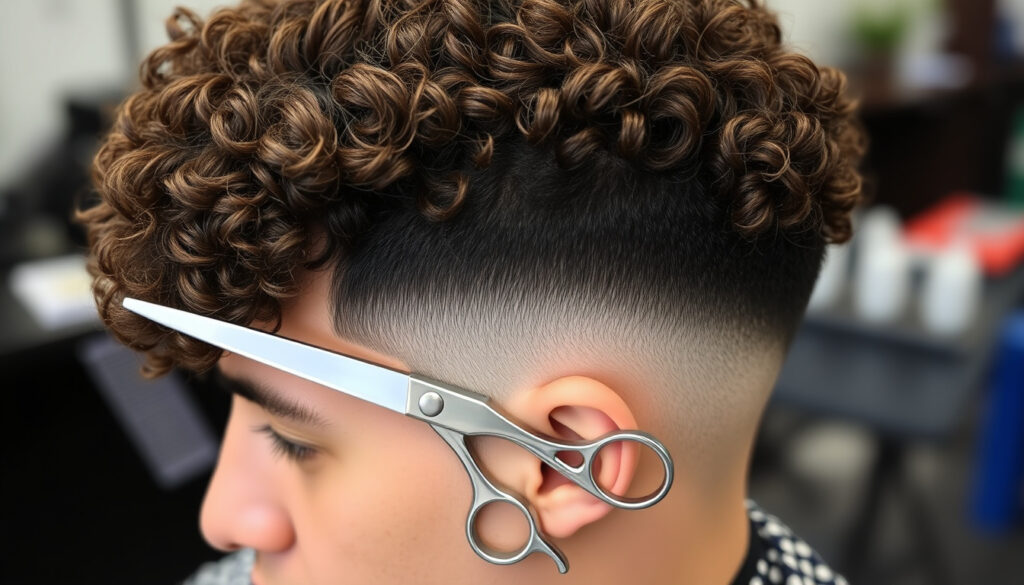
Low Taper Curly Hair: Complete Guide & Tips
Explaining a low taper fade to a barber for your curly hair can feel like a gamble. This guide breaks down exactly how the style works for each curl type, from loose waves to tight coils, so you walk out with defined curls and a clean fade.
Hair type classification range: 1A to 4C ·
Low taper fade description: Fade starts low on the head, retaining length on top ·
Rarest hair type: 1A (straight, fine, no curl)
Quick snapshot
- Low taper fade is a popular choice for curly hair (CurlyNikki curly hair resource)
- Hair types are classified as 1 (straight), 2 (wavy), 3 (curly), 4 (coily) (CurlyNikki)
- 1A hair is the rarest type (CurlyNikki curly hair resource)
- Whether low taper is universally better than mid taper for all curl types
- The long-term effect of frequent tapering on curl pattern health
- Low taper curly styles are commonly refreshed every 2–3 weeks (CurlyNikki)
- Barber tutorials on curly low taper fades have been posted since at least 2022 (YouTube barber tutorial)
- More curl-specific guides expected as the style gains popularity across all hair types
- Product innovations for moisture retention in tapered curly styles
| Label | Value |
|---|---|
| Low taper fade definition | A fade that starts low on the head, keeping length on top (CurlyNikki) |
| Best curl types for low taper | Type 2C to 4A are most common (Faxhion Tips hair care blog) |
| Common mistake | Not specifying ‘low’ taper, resulting in a higher fade than desired |
| Recommended product | Leave-in conditioner or curl cream post-cut (Faxhion Tips) |
| Recommended refresh cycle | Every 2–3 weeks (CurlyNikki) |
| Wash frequency | 2–3 times per week for curly hair with low taper style (Faxhion Tips) |
| Deep conditioning | Once per week recommended (Faxhion Tips) |
| Night protection | Satin or silk pillowcase or durag to reduce friction (Trendy Hair Picks hair trends blog) |
Is low taper good for curly hair?
Benefits of low taper for curly hair
- Preserves curl definition on top while reducing bulk on the sides (CurlyNikki)
- Creates a clean, modern silhouette that works with most curl patterns
- Low taper fade concentrates the fade around the neckline and sideburns, leaving the top curls full (CurlyNikki)
Potential drawbacks
- Some barbers caution against over-tapering tight curls, which can expose scalp (Faxhion Tips)
- If the fade is too aggressive, it may require more frequent touch-ups to maintain shape
Expert opinions from barbers
Barber Ivan, known for his TikTok tutorials, demonstrated a simple low taper fade on curly hair, calling the transformation “straightforward” (YouTube barber tutorial). George The Classic Barber, in a written guide, notes that low taper works best when the barber adjusts blade settings to the curl type to avoid choppy edges (Trendy Hair Picks).
Low taper gives you defined curls on top but demands discipline with upkeep. For curls looser than 3A, the fade can look clean for up to three weeks; for tighter curls (4A–4C), expect a visit every two weeks to keep the fade crisp.
The implication: low taper is a solid choice for most curly types, but tighter curls need a barber experienced with curly textures to avoid a fade that climbs too high.
What taper fade is best for curly hair?
Low taper vs mid taper for curly hair
Four common fade heights, one pattern: the higher the fade starts, the more scalp is exposed. Low taper keeps the fade low around the ears and neckline, retaining maximum length on top. Mid taper starts slightly higher, offering a more dramatic transition (CurlyNikki).
| Fade height | Starting point | Best for curl types | Maintenance frequency |
|---|---|---|---|
| Low taper | Just above the ears, around the neckline | 2C–4A | Every 2–3 weeks |
| Mid taper | Midway up the sides | 3A–4B | Every 2–3 weeks |
| High taper | Near the temples | 4B–4C (may require careful blending) | Every 1–2 weeks |
High taper and its suitability
High taper can work for very tight curls, but it may expose the scalp more, especially if the hair is thin or has low density. Some guides recommend high taper only for those who are comfortable with a more dramatic fade (Trendy Hair Picks).
Factors to consider: curl type, face shape, maintenance
- Curl type: Looser curls (2A–3A) can handle a higher fade; tighter curls benefit from a lower fade to preserve length.
- Face shape: Low taper suits round and oval faces; mid taper can elongate a round face.
- Maintenance: Higher fades require more frequent barber visits to keep the line sharp.
The pattern: for most curly hair, low taper is the safest bet because it preserves curl length on top while still giving a clean fade. Mid taper is a compromise if you want more contrast but still have decent curl definition.
Should I get a low or mid taper?
Visual differences between low and mid taper
Low taper fades fade lower on the head, around the ears, whereas mid taper starts slightly higher, creating a more pronounced transition from top to sides (CurlyNikki).
Maintenance requirements
Both require touch-ups every 2–3 weeks, but the mid taper may show regrowth faster because the fade line is higher and more visible (Trendy Hair Picks).
Personal preference and lifestyle
- If you want to keep as much curl length as possible, choose low taper.
- If you like a more dramatic fade and don’t mind slightly more maintenance, mid taper is a good option.
- Consider your daily styling time: low taper is easier to manage between washes.
What this means: the choice boils down to how much scalp exposure you’re comfortable with and how often you can visit the barber. Low taper is the lower-maintenance option for most curly heads.
Do I just ask for a low taper?
Exact phrasing to use at the barber
- “I’d like a low taper fade, keeping the length on top and fade down.” (wikiHow how-to guide)
- Specify your curl type so the barber adjusts blade settings accordingly.
- Bring a reference photo of the exact look you want.
What to specify about curl length
Tell the barber how much length you want to keep on top (e.g., “leave about 2 inches” or “keep the curls at their natural length”). For Type 4 curls, ask for a higher guard on the clippers to avoid going too short (Care About Your Hair curly hair care blog).
Common mistakes to avoid
- Avoid vague requests like “just a trim” or “make it look clean.” Be specific: “low taper fade, keep the top.”
- Don’t assume the barber knows curly hair. Ask if they are experienced with your curl type.
- Don’t skip the consultation: show the barber a photo and discuss the fade height.
Even with the right words, a barber who isn’t comfortable with curly textures may push the fade too high. The safest move: find a barber who specializes in curly hair, or at least watch a few of their previous cuts on social media.
Why this matters: a miscommunication at the barber can leave you with a style that’s impossible to fix until it grows out. Getting the phrasing right is the cheapest insurance you can buy.
What is type 1, 2, 3, 4 curly hair?
Type 1: straight hair
Type 1 hair has no curl at all. It’s naturally straight from root to tip. 1A is the rarest hair type overall, characterized by very fine, straight strands that lack volume (CurlyNikki).
Type 2: wavy hair (2A, 2B, 2C)
Wavy hair forms an “S” shape. 2A is loose and fine, 2B has more defined waves, and 2C is thick with some curl starting to form. Low taper works well on 2B and 2C because the waves fall naturally over the fade.
Type 3: curly hair (3A, 3B, 3C)
Curly hair has distinct ringlets. 3A curls are large and loose, 3B are medium and springy, 3C are tight corkscrews. Low taper is especially popular among Type 3s because it shows off the curl pattern without bulk.
Type 4: coily hair (4A, 4B, 4C)
Coily hair has a very tight zigzag pattern. 4A is soft and defined, 4B has a less defined curl, and 4C is the tightest and most fragile. For Type 4, a low taper fade can help reduce bulk and make styling easier, but requires careful moisture management (Care About Your Hair).
The implication: knowing your curl type (and its letter suffix) is the foundation of a good low taper fade. Without that knowledge, you may end up with a cut that doesn’t suit your texture.
Comparison: Low vs Mid vs High Taper for Curly Hair
Three fade heights, one key difference: how much of the side and back hair is removed. The table below breaks down the trade-offs.
| Fade type | Fade start | Best curl types | Maintenance | Scalp exposure |
|---|---|---|---|---|
| Low taper | Low (around ears) | 2C–4A | Every 2–3 weeks | Low |
| Mid taper | Midway up sides | 3A–4B | Every 2–3 weeks | Medium |
| High taper | High (near temples) | 4B–4C (with caution) | Every 1–2 weeks | High |
The pattern: the more scalp exposure you want, the higher the fade and the more maintenance required. For most curly hair, the low taper offers the best balance of style and upkeep.
Pros and cons of low taper for curly hair
Upsides
- Preserves curl length and definition on top (CurlyNikki)
- Reduces bulk on sides, making curly hair look more intentional
- Modern, clean silhouette that suits most face shapes
- Lower maintenance than higher fades
Downsides
- Requires barber experienced with curly hair
- Frequent touch-ups needed (every 2–3 weeks) (Trendy Hair Picks)
- Over-tapering can expose scalp on tight curls (Faxhion Tips)
- May not work well for very fine or thin curly hair
How to get and maintain a low taper fade for curly hair: step-by-step
Step 1: Know your curl type
Identify your curl pattern (1–4 with letter suffix) before you go to the barber. This will determine the fade height and the products you’ll need (CurlyNikki).
Step 2: Communicate clearly
Use the exact phrasing: “I’d like a low taper fade, keeping the length on top.” Mention your curl type and bring a reference photo (wikiHow).
Step 3: Choose the right barber
Find a barber experienced with curly hair. Look at their portfolio or ask for a consultation first.
Step 4: Post-cut care
- Apply a curl cream or leave-in conditioner immediately after the cut (Faxhion Tips).
- Use a medium-hold gel for definition if desired (Faxhion Tips).
- Avoid over-washing: shampoo 2–3 times a week and follow with conditioner (wikiHow).
- Deep condition once a week (Faxhion Tips).
Step 5: Maintain the fade
- Schedule barber visits every 2–3 weeks to keep the fade crisp (CurlyNikki).
- Between visits, use a daily spritz of water and leave-in to prevent dryness (Trendy Hair Picks).
- Sleep on a satin pillowcase or wear a durag to protect the curl pattern (Trendy Hair Picks).
- Use sulfate-free shampoo to reduce drying effects (Care About Your Hair).
For 4C hair, a pea-sized amount of curl cream is not enough — use a marble-sized amount and apply with the praying hands method to avoid frizz (Care About Your Hair).
What’s confirmed and what’s still unclear
Confirmed facts
- Low taper fade is a popular choice for curly hair (CurlyNikki)
- Hair types are classified as 1 (straight), 2 (wavy), 3 (curly), 4 (coily) (CurlyNikki)
- 1A hair is the rarest type
- Low taper fade keeps the fade low around the neckline and sideburns (CurlyNikki)
What’s still unclear
- Whether low taper is universally better than mid taper for all curl types
- Long-term effects of frequent tapering on curl pattern health
- Optimal product routine for low taper curly hair varies by individual
Quotes from barbers and experts
“A low taper fade on curly hair is a simple transformation — you just need to keep the fade low and let the curls do the work.”
— Barber Ivan, TikTok tutorial (YouTube barber tutorial)
“Low, high, mid — each fade works for different hair types. For curly hair, low is usually the safest because you keep the most length.”
— George The Classic Barber, in a blog comparing taper fades (Trendy Hair Picks)
“Knowing your hair type — 3C, 4A, 4B, 4C — is the first step to picking the right fade and the right products.”
— Taliah Waajid, hair care brand educator (Care About Your Hair)
For anyone with curly hair, the choice is clear: learn your curl type, communicate it to your barber, and stick to a maintenance routine, or risk ending up with a cut that doesn’t work for your texture. The low taper fade is a versatile foundation, but its success depends on preparation and upkeep.
youtube.com, youtube.com, trendyhairpicks.com, thetaperfade.net, youtube.com, curlynikki.com, taperfadepro.com, lowtaperfade.pro, youtube.com, youtube.com
Frequently asked questions
How long does a low taper fade last on curly hair?
With proper maintenance, the fade stays crisp for about 2–3 weeks. After that, you’ll likely need a touch-up to keep the shape (CurlyNikki).
Can I style curly hair with a low taper fade?
Yes. Use curl cream or leave-in conditioner on damp hair, then apply a medium-hold gel for definition. You can also air-dry or use a diffuser (Faxhion Tips).
Is low taper fade suitable for women with curly hair?
Absolutely. Many women with curly hair choose low taper fades for a modern, low-maintenance look. The fade can be customized to keep more length on top.
What products should I use after a low taper fade on curly hair?
A leave-in conditioner or curl cream is essential. For Type 4 hair, use a marble-sized amount and apply with the praying hands method. Deep condition weekly (Care About Your Hair).
How often should I trim a low taper fade on curly hair?
Every 2–3 weeks for the fade itself, and a full style reset every 4–6 weeks if you stretch visits (Faxhion Tips).
Does a low taper fade work for thick curly hair?
Yes, it’s actually ideal for thick curly hair because it reduces bulk on the sides while keeping the top manageable. Make sure your barber uses thinning shears if needed.
More related posts
 Galaxy M21 to Buy – Prices Availability and Value in 2024
 Wheel of Time Cast – Full List of Actors Seasons 1-3
 Memory of a Killer (2026): Episodes, Cast & Viewing Guide
 Carnegie Mellon Acceptance Rate 2024: Full Guide & Comparisons
 How to Lose a Guy in 10 Days: Is It Worth Watching
 Cheapest Gas Near Me – Best Apps and Tips to Save
 Houston Rockets vs Dallas Mavericks Player Stats & Box Scores