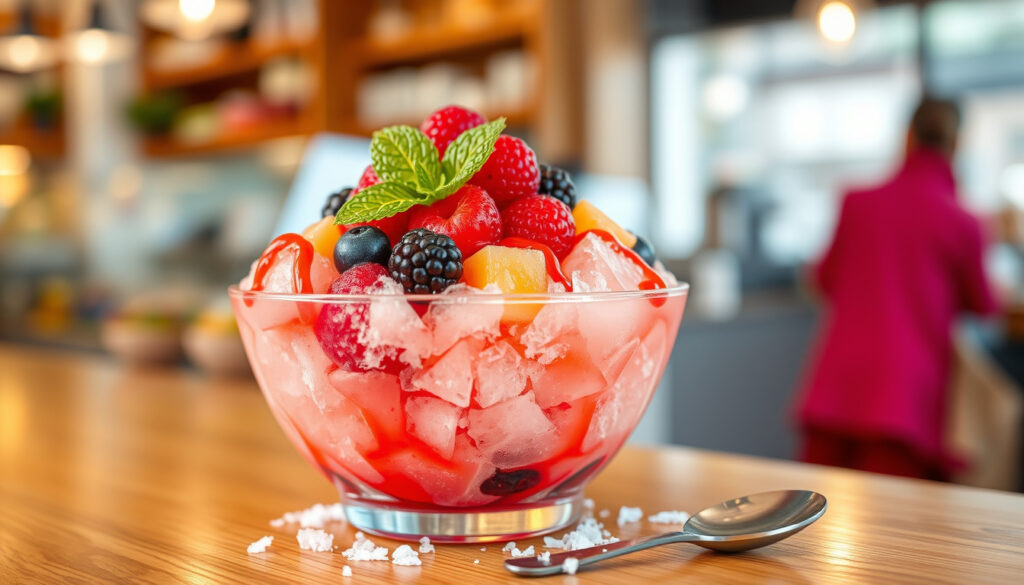
Shaved Ice Near Me: Differences, Health, and Where to Buy
Anyone who has watched a shave ice stand spin a block of ice into a soft, snowy mound knows it doesn’t resemble a snow cone. That texture gap is why people search for “shaved ice near me” — and why price matters: a kid’s cup runs $4 while the loaded Kitchen Sink hits $14 (Get Shaved Truck vendor menu).
Average price per serving: $3–$6 · Calories in a plain shaved ice (no toppings): 80–120 · Shaved ice vendors in the U.S.: over 5,000 · Sugar in a typical syrup serving: 20–30 grams
Quick snapshot
- Snow Hut Shaved Ice in Pasadena, Texas sells an 8 oz cup for $2.75 (Snow Cone Finder vendor listing)
- Get Shaved Truck lists a regular at $5 and a jumbo at $8 (Get Shaved Truck vendor menu)
- Mountain Magic Shave Ice lists a keiki size at $4.50 and a small at $5 (Mountain Magic Shave Ice stand menu)
- Calorie counts are public for only a few chains, such as Matcha Cafe Maiko’s 640-calorie Matcha Shaved Ice (Matcha Cafe Maiko chain nutrition guide)
- Pricing varies by city — Square’s Las Vegas guide shows a $4.90–$11.99 spread (Square merchant pricing guide)
- Los Angeles Times lists Hawaiian-style shave ice from $5.75 (kids) to $9 (large), plus Oakobing at $9.50 for a small (Los Angeles Times regional food coverage)
- Mountain Magic Shave Ice and How Sweet Is This publish complete priced menus online (Mountain Magic Shave Ice stand menu; How Sweet Is This shop menu)
- Compare menus before you drive, then order the smallest size and add one topping you actually want.
- The gap between an 8 oz cup and a 32 oz jumbo at the same stand shows why size matters more than the base price.
Nine facts, one pattern: shaved ice starts cheap, stays dairy-free until you add milk, and reaches restaurant prices only at the top end of the menu.
The pricing data below puts the whole market in one frame — from $2.75 budget cups to $18.99 premium versions.
| Label | Value |
|---|---|
| Origin | Japan (kakigōri) and Hawaii |
| Main ingredient | Ice |
| Typical serving size | 8–16 oz |
| Common topping base | Fruit syrups |
| Dairy-free | Yes, unless condensed milk is added (Haleiwa Town Shave Ice Hawaiian shop menu) |
| Budget small cup | $2.75 at Snow Hut, Pasadena, Texas (Snow Cone Finder vendor listing) |
| Premium large | $18.99 at Oakobing, Los Angeles (Los Angeles Times regional food coverage) |
| Las Vegas average | $7.99 (Square merchant pricing guide) |
| Plain shaved ice calories | 80–120 per serving |
The range — $2.75 to $18.99 — is wider than most people expect for a dessert made of ice, which means the base price tells you little until you check the size.
Is there a difference between a snow cone and shaved ice?
Yes, and the difference is visible before you take a bite: shaved ice looks like soft snow, a snow cone looks like a cup of crushed ice.
Texture and ice differences
- Snow cones are built on crushed ice — coarse crystals that stay crunchy and hold syrup on the surface.
- Shaved ice uses much finer shavings, so the mound is dense, fluffy, and quick to melt.
- The names tell the story: Get Shaved Truck, Haleiwa Town Shave Ice, and Mountain Magic Shave Ice all use the “shave ice” label, pointing to the finer texture.
The result: shaved ice absorbs syrup into the whole mound, while a snow cone’s syrup sits on top until you stir it in.
Syrup and toppings
- Shaved ice soaks up syrup, so flavor runs through every bite rather than pooling on top.
- Toppings extend the dessert: Hawaiian-style shops often add condensed milk, azuki beans, mochi, or a scoop of vanilla ice cream.
- Some shops bundle several flavors into the base price and charge a small fee for extras.
Regional naming variations
- Hawaiian-style shops call it “shave ice”; mainland menus usually write “shaved ice”; both mean the fine texture, not crushed ice.
- Japanese kakigōri is the original template for finely shaved ice desserts, and Korean-style shaved milk ice has spread in cities like Los Angeles.
- Snow cones are the U.S. fairground classic: coarser ice, crunchy texture, and brightly colored syrups.
The pattern: texture, not the name, separates the two — if the ice is fluffy enough to look like snow, it’s shaved ice; if it crunches, it’s a snow cone.
Where can I buy shaved ice in a bag?
Bagged shaved ice is a convenience play for home machines, parties, and food setups. The texture behaves differently from crushed ice, so the label matters more than the brand.
Retail stores and online options
- Some grocery stores sell bagged shaved ice in the freezer section, especially in summer.
- Online retailers like Amazon stock bags for home machines — search for “shaved ice” rather than “crushed ice.”
- Local ice suppliers and party-rental shops can often source shaved ice by special order for events.
Brands offering bagged shaved ice
- Hawaiian Shave Ice and Snowie are two names commonly cited for bagged ice and home shave ice kits.
- Check the bag format: some products are compressed blocks meant for machines, while others are ready-to-serve shavings.
Tips for buying in bulk
- Plan roughly one 8–16 oz serving per person, matching the typical cup sizes on shop menus.
- Buy the day of the event and keep the bag frozen until service.
- Ask the supplier directly whether the product is shaved or crushed — the two are not interchangeable.
How much to charge for shaved ice?
Vendors setting prices — and buyers checking them — have more public data than most dessert categories. Published menus are consistent enough to read like a market rate.
Pricing by size and toppings
For buyers, the base cup is the value trap: smalls cluster near $4–$5, and the price moves when toppings do. For vendors, the same pattern means the margin lives in upgrades, not the ice.
- Snow Hut, Pasadena, Texas: 8 oz $2.75, 12 oz $3.25, 16 oz $3.75, 32 oz $5.25, plus $0.25 for each flavor beyond the first three (Snow Cone Finder vendor listing)
- Mountain Magic: keiki $4.50, small $5, medium $6, large $7, extra large $8 (Mountain Magic Shave Ice stand menu)
- How Sweet Is This: itsy bitsy $4, small $5, medium $6, large $7 (How Sweet Is This shop menu)
- Get Shaved Truck: kid $4, regular $5, jumbo $8 — and the Kitchen Sink, a jumbo with up to 5 flavors, 3 scoops of vanilla ice cream, and multiple toppings, at $14 (Get Shaved Truck vendor menu)
Toppings change the math fast: at Haleiwa Town Shave Ice, condensed milk, azuki beans, and mochi balls each cost $1.50 (Haleiwa Town Shave Ice Hawaiian shop menu). A $4 base cup can become a $7+ dessert before the third topping lands.
Seasonal and location factors
- In Las Vegas, Square’s merchant pricing guide lists shaved ice at an average of $7.99, with a range of $4.90–$11.99 (Square merchant pricing guide)
- In Los Angeles, the Los Angeles Times roundup includes Hawaiian-style shops at $5.75 (kids) to $9 (large), and Oakobing at $9.50 for a small and $18.99 for a large (Los Angeles Times regional food coverage)
- Seasonal demand pushes prices up at fairs and tourist spots; published year-round menus tend to run lower.
Competitive analysis
- The consistent pattern: smalls at $4–$5, larges at $7–$8, toppings priced separately.
- A kids’ size at $4–$5.99 appears across independent shops, which keeps family orders affordable.
- Premium shops compete on milk bases, toppings, and presentation — not on the ice itself.
Why do people put condensed milk in shaved ice?
Condensed milk is the fastest way to turn plain ice into a dessert that tastes like soft serve. It’s also one of the most culturally embedded toppings in shaved ice.
Flavor and texture benefits
- Condensed milk adds creaminess and sweetness that balance the ice’s cold, neutral base.
- Because it pours like a liquid, it coats the shavings instead of sitting in one spot.
- Hawaiian-style shops treat it as a core add-on: Haleiwa Town Shave Ice lists condensed milk, azuki beans, and mochi balls for $1.50 each (Haleiwa Town Shave Ice Hawaiian shop menu).
Condensed milk is the fastest way to make shaved ice taste like soft serve — and the fastest way to add sugar before any other topping lands.
Cultural origins
- Hawaiian shave ice often layers syrup over an ice cream base or finishes the cup with a condensed milk drizzle.
- Japanese kakigōri traditionally pairs shaved ice with sweetened milk or syrups, and Korean-style shaved milk ice has found a wide audience in U.S. cities.
- Filipino shaved ice desserts lean on sweetened milk as well, mixing in fruit, beans, or corn.
Common variations
- Evaporated milk and coconut milk are the usual substitutes for condensed milk.
- Some shops build the whole base around coconut or oat milk, producing a milkier dessert without dairy.
- Toppings like mochi and azuki beans add texture alongside the creaminess.
The implication: condensed milk is the dividing line between a light snack and a rich dessert — and most shops charge extra for the privilege.
Is shaved ice better for you than ice cream?
The short answer is yes — shaved ice starts lighter than ice cream. The longer answer depends on what goes on top.
Calorie and sugar comparison
Plain shaved ice: 80–120 calories · Matcha Shaved Ice: 640 calories · Uji Kintoki: 430 calories
Two published numbers, one takeaway: toppings, not ice, decide the calorie count. Matcha Cafe Maiko’s nutrition guide lists 640 calories for its Matcha Shaved Ice and 430 for Uji Kintoki (Matcha Cafe Maiko chain nutrition guide).
That spread — from 80 to 640 calories — shows why the base dessert and the finished order are two different products.
| Order | Calories |
|---|---|
| Plain shaved ice, no toppings | 80–120 |
| Matcha Cafe Maiko — Matcha Shaved Ice | 640 |
| Matcha Cafe Maiko — Uji Kintoki | 430 |
The same dessert that starts at 80 calories can reach 640 with the right toppings — the ice is never the problem.
Fat and dairy content
- The base is just ice — no dairy and no fat.
- Dairy enters only through add-ons like condensed milk, ice cream, or milk-based syrups.
- That makes plain shaved ice a practical choice for people who avoid dairy.
Healthy toppings and serving tips
- Order the smallest size and skip the condensed milk if you want the lightest cup.
- Ask for syrup on the lighter side; fruit-forward flavors tend to need less sweetening than candy-style ones.
- Treat toppings as the sugar budget: mochi and azuki change texture and nutrition, but sweetened versions still add sugar.
Shaved Ice vs. Snow Cone vs. Ice Cream: Side by Side
Three desserts, one dividing line: the size of the ice. Everything else — syrup, milk, toppings — builds on that texture.
| Feature | Shaved ice | Snow cone | Ice cream |
|---|---|---|---|
| Ice base | Finely shaved flakes that melt like snow | Crushed, coarse ice crystals | No ice — churned cream and milk base |
| Syrup behavior | Absorbs into the ice | Sits on top of the ice | Flavor is mixed into the base |
| Dairy | Dairy-free unless condensed milk or ice cream is added | Dairy-free | Contains dairy unless labeled non-dairy |
| Texture | Soft, snow-like, quick-melting | Crunchy and icy | Creamy, thick, slow-melting |
| Cultural centers | Hawaii, Japan, Korea | U.S. fairs and boardwalks | Global, with strong U.S. traditions |
The takeaway: if you want syrup in every bite, shaved ice wins; if you want a cold crunch, the snow cone is the original; if you want creaminess, only ice cream delivers it.
Pros and Cons of Choosing Shaved Ice
Upsides
- Dairy-free base — suitable for lactose-intolerant eaters
- Lower fat and calorie ceiling when ordered plain
- Price-friendly entry points at independent stands
- Regional variety: Hawaiian, Japanese, and Korean styles
Downsides
- Syrups and condensed milk can push sugar and calories up quickly
- Premium versions cost as much as a restaurant dessert
- Texture melts fast — it doesn’t travel or store well
- Nutrition info is rarely published by independent shops
The trade-off: shaved ice is the lightest base in frozen desserts, but the toppings — not the ice — decide whether it stays that way.
What’s Confirmed vs. What’s Still Unclear
Confirmed facts
- Published shaved ice menus cluster around $4–$5 for smalls and $7–$8 for larges (Mountain Magic Shave Ice stand menu; How Sweet Is This shop menu)
- Matcha Cafe Maiko’s nutrition guide documents exact calories for its shaved ice items (Matcha Cafe Maiko chain nutrition guide)
- Plain shaved ice — ice and syrup, no milk — is the lowest-fat version of the treat.
What’s unclear
- How shaved ice compares with ice cream depends on toppings and portion size — a cup with condensed milk and ice cream is a different dessert than a plain one.
- Pricing varies by city, season, and event type; Las Vegas’s average doesn’t predict a beach stand’s prices.
- Calorie counts for most independent shops are unpublished, so the 80–120 baseline only holds for plain, syrup-free cups.
Why this matters: the market looks predictable from menu data, but individual orders are anything but — the person holding the syrup gun decides the calories.
What the Menus and Guides Say
The most direct statements about shaved ice value come from the menus and pricing guides themselves.
Jumbo Shave Ice with up to 5 flavors, 3 scoops of vanilla ice cream, and multiple toppings — $14.
Get Shaved Truck menu
That’s the top end of the market: a dessert-sized jumbo with dairy and toppings built in.
Condensed milk, azuki, and mochi balls — $1.50 each.
Haleiwa Town Shave Ice menu
Three small add-ons can add $4.50 to a base cup, which shows how quickly toppings reprice the same ice.
Shaved ice and snowballs average $7.99 in Las Vegas.
Square’s Las Vegas menu pricing guide
Square’s range of $4.90–$11.99 is the widest published spread in this category — useful for vendors, confusing for buyers.
Matcha Shaved Ice: 640 calories. Uji Kintoki Shaved Ice: 430 calories.
Matcha Cafe Maiko nutrition information (April 2023)
Published calorie counts are rare here, which is why Matcha Cafe Maiko’s sheet stands out.
The pattern: the category is priced like a snack but can be assembled like a full dessert — the menu, not the ice, sets the expectation.
Related reading: For more local-service pricing guides in the same “near me” vein, see our breakdown of tint shop costs and bathroom remodeler pricing.
Shaved ice is a genuinely lighter dessert when you order it close to plain — and a genuinely indulgent one when you don’t. The pricing data shows the base cup is affordable almost everywhere; the toppings are where both cost and calories climb. For anyone searching “shaved ice near me” this summer, the choice is clear: compare the base price before you add extras, or you’ll pay dessert-priced money for a treat that started as ice and syrup.
bahamabucks.com, matchacafe-maiko.com, vitaminshoppe.com, nutritioncenter.ctahr.hawaii.edu
Frequently asked questions
Can I make shaved ice at home without a machine?
You can get close by grating a block of ice with a coarse grater, but the texture will lean snow-cone rather than snow-soft. A countertop shaved ice machine or a bag of pre-shaved ice gets closer to the shop version.
Is shaved ice gluten-free?
Plain shaved ice with fruit syrup is typically gluten-free. Toppings are the variable: mochi can contain wheat starch in some brands, and cookie or crunch toppings may contain gluten, so check labels.
What are the most popular shaved ice toppings?
Condensed milk, azuki beans, mochi balls, and vanilla ice cream are the most common add-ons at Hawaiian-style shops. Haleiwa Town Shave Ice sells condensed milk, azuki, and mochi as standard extras.
How many calories are in a typical shaved ice with syrup?
A plain cup runs 80–120 calories before syrup. With syrup and toppings, published numbers from Matcha Cafe Maiko go as high as 640 calories for its Matcha Shaved Ice, and a typical syrup serving adds roughly 20–30 grams of sugar.
Does shaved ice contain dairy?
Not by default. The base is just ice and syrup, so a plain cup is naturally dairy-free. Dairy appears only through add-ons such as condensed milk, ice cream, or milk-based syrups.
What is the best way to store bagged shaved ice?
Keep it in the freezer and serve it the same day. If the ice melts and is refrozen, the fine shavings fuse into a hard block that has to be re-shaved.
Is shaved ice safe for people with diabetes?
Plain shaved ice has no sugar before syrup, but a typical syrup serving adds around 20–30 grams of sugar. Anyone managing blood sugar should treat syrup-heavy shaved ice like any other sweetened dessert and check with their healthcare provider.
More related posts
 The Summer I Turned Pretty Season 3 Premieres July 16
 How Long Does It Take to Walk a Mile? Average Times by Age & Pace
 Jamie Lee Curtis Oscar: Win for Everything Everywhere All at Once
 Social Security Disability Benefits Pay Chart 2026: Max Amounts
 How to Unclog Ears: Safe Home Remedies | Medical Tips
 Coughing Up Green Mucus: Causes, Seriousness & Treatment
 Andrew Scott Movies and TV Shows – Full Filmography and Key Roles
 I Am Pibble Wash My Belly: Origin and Meaning Explained