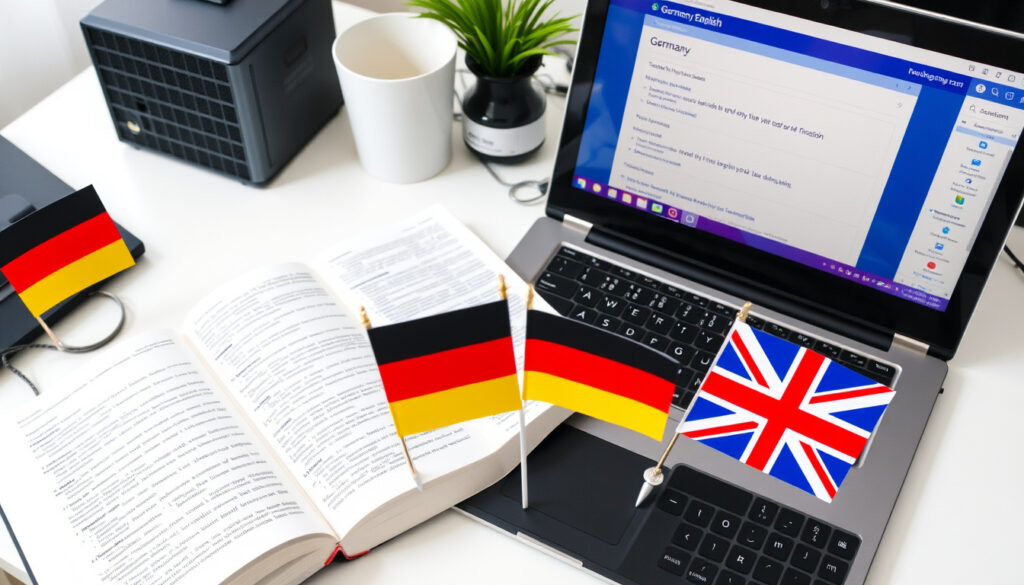
Translate German to English: Best Tools and How-to Guide
German and English are linguistic siblings, but they don’t always introduce themselves the same way. Bekommen looks like “become” but means “to get” — a false friend that, as LiveLingo’s translation guide notes, shapes how translation tools handle your text.
Tools compared: Google Translate, DeepL, Reverso Context, Linguee, Translate.com · Common pitfall: word-for-word literalism · Top tip: proofread machine output
Quick snapshot
- Google Translate supports more languages and has a built-in browser extension. LiveLingo’s translation guide
- DeepL is often ranked higher in accuracy for European languages. LiveLingo’s translation guide
- Reverso Context is especially useful for idioms and colloquialisms. LiveLingo’s translation guide
- Linguee provides context examples that show real usage. LiveLingo’s translation guide
Key facts at a glance
Before you pick a translator, it helps to know where the biggest fault lines live: false friends, formality, and word order keep showing up in expert guides.
| Fact | Why it matters | Source |
|---|---|---|
| German and English both sit on the West Germanic language branch. | Shared roots create useful cognates, but also false friends. | LiveLingo’s translation guide |
| Bekommen looks like “become” but means “to get.” | False friends cause errors even in otherwise clean translation. | LiveLingo’s translation guide |
| German nouns have gender and form long compound nouns. | Literal translation can get awkward. | LiveLingo’s translation guide |
| Formal Sie vs. informal du changes pronouns and verb forms. | Machine translation can miss register. | LiveLingo’s translation guide |
| German puts verbs at the end of subordinate clauses. | Verb placement is a recurring source of ambiguity. | MirrorCaption’s translator app guide |
| DeepL is widely regarded for written German-to-English accuracy. | A strong choice for documents and nuanced business text. | MirrorCaption’s translator app guide |
| Reverso Context is especially useful for idioms and colloquialisms. | Example sentences help you choose the right phrase. | LiveLingo’s translation guide |
| Linguee provides context examples. | It helps you check how a German word is used in real translations. | LiveLingo’s translation guide |
| Proofreading is recommended for consistency and tone. | Machine output still needs a final human pass. | MotaWord’s techniques guide |
The pattern: These facts explain why tool selection depends on text type and structure rather than a single “best” option.
Why German-to-English translation is harder than it looks
A single German sentence can contain several ideas folded into one compound noun, and the verb may not appear until the very end. That structure is exactly what makes machine translation interesting.
False friends: bekommen is only the beginning
- The trap: bekommen means “to get,” not “to become.”
- Why it happens: German and English share roots, but word meanings drifted apart.
LiveLingo’s translation guide notes that false friends like this are a common source of errors in German-to-English work.
Noun genders and compound nouns
- German nouns carry gender: der, die, and das are not decoration; they affect surrounding words.
- Compound nouns stack meanings: literal translation can produce awkward results.
LiveLingo’s translation guide says noun genders and compound nouns are challenging for German-to-English translation.
Register: Sie vs. du
- Formal German: Sie for strangers and colleagues you don’t know well.
- Informal German: du for friends, family, and children.
LiveLingo’s translation guide says register matters because German’s formal and informal distinctions change pronouns and verb forms.
Verb placement: the ending is the point
- Verb-final clauses: German puts the verb at the end in subordinate clauses.
- Ambiguity risk: MirrorCaption’s translator app guide calls verb placement a recurring source of translation ambiguity.
That means a tool that preserves German word order will sound stiff in English, while a tool that smooths it over can change the emphasis.
The paradox: The more logically German packs information, the more an English translation has to untangle it. The best tool is usually the one that respects the German structure without copying it word for word.
The implication: Understanding these structural traps — false friends, gender, register, and verb placement — helps you choose the right tool for each text type.
Best German-to-English tools compared
The real question is not which tool is “best” in the abstract; it’s which one fits the kind of German text you throw at it.
| Tool | Strongest for | What the guides say |
|---|---|---|
| Google Translate | Convenient lookups and broad language support | Supports more languages and has a built-in browser extension. LiveLingo’s translation guide |
| DeepL | Written German-to-English accuracy | Widely regarded for documents and nuanced business text. MirrorCaption’s translator app guide |
| Reverso Context | Idioms and colloquialisms | Especially useful when phrases don’t translate literally. LiveLingo’s translation guide |
| Linguee | Real context examples | Shows how a German word is used in translated sentences. LiveLingo’s translation guide |
| Translate.com | Dictionary-style lookups and human services | Offers dictionary-based translation and human translation services. LiveLingo’s translation guide |
Can I live translate German to English?
Yes, live translation is possible with apps like Google Translate and Microsoft Translator. Google Translate offers a conversation mode for two-way speech translation, and camera translate allows you to point your phone at German text and see instant English overlay.
Google Translate: convenience first
- Strengths: broad language support and a built-in browser extension.
- Watch it: German’s verb-final structure can create ambiguity.
LiveLingo’s translation guide says Google Translate supports more languages and has a browser extension. MirrorCaption’s translator app guide adds that DeepL and Google Translate are hard to beat for emails, contracts, and web pages.
DeepL: the document specialist
- Strengths: natural-sounding written output and strong business-text reviews.
- Reputation: widely regarded for written German-to-English accuracy.
MirrorCaption’s translator app guide says DeepL is widely regarded for written German-to-English accuracy, especially for documents and nuanced business text.
Reverso Context and Linguee: context as a feature
- Reverso Context: useful for idioms and colloquialisms.
- Linguee: useful for checking real-world usage.
LiveLingo’s translation guide highlights Reverso Context for idioms and Linguee for context examples. Both tools help when a dictionary alone is not enough.
In practice, that means deciding whether you need natural prose or quick reach before you press translate.
Practical workflow for cleaner translations
How can I translate text from German to English?
You can use online tools like Google Translate, DeepL, or Reverso Context by typing or pasting text. For documents, DeepL provides stronger accuracy; for quick phrases, Google Translate offers speed and convenience. The guides converge on a practical routine. Use it the next time a German sentence feels stuck.
- Shorten the German sentence first. Keep source sentences short, avoid nested clauses, and translate in chunks. LiveLingo’s translation guide
- Set the register. Decide whether the target audience expects a formal or informal English tone, because German’s Sie/du has no direct English equivalent. LiveLingo’s translation guide
- Translate in context. Use Reverso Context or Linguee to check idioms and collocations. LiveLingo’s translation guide
- Review for false friends and word order. Watch for bekommen and verb-final clauses. MirrorCaption’s translator app guide
- Proofread the output. Read it aloud to improve consistency, readability, and tone. MotaWord’s techniques guide
- For technical manuals, keep terminology consistent. Use industry-specific dictionaries and test translated instructions against actual procedures. LiveLingo’s language guide
The trade-off: A fast first pass is useful, but the final draft should be the one that sounds natural to an English-speaking reader, not the one that mirrors German word order.
The pattern: This workflow addresses the structural challenges that trip up machine translation and gives you a repeatable process.
What’s confirmed and what’s still your call
After reading through translator guides and language-industry tips, a clear split appears between firm rules and judgment calls.
Confirmed by the guides
- False friends are a real accuracy trap. LiveLingo’s translation guide
- Verb-final word order causes recurring ambiguity. MirrorCaption’s translator app guide
- DeepL has a strong accuracy reputation. MirrorCaption’s translator app guide
Still your call
- Best tool depends on text type. Casual chat, business email, legal docs, and creative marketing pull in different directions. LiveLingo’s translation guide
- Idioms need adaptation, not direct translation. MotaWord’s techniques guide
- No single guide covers every free-vs-paid case. Different tools serve different needs. LiveLingo’s translation guide
What to watch: The next time a translation sounds odd, check whether the source sentence used an idiom, a formality choice, or a verb buried at the end. That diagnosis usually tells you which tool can help.
The implication: Use the confirmed facts as a foundation and apply judgment for the rest based on your text type and audience.
What the guides keep saying
Different sources phrase it differently, but the advice keeps pointing in the same direction.
“DeepL is widely regarded for written German-to-English accuracy, especially for documents and nuanced business text.”
— MirrorCaption’s translator app guide
“For text such as emails, contracts, and web pages, DeepL and Google Translate are described as hard to beat.”
— MirrorCaption’s translator app guide
“Reverso Context is especially useful for idioms and colloquialisms in German-English translation.”
— LiveLingo’s translation guide
“Proofreading is recommended to improve consistency, readability, and tone in translated German documents.”
— MotaWord’s techniques guide
Why this matters: These are not abstract style preferences. They decide whether a German phrase comes across as polite, technical, or completely lost in English.
The pattern: Across sources, DeepL and Reverso Context fill different needs, and proofreading remains the universal final step.
Related reading: German to English Translation – Best Tools and Accuracy Guide · German to English Language Challenges – Workflow Tips for Business, Casual & Technical Use
zipdo.co, livelingo.io, worldmetrics.org, wifitalents.com, mirrorcaption.com, machinetranslation.com, provimedia.de, immersivetranslate.com
Frequently asked questions
How do I say ‘OK’ in German?
The direct equivalent of “OK” in German is “okay” or “in Ordnung.” Google Translate will output “okay” in most cases. In formal writing, “einverstanden” or “genehmigt” may be used.
What does ‘süß’ mean in English?
Süß translates to “sweet” or “cute” in English. It is an adjective commonly used for food, people, and animals. Context determines whether “sweet” or “cute” is more appropriate.
Which German-to-English translator is most accurate?
Can Google Translate handle German-to-English well?
Why does machine translation sometimes sound stiff?
Is DeepL better than Google Translate for German?
What is the best free tool for German idioms?
How can I make a German-to-English translation sound more natural?
In short, there is no magic button, but there is a workflow that works.
Related reading
If you want to explore these sources directly, all of them are worth a bookmark.
- LiveLingo: German-to-English translation guide
- LiveLingo: German-to-English language guide
- MirrorCaption: German-to-English translator app guide
- MotaWord: top techniques for smooth German-to-English translations
Start with the guides above, and keep the false-friend examples in your back pocket.
More related posts
 I Am Pibble Wash My Belly: Origin and Meaning Explained
 Seahawks vs Patriots Score: History, 2026 & 28-3 Myth
 Best Lightweight Packable Puffer Jackets: 2026 Guide
 1 (800) Expedia Customer Service Number – Official Contact
 Mixed Connective Tissue Disease: Symptoms, Diagnosis, and Treatment
 Flush Mount Ceiling Light: Selection, Installation & Tips
 Cox Cu tomer Service Number: 24/7 Support and Hour
 How to Paint Kitchen Cabinets Without Sanding: Guide