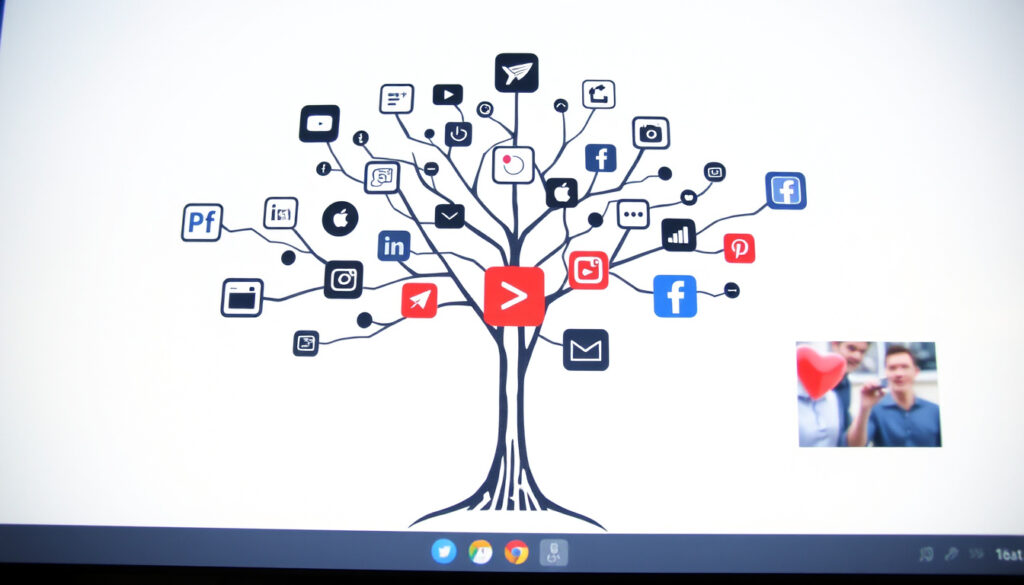
Social Media EmbedTree: What It Is and How to Use It
Anyone who’s tried managing social media across a handful of platforms already knows the headache: each network has its own rules for sharing content, and what works on Instagram falls flat on LinkedIn. Embedding is the closest thing to a universal language for cross-platform sharing, and a tool called EmbedTree aims to make that language easier to speak.
5-5-5 Social Media Rule: Post 5 times per day, on 5 platforms, 5 days a week ·
Global social media users (2024): 5.17 billion ·
Common social media types: 7 (Facebook, Instagram, LinkedIn, Twitter, YouTube, Pinterest, TikTok)
Quick snapshot
- Embed code is provided by platforms (Search Engine Magazine, marketing publication)
- EmbedTree aggregates content from multiple social networks (TechZeph, tech news site)
- Embedded content can increase on-page engagement (StoryBox, content marketing platform)
- Best embedding tool is subjective — depends on platform mix (Jayforwi, content strategy blog)
- Effectiveness of 5-5-5 rule varies by audience and niche (BuiltinNYC, business resource)
- Multiple guides published in early 2025 show growing interest in embed hubs (CloudSecurityTips, tech security site)
- EmbedTree-like tools may become standard for link-in-bio solutions (BuiltinNYC, business resource)
| Fact | Value |
|---|---|
| Social media users worldwide | 5.17 billion |
| 5-5-5 rule | Post 5x/day, 5 platforms, 5 days/week |
| EmbedTree aggregation | Supports multiple social networks in one feed |
| 7 types of social media | Social networks, media sharing, microblogging, forums, etc. |
What is a social media embed?
A social media embed is a snippet of code that takes content from one platform — say a tweet, an Instagram photo, or a YouTube video — and displays it on a different website. The content remains hosted on the original platform, but the embedded version renders as an interactive widget on your page, complete with the original post’s text, media, and engagement buttons. That’s the core distinction: you’re not copying the file; you’re borrowing the live version.
What does “embed” mean on IG posts?
On Instagram, embedding means copying a special code Instagram generates for each public post or Reel. When you paste that code into your website’s HTML or CMS block, visitors see the Instagram post inside your page — they can like, comment, and click through to the original without leaving your site (ExploreWaves, digital media site). The term “IG embed” is shorthand for this process, and it has become essential for news sites, blogs, and portfolios that want to share visually rich social proof.
What does “embed link” mean?
An “embed link” is the hyperlink version of an embed. Instead of pasting code, some platforms let you share a direct link that, when clicked the right way, displays the embedded content. In practice, embed links are often used in email newsletters or social bios where full embed code won’t render (StartupBooted, startup resource). The result is similar — the reader sees a preview — but with less control over appearance.
EmbedTree’s approach treats the embed link as a central asset: one URL that opens a hub of all your embedded feeds. For creators juggling four or five platforms, that single link solves the “which embed, where?” problem directly.
What is the purpose of embed?
Embedding serves a single strategic goal: keep the user on your page while borrowing social proof from another. A tweet embedded in a blog post adds a real-time voice without the reader navigating away. An Instagram Reel embedded in a product page makes the product feel lived-in and authentic (TycoonStory, business publication). The purpose isn’t just decoration — it’s about attention retention.
What are the benefits of embedding content?
The measurable benefits stack up. Embedded content increases time on page because visitors engage with the widget — playing a video, scrolling a carousel, or reacting to a post. It also improves content freshness: embedded tweets update automatically when someone replies or retweets, so your page doesn’t go stale. SEO-wise, Google’s algorithms recognize embedded content as active engagement signals, though the impact is indirect.
EmbedTree centralizes these benefits across platforms. Instead of embedding a Twitter timeline here and an Instagram grid there — each with different code and styling — EmbedTree gives you one set of code that pulls from all connected networks.
For a small business owner managing Facebook, Instagram, and TikTok: embedding five separate feeds across a website means five different code snippets, five different update cycles, and five different load times. EmbedTree collapses that into one. The trade-off is reliance on a single third-party hub, but the convenience gain is significant.
The implication: Embedding is not a technical trick — it’s a behavioral strategy. If your audience scrolls Instagram, meet them there without sending them away. The platform that makes that frictionless wins the embed battle.
Is it better to embed or link?
The short answer depends on what you want the reader to do next. Embedding keeps them inside your ecosystem; linking sends them to someone else’s. For publishers, the choice is often clear: embed for deeper engagement, link for attribution or when the third-party content is too complex to replicate inline.
What happens when you embed a link?
When you embed a link — as opposed to embedding a post — you’re essentially creating a clickable preview card. Platforms like Twitter and LinkedIn generate “link previews” (thumbnail, headline, description) when you paste a URL. The preview lives on your page, but clicking it opens the destination site. This is less immersive than a full embed but faster to set up.
What is the difference between embedding and linking?
Four differences matter most:
- User location: Embedding keeps the user on your site; linking sends them away.
- Interactivity: Embedded content is interactive (play, like, share) inside your page; a link is static until clicked.
- Control: Linking is simpler — one URL — while embedding requires code but gives you layout and styling control.
- Analytics: Embedded content often generates its own engagement data (views, plays) visible to the original platform owner, not necessarily to you.
Six factors, one pattern: embedding buys engagement at the cost of complexity, while linking buys simplicity at the cost of attention.
The pattern that emerges: embedding trades setup effort for user retention. The table below lays out the trade-offs side by side.
| Criteria | Embed | Link |
|---|---|---|
| User stays on your site | Yes | No |
| Setup difficulty | Needs code snippet | Just a URL |
| Interactivity | Full (play, like, share) | None until click |
| Content freshness | Auto-updates | Static |
| Mobile compatibility | Variable | High |
| Page load impact | Higher (multiple requests) | Minimal |
How to use an embedded link?
Using an embedded link starts the same way as any embed: you need the embed code from the source platform. From there, the process is a short sequence of copy-paste steps, though tools like EmbedTree streamline it by generating one unified snippet for all your connected accounts.
Can you give me an example of an embedded link?
A clear example: a news article about a sports event embeds a tweet from the winning team’s official account. The tweet appears as a live box inside the article — readers can see the celebration message and the engagement count. That’s an embedded post. An embedded link, by contrast, would be a simple hyperlink saying “See the winning team’s tweet here” that opens Twitter in a new tab.
Here’s a practical five-step workflow drawn from multiple EmbedTree guides:
- Create a central hub page using EmbedTree’s interface — this is where your feeds will live.
- Connect your social accounts: Instagram, TikTok, YouTube, Facebook, Twitter, and others. EmbedTree uses official API access after you authorize the connection.
- Choose a layout — grid, list, or carousel — and customize colors, fonts, and background to match your brand.
- Copy the generated embed code or single shareable link. Paste the code into your website’s HTML, or add the link to your Instagram bio, newsletter, or email signature (instapv, social media tip site).
- Test the page on both phone and computer, then update it regularly to keep the content fresh.
Too many embeds on one page can slow load time and overwhelm visitors. BuiltinNYC suggests prioritizing your top-performing links and keeping titles short for better scanability.
What is the 5 5 5 rule for social media?
The 5-5-5 rule is a posting framework that suggests publishing content five times per day across five different platforms, five days a week. It’s a consistency benchmark rather than a hard metric — designed to prevent the feast-or-famine posting pattern that kills algorithmic visibility.
What are the 7 types of social media?
The seven commonly cited types are: social networks (Facebook, LinkedIn), media sharing (Instagram, YouTube, TikTok), microblogging (Twitter), discussion forums (Reddit, Quora), bookmarking (Pinterest), review sites (Yelp), and interest-based networks (Goodreads). Each type serves a different content format and audience expectation.
Embedding strategies vary by type: visual content from Instagram and YouTube embeds beautifully, while text-heavy forums like Reddit are better linked than embedded. The 5-5-5 rule works best when you select the types that match your content strengths rather than spreading across all seven.
Why this matters: The rule and the taxonomy are both simplification tools. The real risk isn’t missing a platform — it’s spreading too thin. EmbedTree’s value here is that it aggregates only the platforms you actually use, so your hub reflects your real presence, not a checklist.
“EmbedTree acts as a centralized hub where all your social media content — from Instagram Reels to YouTube videos — can be collected and displayed in one place.”
“Think of EmbedTree as a social media hub aggregating all your content from Instagram, TikTok, YouTube, and more into a single, shareable page.”
— StoryBox, content marketing platform
Embedding social media content is no longer a nice-to-have — it’s how modern websites keep visitors engaged without handing them over to the competition. EmbedTree offers a single-link solution that consolidates the chaos of multi-platform embedding, but its value depends on how many networks you actually need to cover. For a freelancer with two Instagram accounts and a YouTube channel, a free EmbedTree hub is a time-saver. For a brand managing TikTok, Twitter, LinkedIn, and Pinterest, the convenience of one code block versus four is substantial. Users who consolidate must accept the trade-off: you trade independence for integration.
Related reading: social media stuff embedtree organize all your links · social media stuff embedtree guide
Frequently asked questions
Is EmbedTree free?
Multiple guides describe EmbedTree as offering a free tier with optional paid upgrades for additional customization and analytics. Exact pricing details vary by source, so checking the official site for current plans is recommended.
How do I create an EmbedTree account?
The standard process involves visiting the EmbedTree website, choosing a username, connecting your social accounts, and selecting a layout before publishing your hub link. Most guides report the setup taking under ten minutes.
What platforms does EmbedTree support?
Sources consistently list Instagram, TikTok, YouTube, Facebook, Twitter (X), LinkedIn, and Pinterest as supported platforms. Some guides also mention support for blog links and contact forms.
Does embedding affect SEO?
Embedding can improve on-page engagement signals like time on site and scroll depth, which search algorithms factor into rankings. However, embedded content is hosted on the original platform’s servers, so it does not directly contribute your domain’s backlink profile.
Can I embed Instagram posts on my website?
Yes. Instagram provides embed code for every public post and Reel. Copy the code from the post’s menu (the three dots) and paste it into your website’s HTML or CMS block. Tools like EmbedTree automate this process for multiple Instagram posts at once.
How do I remove an embedded link?
To remove an embedded link, delete the embed code snippet from your website’s HTML or, if using a tool like EmbedTree, disconnect the specific source platform from your hub dashboard. The embedded content will disappear on the next page load.
What is the difference between an embed and a widget?
An embed is a specific piece of code for a single piece of content (one tweet, one video). A widget is a larger, reusable component — like a social media feed — that can display multiple embeds. EmbedTree is closer to a widget: it aggregates multiple embeds into a single interactive block.
More related posts
 Cronos: The New Dawn Review 2025 – Is It Worth Getting
 Old Navy Christmas Pajamas: Family Matching Sets & Sale Guide
 Royal Challengers Bengaluru vs Punjab Kings – IPL 2024 Results
 Nobody Wants This Season 3: Release Date & Cast Confirmed
 Education Department IDR Plans Injunction: What You Should Know
 Dow Jones Futures Live: Today’s Pre-Market Data & Analysis
 6 Minute Solar Eclip e 2027: Be t Place and Safety Guide
 Voyager of the Seas: Current Location, Itinerary & Tips