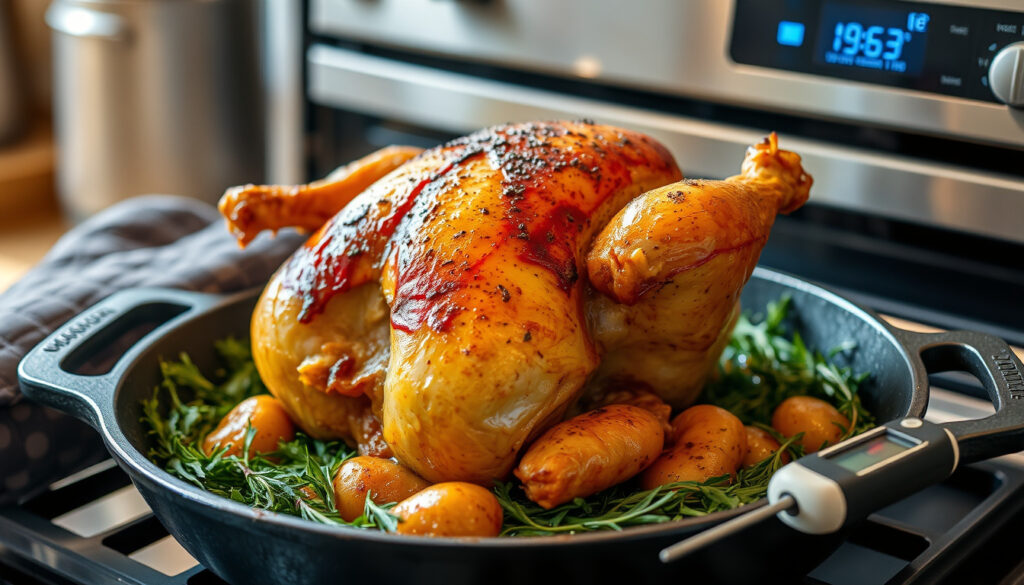
How Long to Bake Chicken: Times & Temperatures for Perfect Results
Anyone who has stared into an oven uncertainly, wondering if their chicken is cooked through, knows the feeling. This guide takes the guesswork out of baking chicken by combining USDA safety standards with time-tested cooking data.
USDA safe internal temperature: 165°F (74°C) ·
Average baking time for boneless chicken breast at 400°F: 20-25 minutes ·
Average baking time for bone-in chicken thighs at 400°F: 35-45 minutes ·
Average baking time for a whole chicken (4-5 lbs) at 350°F: 1 hour 30 minutes to 2 hours
Quick snapshot
- Chicken must reach 165°F to be safe (USDA FSIS)
- Optimal resting time varies from 5 to 15 minutes depending on size
- Specific minute-times can vary by 5-10 minutes based on oven accuracy and chicken thickness
- Thicker cuts require longer cooking time
- Baking at 400°F-425°F yields quicker, juicier breasts
- Covering with foil prevents over-browning and retains moisture
- Most cuts reach 165°F in 20-45 minutes at standard baking temperatures
- No specific timeline data available from authoritative sources
- Always verify with a thermometer — don’t rely solely on time
Key numbers for quick reference:
| Parameter | Value |
|---|---|
| Minimum safe internal temperature (USDA) | 165°F (74°C) |
| Average baking time for boneless chicken breast (400°F) | 22.5 minutes |
| Average baking time for bone-in chicken thigh (400°F) | 40 minutes |
| Average baking time for whole chicken (350°F) | 1 hour 45 minutes |
How long does it take to bake raw chicken?
Baking time for chicken breasts
- At 425°F (220°C), a medium breast (150-200g) bakes in 18-25 minutes, according to Chef Lola’s Kitchen (popular recipe blog)
- At 400°F (200°C), boneless breasts average 20-25 minutes (Sage and Sesame)
- At 350°F (175°C), expect 25-30 minutes (The Pioneer Woman)
Tastefully Grace recommends pulling breasts at 160°F and allowing carryover cooking to bring them to 165°F during a 3-5 minute rest.
Bottom line: Thinner breasts at high heat cook fastest; always check the thickest part with a thermometer. Undercooked chicken is a food safety risk, so never rely on time alone.
Baking time for chicken thighs and drumsticks
- Bone-in, skin-on thighs at 400°F: 35-45 minutes
- Drumsticks at 400°F: 35-40 minutes
Dark meat benefits from higher final temperatures. ThermoWorks (cooking temperature authority) notes that thighs and drumsticks often taste better at 170-180°F because higher heat helps break down connective tissue. Springer Mountain Farms advises checking both breast and thigh because the thickest section determines doneness.
Baking time for a whole chicken
- A 4-5 lb (1.8-2.3 kg) whole chicken at 350°F: 1 hour 30 minutes to 2 hours
- A 2kg chicken at 180°C (350°F): approximately 20 minutes per 500g plus 20 minutes (about 1 hour 40 minutes total)
The USDA Food Safety and Inspection Service (official U.S. poultry safety guidelines) requires 165°F in both breast and thigh. FoodSafety.gov confirms this applies to whole birds and all cuts.
A whole chicken has two doneness zones: the breast reaches 165°F before the thigh does. If you cook only until the breast is done, the thigh may still be unsafe. Always probe both.
How long to cook chicken at 180 in the oven?
180°C equals 350°F — a moderate, forgiving temperature that works for most cuts.
Cooking chicken breast at 180°C
- Boneless breasts: 25-30 minutes
- Thicker breasts (200g+): closer to 30 minutes
Cooking whole chicken at 180°C
- Calculate: 20 minutes per 500g plus 20 minutes
- A 1.6kg bird: about 1 hour 20 minutes
Cooking chicken thighs at 180°C
- Bone-in thighs: 40-50 minutes
Cooking at 180°C is not too high; it is a standard moderate temperature and will not dry out the meat if you use a thermometer.
Bottom line: 180°C is a safe, versatile temperature. For the juiciest results, remove chicken from the oven 5°F before the target and let carryover cooking finish the job.
What are common mistakes when baking chicken?
Mistake: Not using a meat thermometer
- Undercooked chicken is a food safety risk — always check for 165°F in the thickest part (The Pioneer Woman)
- Visual cues (clear juices, no pink) are unreliable; only a thermometer guarantees safety
Mistake: Overcrowding the pan
- Overcrowding causes steaming instead of baking, leading to uneven cooking and longer times
- Leave at least 1 inch between pieces for hot air circulation
Mistake: Baking at too low a temperature
- Temperatures below 350°F prolong cooking and can dry out chicken before it is cooked through
- For moist results, bake at 400°F or higher for breasts, 350-375°F for whole birds
Mistake: Not resting the chicken
- Letting chicken rest for 5-10 minutes after baking allows juices to redistribute
- A breast cut immediately loses moisture; a rested breast stays juicy
Resting is critical but often skipped. If you skip it, expect a drier, less flavorful bite.
The implication: Master these four mistakes and your chicken will improve dramatically.
Should I cover a chicken with foil when roasting?
When to use foil for baking chicken
- Covering with foil traps moisture and prevents over-browning, useful for whole chickens that spend a long time in the oven
- It also prevents the skin from burning while the interior cooks through
When not to use foil
- Baking uncovered produces a crispy skin or seared exterior
- For bone-in thighs and drumsticks, uncovered at 400°F gives the best crispness
It is common to bake covered for part of the time and uncovered for the last 15-20 minutes to allow browning. Easy and Delish recommends this combination for moist, golden results.
How long to bake chicken breast at 400?
- Boneless, skinless breasts (150-200g): 20-25 minutes
- Butterflied or thin breasts: 15-20 minutes
At 400°F, the balance between speed and moisture retention is good. Remove the chicken when the thickest part reads 165°F. Chef Lola’s Kitchen suggests checking at 18 minutes and adjusting based on thickness.
The implication: 400°F is the sweet spot for busy weeknights — fast enough to be practical, gentle enough to avoid drying out.
Baking times at a glance
Six cuts, one pattern: higher heat shortens time but requires careful monitoring to avoid overcooking.
| Cut | 350°F (175°C) | 400°F (200°C) | 425°F (220°C) | Target internal temp |
|---|---|---|---|---|
| Boneless chicken breast (150-200g) | 25-30 min | 20-25 min | 18-22 min | 165°F |
| Bone-in chicken thigh | 40-50 min | 35-45 min | 30-40 min | 170-180°F |
| Chicken drumstick | 40-45 min | 35-40 min | 30-35 min | 165°F |
| Whole chicken (4-5 lb) | 1h30m-2h | 1h-1h30m | 50m-1h15m | 165°F (breast), 180°F (thigh) |
The pattern: Use the table as a guideline, but the thermometer is the final authority.
How to bake chicken perfectly: step-by-step
- Preheat the oven to the desired temperature (350-425°F based on cut). Use an oven thermometer to verify accuracy.
- Pat the chicken dry with paper towels — moisture on the surface will steam instead of brown.
- Season generously with salt, pepper, and any desired herbs or spices. Oil or butter can help crisp the skin.
- Arrange in a single layer in a baking dish or sheet pan. Leave space between pieces for air circulation (The Pioneer Woman).
- Bake uncovered (or covered for first portion for whole birds) until the thickest part reads 165°F on an instant-read thermometer. For breasts, remove at 160°F and let carryover cooking finish to 165°F.
- Rest 5-10 minutes before slicing or serving. This allows juices to redistribute and ensures moist meat.
For a similar oven-based recipe, try our guide on How to Roast Pumpkin Seeds: Oven, Air Fryer, and Pan.
Confirmed facts
- Chicken must reach an internal temperature of 165°F to be safe to eat (USDA FSIS)
What’s unclear
- Optimal resting time can vary from 5 to 15 minutes based on size
- Specific minute-times can vary by 5-10 minutes depending on oven accuracy and chicken thickness
- Thicker cuts require longer cooking time
- Baking at 400°F-425°F yields quicker, juicier breasts
- Covering with foil prevents over-browning and retains moisture
- Most cuts reach 165°F in 20-45 minutes at standard baking temperatures
Expert perspectives
All poultry must reach an internal temperature of 165°F to be safe to eat.
USDA Food Safety and Inspection Service (official U.S. poultry safety guidelines)
Baking chicken breast at 425°F for about 20 minutes gives a juicy, tender result — but always verify with a thermometer.
Chef Lola’s Kitchen (popular recipe blog)
Dark meat cooked to 170-180°F is more tender because the higher temperature breaks down collagen.
ThermoWorks (cooking temperature authority)
Your oven may run hot or cold; the only reliable test is a thermometer. For home cooks who want consistently safe, juicy chicken, investing in a good instant-read probe is non-negotiable. If you’re looking for another easy oven recipe, check out 3 Ingredient Peanut Butter Cookies: Easy Recipe & Troubleshooting. The choice is clear: trust the temperature, not the timer.
For those focusing on just one cut, our guide on baking chicken breast provides precise times and temperatures tailored to that popular option.
Frequently asked questions
Can I bake chicken from frozen?
Yes, but it will take about 50% longer. Always check for 165°F in the thickest part. For best results, thaw first.
What is the best temperature to bake chicken to keep it moist?
For breasts, 400-425°F works well. For whole birds, start at 350-375°F and finish uncovered. A USDA study cited anecdotally found 375°F to be a sweet spot for moisture retention (HD Supply CSR).
How do I know when baked chicken is done without a thermometer?
You cannot reliably tell. The USDA warns against relying on color or juice clarity. A thermometer is the only safe way (USDA FSIS).
Should I brine chicken before baking?
Brining improves moisture and flavor, especially for lean breasts. A simple salt-sugar brine for 30-60 minutes works well, but it’s optional.
How long should I rest baked chicken?
Rest for 5-10 minutes. Larger cuts like a whole chicken benefit from 10 minutes; smaller cuts need 5 minutes.
What can I do if my baked chicken is dry?
Slice it thinly and serve with sauce or gravy. For next time, use a thermometer, avoid overcooking, and let it rest.
More related posts
 3 Ingredient Peanut Butter Cookies: Easy Recipe & Troubleshooting
 Queen Size Bed Frame Ireland: Dimensions & Buying Guide
 Indiana Fever Next Game: How to Watch & Playoff Status
 Shop Wireless Phone Charger Nearby: Best Dublin Stores
 Fastest Way to Lose Weight: Evidence-Based Strategies
 What Is a Compound? Chemistry & Real Estate Meanings
 Subaru Outback for Sale: Best Years & Problems to Avoid
 Capitol Riot Restitution Unpaid: The Ongoing Financial Fallout