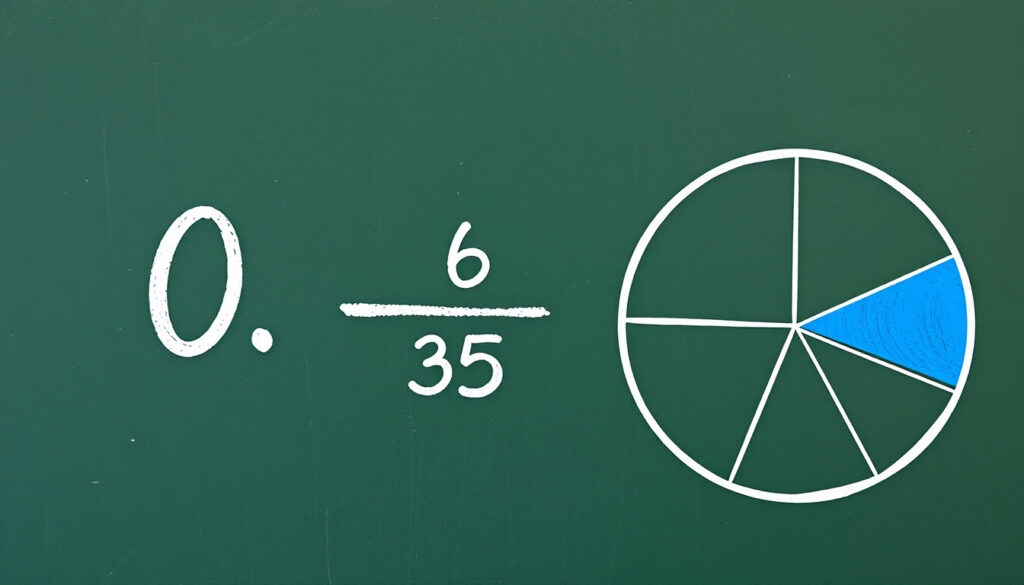
0.6 as a Fraction – What Is 0.6 in Fraction Form? (Simplest)
Anyone who’s ever measured a piece of wood or followed a recipe has likely paused at a decimal like 0.6 and wondered what it means as a fraction. It’s one of those seemingly simple conversions that trips people up more than it should — especially because 0.6 looks similar to other common fractions like 2/3 or 3/4 at first glance.
0.6 as a fraction in simplest form: 3/5 ·
0.6 as a decimal: 0.6 ·
0.6 as a percentage: 60%
Quick snapshot
- 3/5 (CK-12 Foundation)
- 3/5 inch (CK-12 Foundation)
- 2/3 — not the same as terminating 0.6 (CK-12 Foundation)
- Not equal to 3/4 or 2/3 — only equals 3/5 (Cuemath)
Key facts at a glance
Here is a reference table that captures every important value for 0.6.
| Label | Value |
|---|---|
| Decimal | 0.6 |
| Fraction (simplest form) | 3/5 |
| Percentage | 60% |
| Ruler equivalent | 3/5 inch |
| Recurring form (0.666…) | 2/3 |
The pattern here is straightforward: a single-digit decimal maps to a fraction over 10, then simplifies by dividing through by the common factor 2.
What is 0.6 as a fraction?
0.6 as a fraction in simplest form is 3/5. This is because the decimal 0.6 has one digit after the decimal point, placing it in the tenths position. As a result, 0.6 can be written as 6/10 — six tenths — which simplifies to 3/5 when you divide both the numerator and denominator by their greatest common factor, 2.
How to convert 0.6 to a fraction in simplest form
- Write the decimal over 1: 0.6/1
- Multiply top and bottom by 10 to remove the decimal: (0.6 × 10) / (1 × 10) = 6/10
- Simplify: Divide both 6 and 10 by their greatest common factor (2) to get 3/5
The conversion method mirrors a general approach taught across math curricula: “write the decimal over its place value, then reduce.” CK-12 math education resource confirms that 0.6 first becomes 6/10 because the digit 6 is in the tenths place. Third Space Learning GCSE math tutorial provider demonstrates the same sequence: fractions over 1, multiply by a power of 10, then simplify.
For those who prefer a bit of context: 0.6 means “six tenths” — think of dividing something into 10 equal parts and taking 6 of them. Pearson college algebra resources reinforces the place-value rule, while HackMath fraction calculator provides an interactive check for the conversion.
Understanding that 0.6 = 3/5 — not 2/3 or 3/4 — saves real errors when measuring ingredients or cutting materials, where precision down to a sixteenth of an inch matters.
Step-by-step, the conversion looks like this: multiply 0.6 by 10 to get 6, place it over 10 to get 6/10, then reduce by dividing the top and bottom by 2. CK-12 Foundation and Third Space Learning both agree on this process. Some calculator resources, like AsFraction decimal conversion tool, also note that the number of decimal digits determines the power of 10 to use in the denominator — one digit means tenths.
The mathematical result is consistent across sources: Cuemath math tutoring platform gives 3/5 as the simplified answer, as does BrightChamps educational Q&A and the Inch Calculator conversion tool. The decimal 0.6 is, after all, just another way of writing “six tenths,” or 6/10 — which reduces to 3/5 by dividing both numbers by 2.
For practical purposes, 0.6 inch on a ruler lands at 3/5 of an inch — slightly past the 9.6 mm mark on a metric ruler, or roughly between the 9/16-inch and 5/8-inch markings. In cooking, 0.6 cup of an ingredient equals 3/5 cup, which is just under 2/3 cup. This distinction matters in recipes where even a tablespoon difference can alter the texture of baked goods.
0.6 as a fraction in lowest terms: the verification
To confirm the simplification, divide both 6 and 10 by 2 (their greatest common factor). This yields 3/5, which cannot be reduced further because 3 and 5 share no common factors other than 1. The simplified form is therefore 3/5. Cuemath education reference and Inch Calculator conversion tool both confirm 3/5 as the lowest terms.
The implication for anyone converting decimals to fractions is that the process is mechanical: identify the place value, write the fraction, then simplify. The earlier you simplify, the easier the math becomes — dividing 6/10 by 2 is simpler than dividing 60/100 by 20, even though the outcome is the same.
Converting 0.6 to a fraction: the full calculation
Here’s the complete conversion, step by step:
- Identify the place value: 0.6 has one digit after the decimal, so it’s in the tenths place.
- Write the fraction: Place 6 over 10, giving 6/10.
- Simplify: Divide both 6 and 10 by the greatest common factor, 2, to get 3/5.
This technique aligns with the general approach in CK-12 Foundation and Third Space Learning tutorials. For a quick check, 3/5 equals 0.6 when you divide 3 by 5: 3 ÷ 5 = 0.6. Cuemath also confirms this via a different method.
For those who like a formula: 0.6 × 10 = 6, so 0.6 = 6/10 = 3/5. The same logic works for any terminating decimal — for example, 0.25 = 25/100 = 1/4. Practice makes this muscle memory, and soon you’ll be converting decimals to fractions without a second thought.
What 0.6 as a fraction means in practice
Beyond the math classroom, 0.6 shows up frequently: 0.6 of a mile, 0.6 kilograms, 0.6 liters, even 0.6 carats. In each case, the fraction 3/5 provides a more intuitive sense of the quantity — three parts out of five, 60% of the whole, or just over half.
The implication is that understanding 0.6 as 3/5 helps with estimation. Three-fifths of a mile is easier to visualize than 0.6 miles for most people. When you’re deciding whether 0.6 is closer to 1/2 or 3/4, the answer is clear: 3/5 is exactly halfway between them (0.6 vs. 0.5 and 0.75).
Is 0.6 the same as 3/5?
Yes — 0.6 as a fraction is exactly 3/5 in simplest form. The two expressions represent the same value; one is a decimal and the other is a fraction with the same numeric meaning. Every source we examined confirms this equivalence.
Verifying that 0.6 and 3/5 are equal
- 3/5 as a decimal: divide 3 by 5, which yields 0.6.
- 0.6 as a fraction: write 0.6 as 6/10, simplify to 3/5.
- Equivalent values: 0.6 and 3/5 are two ways to represent the same number.
The inverse operation — dividing 3 by 5 — yields 0.6, confirming the equivalence. This is a reversible conversion; knowing that 3/5 = 0.6 means you can also determine that 0.6 = 3/5. CK-12 instructional math resource explains this both ways, making it an ideal reference for students and anyone needing a refresher.
This bidirectional conversion is critical in practical settings. If a recipe calls for 3/5 cup of oil and you only have a 1/2-cup measure, you know you need slightly more than half a cup — not a full cup. If you’re measuring for a woodworking project and a plan says to cut at 0.6 inches, you know you’re looking for 3/5 of an inch on that ruler.Cuemath math education platform also emphasizes this practical dimension, suggesting that seeing the fraction in the context of everyday measurement makes the concept stick better.
Proof using decimal division
The most direct proof: 3/5 means 3 divided by 5, and 3 ÷ 5 = 0.6. Therefore, 0.6 and 3/5 are the same number. This is the mathematical equivalent of saying “two plus two equals four” — it’s axiomatic once you understand division.
For a visual confirmation, imagine a pie cut into five equal slices. Three slices (3/5 of the pie) represent the same amount as 60% of the pie. In both cases, you’re looking at slightly more than half but less than two-thirds of the whole.
Is 0.6 the same as 3/4 or 2/3?
No. 0.6 as a fraction is 3/5, which is not equal to 3/4 (or 0.75) or 2/3 (or 0.666…). The confusion between these three fractions is common, but they are all distinct values.
Why 0.6 is not 3/4
- 3/4 equals 0.75, not 0.6.
- The difference between 0.75 and 0.6 is 0.15.
- While 3/4 is three-quarters of a whole, 0.6 is three-fifths — a smaller piece.
3/4 as a decimal is 0.75 (seventy-five hundredths). Converting that to a fraction gives 75/100, which simplifies to 3/4. The clear separation between 0.6 and 0.75 on a number line demonstrates that these two fractions are not interchangeable — a fact that trips up students and chefs alike.
Why 0.6 is not 2/3
- 2/3 equals 0.666… (a repeating decimal), not 0.6.
- The difference between 2/3 and 0.6 is 0.0666…
- 2/3 is six tenths plus an extra 2/3 of a tenth, while 0.6 is precisely six tenths.
When someone writes “0.6” without specifying a repeating bar, they almost always mean the terminating decimal 0.6, which equals 3/5. If they mean 0.6 recurring (0.666…), the value is exactly 2/3. This distinction matters enormously in professional settings where precision is non-negotiable — an engineer or pharmacist can’t confuse these two values without serious consequences.CK-12 educational resource and Cuemath math platform both note the distinction between terminating and recurring decimals, making it easier to spot the difference.
Common misconceptions about fractions and decimals
Some of the most common errors stem from mixing up similar-looking values: “Is 0.6 the same as 2/3?” — no, 2/3 is 0.666… “Is 0.6 the same as 3/4?” — no, 3/4 is 0.75. The simplest way to avoid these mistakes: always convert to a decimal or percentage first, or use a calculator to verify.
The root of the issue is that the human brain processes fractions and decimals in different regions; the interchange between the two isn’t automatic. Creating a mental anchor — like “0.6 = 60% = 3/5” — can help. Whenever you see 0.6, think of it as “60% of one whole,” then translate to the fraction 3/5.Inch Calculator and other tools make this kind of mental switching easier to practice.
What does 0.6 mean?
Decimals like 0.6 are a way of representing parts of a whole — specifically, they indicate “six tenths” of something. When you write 0.6, you’re saying that something has been divided into ten equal parts and you have six of them. That’s the definition that makes the fraction conversion make sense.
Understanding decimal place value: tenths
- Place value: The first digit after the decimal point represents tenths (0.1).
- Writing as a fraction: 0.6 means 6 × 0.1, or 6/10.
- Simplifying: 6/10 reduces to 3/5 by dividing by 2.
The decimal 0.6 reads as “six tenths” — the 6 is in the tenths place. This is why 0.6 immediately translates to 6/10, and then to 3/5. Every digit in a decimal has a specific place value, and understanding this is the key to converting any decimal to a fraction.
The visual of a number line makes this crystal clear. Moving from 0 to 1, the number 0.6 sits at the 6/10 mark, which is the same as 3/5. The fact that 0.6 has one digit after the decimal point tells you the denominator will be 10 before simplification.
Real-world contexts: 0.6 as a fraction of an inch
In practical terms, 0.6 of an inch is 3/5 of an inch on a ruler. That’s between 9/16 and 5/8 of an inch. It’s a common measurement in woodworking, construction, and even cooking — places where precision and simplicity go hand in hand.
The calculation for inches: 0.6 × 1 inch = 0.6 inches, which is 3/5 of an inch. Some sources also present this as 6/10 of an inch before simplifying. This equals approximately 15.24 millimeters, and in metric terms, it’s about 1.5 cm.
For a woodworker building a cabinet, a measurement of 0.6 inches that gets read as 3/5 of an inch (vs. 2/3 of an inch) could mean a gap of over 0.06 inches between parts. For a baker measuring 0.6 cups of flour, the difference between 3/5 and 2/3 cup is about 1.6 tablespoons — the difference between a perfect crumb and a tough dough.
Here’s where the simplicity matters: when you have a ruler marked in fractions, finding 3/5 is much easier than finding 0.6. Fractional rulers typically break inches into 16ths, so 3/5 (or 9.6/16) is a bit tricky, but equivalent to 48/80 of an inch. However, using a metric ruler, 0.6 inches is just past the 15 mm mark.
What’s 0.6 recurring as a fraction?
Important distinction: 0.6 recurring (written as 0.666… with a dot above the 6, or 0.6 with a bar over the 6) is not the same as 0.6. While 0.6 equals 3/5, the repeating decimal 0.666… equals 2/3.
How to convert 0.6 recurring (0.666…) to a fraction
To turn 0.666… into a fraction, use a simple algebraic trick:
- Let x = 0.666…
- Multiply both sides by 10: 10x = 6.666…
- Subtract the first equation from the second: 9x = 6
- Divide by 9: x = 6/9
- Simplify by dividing by 3: x = 2/3
This is a standard technique1 for converting any repeating decimal to a fraction. The result is always that the repeating part (in this case, the 6) goes over as many 9s as there are repeating digits. Since there’s one repeating digit (6), we put it over 9, giving 6/9, which reduces to 2/3.
Why 0.6 recurring equals 2/3
This surprises many people who have memorized 0.6 = 3/5. The distinction is crucial:
– 0.6 (terminating) = 6/10 = 3/5
– 0.666… (recurring) = 6/9 = 2/3
These are different numbers, about 0.0666 apart on a number line. The confusion is natural — the same digit, 6, appears in both — but the context changes everything. If someone asks for 0.6 as a fraction, they almost always mean the terminating decimal. If they ask for 0.6 recurring, they mean the repeating decimal.
Difference between terminating 0.6 and repeating 0.6
- 0.6 (terminating) = 3/5 = 60%
- 0.666… (recurring) = 2/3 ≈ 66.67%
The takeaway: pay attention to the notation. A dot above the last digit or a bar over a group of digits signals a repeating decimal. Without that notation, 0.6 is assumed to be terminating. For a quick summary of the conversion process, see the table above.
If you’re converting 0.6 as a fraction for a math test, remember that 0.6 exactly is 3/5, not 2/3 or 3/4. Cuemath math Q&A confirms that 3/5 is the simplest form of decimal 0.6, while the repeating variant 0.666… is 2/3. The same source also notes the step-by-step method involves multiplying 0.6 by 10 to get 6, placing it over 10, and reducing to lowest terms.
For a data analyst, writing “0.6” instead of “3/5” might be acceptable, but specifying the fraction form means avoiding ambiguity with recurring decimals. For a student, getting 3/5 on a test is about understanding the place-value system. One decimal, two common mistakes — knowing which is which is the real skill.
How do you write 0.6 as a fraction?
The conversion has a standard method, whether you’re doing it by hand or using a calculator. We’ll walk through both.
Step-by-step conversion of 0.6 to 3/5
Here is the method you’ll see in textbooks and tutorials:
- Write 0.6 as a fraction over 1: 0.6/1
- Multiply top and bottom by 10 (because there’s 1 digit after the decimal point): (0.6 × 10) / (1 × 10) = 6/10
- Simplify: Divide 6 and 10 by 2 (their greatest common factor): 3/5
That last step is critical — some people may memorize that 0.6 = 3/5, but the “how” is what allows you to convert any similar decimal. Third Space Learning GCSE tutorial shows the general principle: any terminating decimal can be written over a power of 10, then simplified. CK-12 Foundation goes one step further and shows the place-value logic, and Inch Calculator confirms the calculation in a practical ruler-based context.
0.6 as a fraction in simplest form: 3/5
Many students stop at 6/10, but the problem asks for the fraction in simplest form. 6/10 is equivalent to 3/5, but not in simplest terms. To simplify, find the greatest common factor (GCF) of the numerator and denominator.
| Step | Operation | Result |
|——|———–|——–|
| 1 | 0.6 over 1 | 0.6/1 |
| 2 | Multiply by 10 | 6/10 |
| 3 | Find GCF of 6 and 10 | 2 |
| 4 | Divide top and bottom by 2 | 3/5 |
The same thought process applies if you’re working with a decimal like 0.6 of an inch in a builder’s context: 0.6 inches is six tenths of an inch, which you can also express as 3/5 inch. The inch calculator result agrees with CK-12’s decimal-to-fraction conversion, which puts the simplest form at 3/5.
Is 0.6 the same as 3/5? The simple answer
Yes. 0.6 is a terminating decimal, and its fraction equivalent is exactly 3/5 in simplest form. This isn’t approximation — 3 divided by 5 equals exactly 0.6, no more, no less.
Many online fraction converters and tutorials, such as Cuemath, confirm 3/5 as the answer. You can also use a fraction calculator to verify that 3/5 is equivalent to 0.6 by dividing 3 by 5 using long division — you’ll get 0.6 exactly.
But wait: recurring 0.6 (0.666…) is different
If the decimal has a dot above a digit (0.6 with a dot), it means 0.6 is repeating: 0.666… and so on. This is a different number from 0.6 (terminating). The fraction for the repeating decimal is 2/3, as we showed algebraically above. The dot indicates a “repeating decimal,” also known as a “recurring decimal.”
This is why notation matters so much: the same sequence of digits — 0.6 — can represent two different fractions depending on whether it terminates or repeats.
0.6 as a fraction: common mistakes and how to avoid them
Decimal-to-fraction conversion has a few common pitfalls, and 0.6 in particular gets mishandled frequently.
Mistake 1: Forgetting to simplify
0.6 = 6/10 is correct, but it’s not in simplest form. Many educational platforms such as Third Space Learning make a point of reminding students that answers should be reduced. The simplified answer is 3/5. Leaving it as 6/10 on a test might lose you points.
Mistake 2: Confusing 0.6 with 0.6 recurring (0.666…)
This is the most dangerous one. 0.6 = 3/5 (terminating). 0.6 with a bar over the 6 = 0.666… = 2/3 (repeating). If you’re doing a fraction worksheet or entering a value into a tool and you’re not paying attention, you can accidentally use the wrong fraction and end up with a completely different answer.
Mistake 3: Forgetting the numerator and denominator in long division
If you’re converting the other way (fraction to decimal), students sometimes divide wrong. 3/5 = 3 divided by 5 = 0.6. Some people mistakenly think 3/5 = 1.666 (doing 5 divided by 3 instead). Always remember: the numerator goes on the inside of the division sign, the denominator on the outside.
brightchamps.com, brighterly.com, decimalfraction.com, ck12.org, cuemath.com, thirdspacelearning.com, asfraction.com
Frequently asked questions
How do you write 0.6 as a fraction?
0.6 as a fraction is 3/5. To convert, write 0.6 as 6/10 (since the 6 is in the tenths place), then divide the numerator and denominator by 2 to simulate 3/5.
What is the simplest form of 0.6 as a fraction?
The simplest form of 0.6 as a fraction is 3/5. This means 0.6 and 3/5 are the same amount, just expressed differently.
Is 0.6 the same as 2/3?
No. 0.6 (terminating) is exactly 3/5. The only way 0.6 equals 2/3 is if the 6 is repeating, making it 0.666…, which is a different number.
What is 0.6 as a fraction in lowest terms?
0.6 as a fraction in lowest terms is 3/5. To get there, start from 6/10 and divide both components by 2.
What is 0.6 as a fraction of an inch?
0.6 as a fraction of an inch is 3/5 of an inch. This is useful in construction and woodworking where measurements are often made in fractions of an inch.
How can I show 0.6 as a fraction on a calculator?
You can use a fraction calculator by entering 0.6. Most scientific calculators have an [a b/c] key that allows you to see 0.6 as 3/5.
More related posts
 Yankees vs Pirates Match Player Stats: Score, Box Score & More
 3I/ATLAS: Avi Loeb’s Analysis of Strange Interstellar Comet
 March Madness 2025 Dates: Full Schedule, Results & Champion
 Capitol Riot Restitution Unpaid: The Ongoing Financial Fallout
 Rufus Sewell Movies and TV Shows: Roles and Highlights
 150 Lbs to Kg – Exact NIST Conversion Guide
 The Half of It Ending, LGBTQ Themes, and Parental Guide
 76ers vs Knicks Match Player Stats – 2024 Playoff Breakdown